
From Shanghai to Guilin with photos!
After three days in Shanghai and three days in Guilin, I’ve finally managed to get my photos uploaded, organized, and captioned! Today is our last day in Guilin, so I’m going to give you a very quick rundown of what I’ve been seeing from Shanghai to Guilin. With luck, I’ll be able to share more photos from China.
Shanghai
I’ve already given a brief overview of what I did in Shanghai, so I’ll just direct you to my photo album and invite you to see a little of what I saw there.
But I also want to share this video, so if you don’t have time to go through all the photos, at least watch this.
Shanghai Museum East
I have lots of photos from this wonderful museum. I’ll share some of my favorites with you here, and then you can enjoy them all.
But I’m going to present it as…
A history lesson
It’s hard to keep track of all the Chinese dynasties, but it’s really helpful to put the art into some context, so I’ll tell you a little about each era. In my album, they are organized by gallery (ceramics, painting and calligraphy, jade, and bronze), but here I’m organizing them by period. (Not every period is represented here, but this might also be helpful if you want to go back and review my photos from the National Palace Museum in my Taiwan album.)
Xia (2070 BCE to 1600 BCE)
The Xia sits at the edge of archaeology and later historical memory. It represents the traditional beginning of hereditary kingship before the better-attested Shang world.

Shang (1600 BCE to 1046 BCE)
The Shang is the first Chinese dynasty supported by extensive written evidence. Its kings ruled through warfare, ancestor ritual, bronze production and divination.


Zhou (1046 BCE to 256 BCE)
The Zhou overthrew the Shang and justified their rule through the Mandate of Heaven. Over time, royal authority weakened as regional lords became independent powers.


Qin (221 BCE to 206 BCE)
The Qin ended centuries of interstate war and created the first unified Chinese empire. Its reforms standardized administration, law, measures, writing and imperial rule.
Han (206 BCE to 220 CE)
The Han transformed the Qin imperial skeleton into a long-lasting state. It expanded westward, elevated Confucian learning and gave later Chinese identity one of its central names.


Three Kingdoms (220 to 280)
Wei, Shu and Wu competed after the Han collapse. The period became one of China’s great political and literary memories of strategy, rivalry and lost unity.

Jin (266 to 420)
The Jin reunited China after the Three Kingdoms, but internal conflict and pressure from northern powers split the realm again into northern and southern traditions.

Sui (581 to 618)
The Sui reunified China after centuries of division and launched enormous state projects, including the Grand Canal. Its overreach helped bring it down quickly.

Tang (618 to 907)
The Tang built one of China’s most influential imperial orders, combining military expansion, urban culture, poetry, Buddhism and far-reaching Eurasian connections.


Five Dynasties and Ten Kingdoms (907 to 960)
After the Tang, northern courts rose and fell quickly while southern kingdoms developed their own centers of power. The period bridged Tang imperial culture and Song restoration.
Song (960 to 1279)
The Song built a sophisticated civil state with commercial growth, printing, scholarship and urban life, even as it faced powerful northern rivals and eventually Mongol conquest.


Yuan (1271 to 1368)
Founded by Kublai Khan, the Yuan placed China inside the Mongol imperial world. It connected China to Eurasian exchange while ruling through a conquest-dynasty order.


Ming (1368 to 1644)
The Ming restored Han Chinese imperial rule after the Yuan. It rebuilt institutions, sponsored maritime expeditions, strengthened the Great Wall and later struggled with fiscal and military pressure.


Qing (1644 to 1912)
The Qing expanded China’s territorial reach under Manchu rule, then faced population pressure, rebellions, Western imperialism, reform crises and revolution.


The Republican Period (1912 to 1949)
The Republic of China replaced dynastic rule, but its mainland years were marked by warlordism, party-state building, Japanese invasion and civil war.


The People’s Republic of China (1949 to present)
The People’s Republic replaced the Republic on the mainland after the Chinese Civil War. It is not a dynasty, but it completes the succession from imperial China into the modern state.
Suzhou
In Suzhou we visited the Couple’s Garden, a silk factory, and Xiyuan Temple. Visually, the Couple’s Garden was the highlight. Here are a few photos.


We also had a chance to listen to a local singer from Suzhou. Here she sings a traditional Chinese folk song, “Mo Li Hua” (Jasmine Flower).
You can find the rest of my Suzhou photos in my album.
Guilin
We flew from Shanghai to Guilin last Friday and had three full days here. And, by the way, we’ve had a lot of group meals, all of which have been terrific. I haven’t been taking a lot of pictures of the food, as it keeps coming to the center of the table on the lazy Susan while we’re already eating. Everything is family style, and even though we are consistently eating Chinese food, it has been extremely varied, and extremely plentiful.
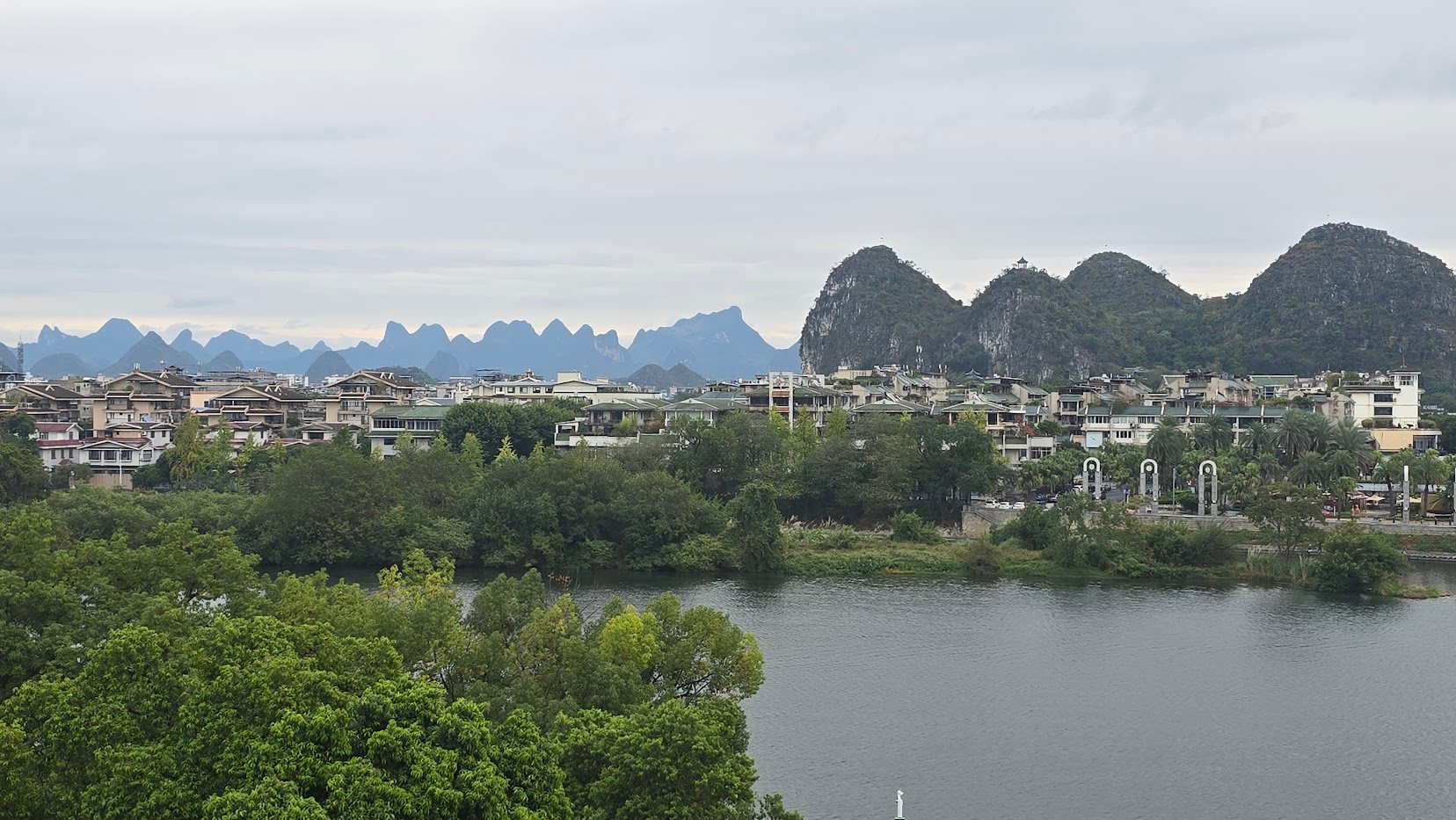
The first night we took a walk around the lake that is right in front of our hotel. Other stuff in Guilin included fan painting, a tea farm, a walk I took around the city on my own this afternoon, and a second walk around the lake to see the Sun and Moon Pagodas. I also got a haircut.


Check out all my photos from Guilin.
Li Jiang River Cruise
On Saturday we drove about an hour to the starting point for a four-hour cruise on the Li Jiang River. The scenery was really stunning, though it was overcast and a bit hazy. Here are some highlights.


There are lots more photos from the cruise in my album.
Dong village
Yesterday we drove about two hours each way to visit a Dong village. The Dong are an ethnic minority, one of 55 in China. Many of them live in mountain villages in this region. A total of about 3.5 million Dong live in China.


When we arrived, a group of women were waiting to welcome us with song.
Then we walked around the village and had a chance to meet some local residents. Some of our encounters were clearly staged, such as when we approached the well just as a local woman showed up to fetch water. But it was interesting to see and learn about life in this community. The women served us a wonderful lunch, and afterwards they answered our questions about life in their village.
We got more music before we left. The man closest to me and the woman are playing the lusheng, which is a mouth organ with multiple bamboo pipes, each fitted with a free reed, which are fitted into a long blowing tube made of hardwood.
Be sure to visit my album to see all my photos and videos from the Dong village. You’ll be amazed by the incredible lunch table they laid out for us.
In case you missed any of them, here are all my China photo albums so far: