
Kagoshima and the Little Volcano that Wouldn’t
I’m back in Japan. After my OAT tour of Taiwan, China, and Tibet, I returned to the island of Kyushu, the third-largest and southwesternmost of Japans’ main islands. And I started in Kagoshima. From there, I’ll be working my way north, and I will end my ten-week adventure in Fukuoka.
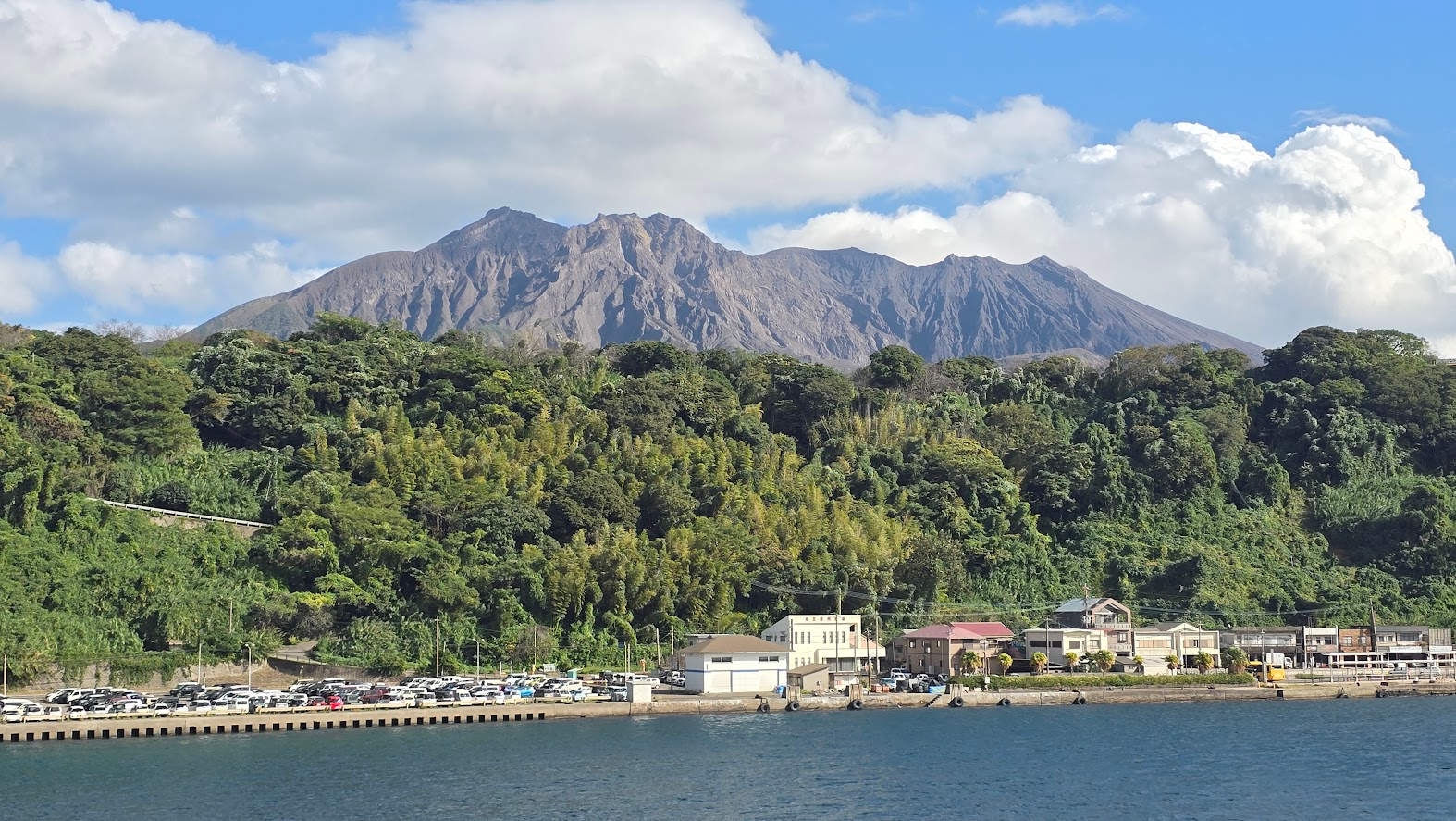
While I was in Kagoshima, I spent a not-entirely-reasonable amount of time watching the nearby volcano, Sakurajima. One of the world’s most active volcanoes, Sakurajima erupts a few hundred times per year. It had erupted 332 times in 2026 before my visit. So I was pretty confident I’d see an eruption during my two days there.
But it was not to be.
Arrival in Kagoshima
After two months of guided travel experiences (two back-to-back OAT tours), I’m happy to be on my own for the rest of the trip. I flew from Beijing to Tokyo, and then Tokyo to Kagoshima. I figured out how to take the airport limo bus to Kagoshima Chuo, the main train station. My hotel was directly across the street from the station. And it turned out my hotel was even closer to where the bus stopped, so I got off and strolled a few feet to the entrance of my hotel.
It was already dark by the time I arrived, and after all the big meals we had on the tours, I was happy to get some takeout noodles from a nearby convenience store. And I was practically asleep before my head hit the pillow.
Guided Tour
I had a private tour of Kagoshima arranged for the next day. Sugako (Su for short) messaged me to let me know she’d meet me at 9am in the hotel lobby, and she was waiting for me when I came down.
We traveled via the hop-on-hop-off bus to several of the main sights. This turned out to be easy and convenient. And Su was a delightful host for the day, providing a good bit of information without too many details.
Saigō
Shortly after we boarded the HOHO, Su asked me if I’d ever heard of Saigō Takamori. I hadn’t. He was the inspiration behind Ken Watanabe’s character in The Last Samurai, a movie I’ve never seen (but now I guess I should).
Saigō (1828–1877) was a samurai and a politician, and, according to Wikipedia, “one of the most influential figures in Japanese history.” He was involved in the overthrow of the Tokugawa shogunate, the military government that had ruled Japan since 1603. This action led to the Meiji restoration in 1868. Saigō played a role in the Meiji government for a while, but then became disillusioned with its direction and staged an rebellion in 1877, leading to his death. He was wounded during the fighting, and, unable to continue, committed ritual suicide (seppuku). His death essentially ended the rebellion.
We encountered statues of Saigō during our tour. He was born in Kagoshima and he died there. The HOHO bus stopped at a number of these statues, but we didn’t get off.
Shiroyama Observatory
Our first disembarkation was on the top of this hill, where we got commanding views of the city and across the 4‑km stretch of Kinko Bay to Sakurajima.

Sengan-en Garden
Sengan-en Garden came into existence in 1658. Its creator was Shimazu Mitsuhisa, the 19th head of the Shimazu clan. (Also spelled Shimadzu.) The Shimazu family traces its roots back about 800 years. They were the de facto rulers of southern Kyushu for centuries. They lost power with the decline of feudal rule in the 19th century, and today their only title is hereditary. The Shimazu clan is led by its 33rd head, Tadahiro Shimazu (born 1972). He serves as the CEO and president of Shimadzu Limited (Shimadzu Kōgyō), a Kagoshima-based company that manages historic clan properties and tourist attractions—most notably the famous Sengan-en garden.
Sengan-en was the residence of several Shimazu patriarchs, and it underwent significant rebuilding more than once. Most of the residence today dates from the 19th century. The gardens have also been renovated.
It was a beautiful day to wander through the lovely gardens and the charming residence. Entries in a recent chrysanthemum festival were on display, adding nice fall color even though fall is arriving late this year and the maple trees in the garden are still mostly green.


Sakurajima
From the garden, where we also had a bit of lunch, we hopped back on the HOHO and rode a short way to the ferry terminal. We rode across Kinko Bay to Sakurajima (cherry blossom island). There we rode another HOHO, up to the visitor center and back.
We never got an eruption. But we got a rainbow!

Shabu shabu
At Su’s recommendation, I ended up having dinner at Ichiniisan, right across from my hotel. I’d never hard shabu shabu before, and that’s their specialty.

It was a great dinner!
Day two
As much as I enjoyed my tour with Su, I was happy to have a day on my own. I started out with a walk to the Kagoshima City Museum of Art.
On the way, I ran into this guy:

Kagoshima City Museum of Art
This turned out to be a small but excellent museum. It included a lot of works by western artists, and works by Japanese artists who worked in western style.


I made a separate photo album with favorite works from the museum.
That’s pretty much all I did. I walked around some, but didn’t push myself, and I enjoyed some time to relax.
Day three
Day three on Kyushu was a travel day. I went by train from Kagoshima to Kumamoto, where I am now. And that’s where I’ll continue in my next blog post.
But I have to share the following:
Su sent me this photo while I was on the train. The little volcano that wouldn’t, finally did.
