
Lhasa: Buddha Overload
I had three days in Lhasa, the historic capital of Tibet and the capital of the Tibet Autonomous Region of China. It was interesting, with some stunning historical sights and beautiful mountain landscapes surrounding the city.
But I have to admit, I’m a little overloaded on Buddha. We spent all three days in the city, and the majority of the things we saw were Buddhist. They were all worth seeing, but I really wish I’d had a chance to escape to the surrounding area and see more of the landscape.
Our trip leader for these three days was Morgan. His real name is Phuntsok, but when he said it, it was nearly unpronounceable, so we all called him Morgan. He told us he only recently got this name from a previous tour member who said he looks like Morgan Freeman. And he kind of does.
Anyway, Morgan would guide us through these sights and point out all the Buddha statues and identify them. There’s the Compassion Buddha, the Longevity Buddha, the Medicine Buddha, something like five different Wisdom Buddhas, and plenty of others. And they all have names that are unpronounceable, except when Morgan would say them, in which case they are unspellable.
I still have to go through my photo album and organize everything, but here are some highlights.
Day One
Tibet Museum
This excellent museum, which seems not to have a website, combines a lot of historical information and artifacts with some of the great art and craft of the Tibetan people. We spent a few hours here, and of course I took way too many photos, especially of the excellent ceramics collection, which includes many items from Tibetan temples and monasteries.

Wanli period, Ming dynasty (1573–1620)

Qianlong period, Qing dynasty (1736–1795)

Qing dynasty (1616–1912)

18th-19th century
Norbulingka
Norbulingka, which was the summer palace of the Dalai Lamas, means “Jeweled Park” or “Treasure Garden” in Tibetan. Construction began in 1755, under the 7th Dalai Lama. The 8th Dalai Lama expanded it, as did the 13th and 14th (current) Dalai Lamas. The 14th Dalai Lama escaped from Norbulingka to India on March 17, 1959. The Chinese government took control of the palace and gardens, and it became a public park and museum. Starting in 2003 the government undertook a major renovation project.
Norbulingka has 374 rooms distributed across multiple palace buildings. The garden covers a vast area, and we only saw a small portion of it. No photographs were allowed inside any of the palace buildings.


The current Dalai Lama lived here for the last few years before his exile.
Day Two
Lukhang Park
Probably my favorite Lhasa experience was spending our second morning in Lukhang Park. It was bustling with activity, and this was really a great opportunity to see local people enjoying themselves. The highlight, for me, was watching people dancing traditional dances, many in traditional costume, looking so joyful and exuberant.

At one point while I was watching these dances, Morgan came over to me and asked me how I was enjoying it. I couldn’t respond because I was completely choked up. There was something so beautiful seeing people, probably mostly strangers to each other, coming together in a spirit of community and sharing their culture and their history through music and dance.

This was also a place to get some great photos of Potala Palace and the many ducks and geese (and people) enjoying the lake below.


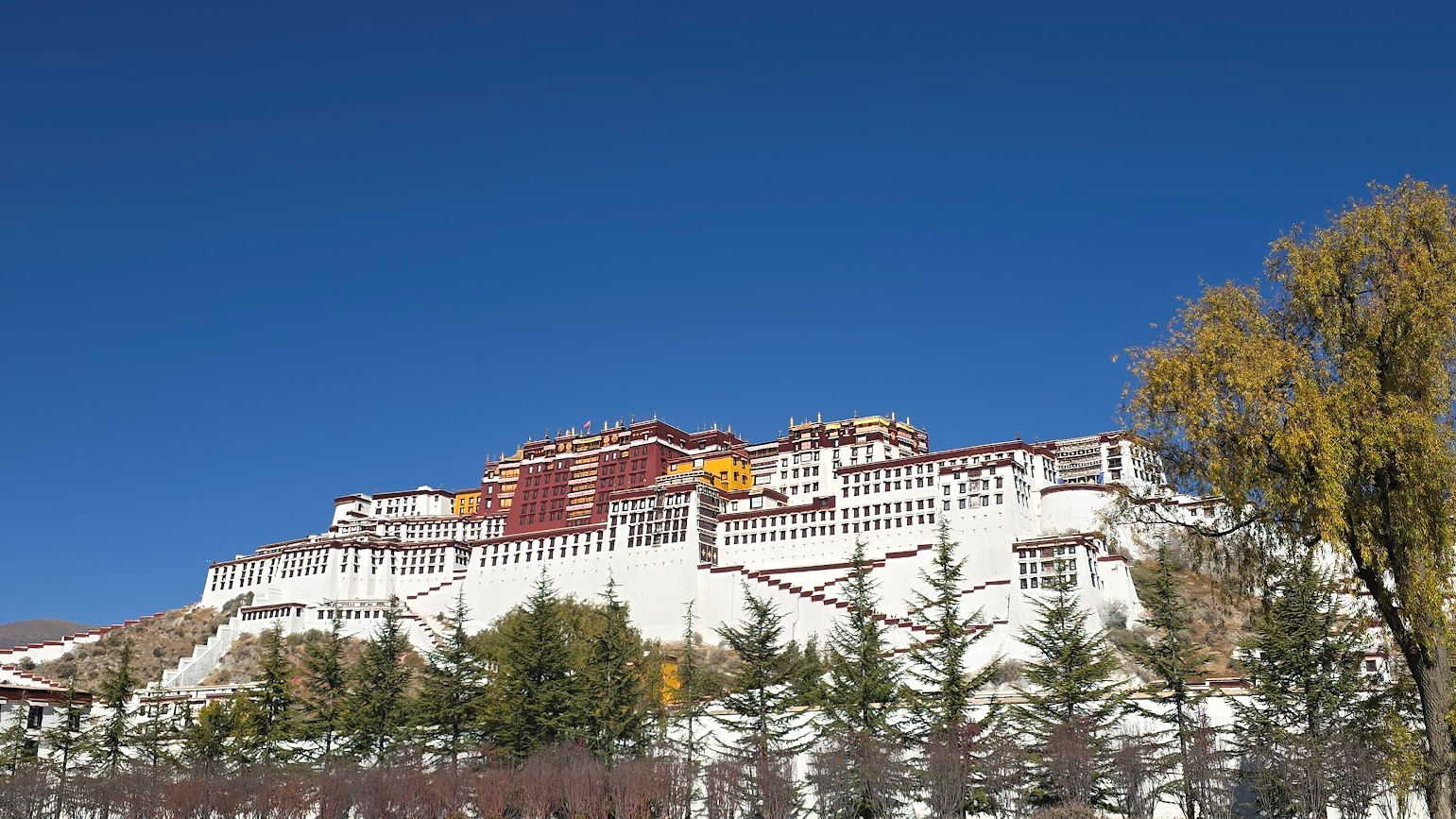
Potala Palace
After the park, we joined some faithful Buddhists on a clockwise walk around Potala Palace.
Kora
Circumambulation, called kora in Tibetan, is an important Buddhist ritual. Kora is a form of meditative practice as well as a kind of pilgrimage. It can involve walking around a sacred site, such as a temple or stupa, or it can be an arduous trek around a sacred lake or mountain.
Kora is always done clockwise. Keeping the stupa or temple on your right side is an ancient sign of respect. In traditional South Asian culture, the right side is considered clean and auspicious, while offering your left side or turning your back to a holy relic is viewed as disrespectful. And moving sunwise (clockwise) maintains harmony with the Cosmic Order by reflecting the apparent path of the sun across the sky, symbolizing balance, truth, and conformity to natural laws.
Circumambulation is frequently performed three times to symbolically pay homage to the Triple Gem of Buddhism:
- The Buddha (the awakened teacher)
- The Dhamma (the Buddha’s teachings)
- The Sangha (the community of practitioners)
While walking, practitioners often chant mantras, use prayer beads (mala), or spin prayer wheels. The physical movement acts as a form of walking meditation that purifies the body, speech, and mind.

We didn’t go all the way around, (no less go three times around) because, as you can see from the photos, visiting the palace requires a bit of an uphill climb. And we were already at 12,000 feet of elevation. This is why Tibet is known as “the roof of the world.”
Visiting the Palace
For me, the climb up wasn’t as tough as I thought it might be. I took it slow, stopping to catch my breath. But it’s not a long hike, nor is it steep.
Photos aren’t allowed inside Potala Palace, so I don’t have any pics that show the rooms and all the Buddha statues that I can’t name or pronounce.


I will eventually find time to organize all the photos I took here (and all of Lhasa). I just took so many, and so many are duplicates, so it’s going to take a while.
Day Three
Jokhang Temple
Here’s where I really got over-Buddha’d.
Jokhang Temple is considered the most important and most spiritual temple in all of Tibetan Buddhism. That’s because Songtsen Gampo, Tibetan king in the 7th century, made two very strategic marriages. The first was to Princess Bhrikuti from Nepal; the second was to Princess Wencheng, a member of the Tang Dynasty family. The marriages helped expand and strengthen the Tibetan Empire as well as leading to a golden age for Tibetan Buddhism.
Each bride brought a significant statue of Shakyamuni Buddha, the founder of Buddhism. Princess Bhrikuti brought Jowo Mikyö Dorje, a statue of the Buddha at age 8. Songtsen Gampo built Jokhang Temple specifically to house this statue. Princess Wencheng brought Jowo Shakyamuni. It was originally housed in a different temple, but the two statues have been swapped, and now Jowo Mikyö Dorje is at the other temple.
I’m pretty sure I got a glimpse of Jowo Shakyamuni while we walked around Jokhang Temple.

I also got glimpses of dozens of other Buddha statues while walking through. But honestly, they all look more or less alike to me, and there were such a crowd of pilgrims and worshippers who came to make offerings and pray, I can’t tell you why this (or any) Buddha statue is more important than any other one.
Prostrating
The most interesting thing about visiting Jokhang Temple was the big assemblage of worshippers who were praying by prostrating themselves.
Kora
There was also kora here, with lots more people participating than at Potala Palace.

Dance
And inside the temple courtyard, pilgrims wearing traditional garb from their villages, danced and sang.
I really appreciated the activities of the people who came here far more then the temple itself (or the Buddhas).
Sera Monastery
Our final stop was Sera Monastery, where monks go to become better monks? I’m not sure exactly what their goal is, but this is a community of learning for monks.
And again, I was less interested in seeing the place than I was in seeing the people. Here, what made the visit worthwhile for me was the “debate.”
Monks debate at Sera Monastery every afternoon except Sunday. Though they call it debate, it’s more like a sort of ritual yelling match simultaneously performed by hundreds of monks in pairs. There’s a lot of clapping, intended to wake up the mind (or the heart or the soul, I’m not sure).
I’m back in Japan now (Kagoshima, to be specific), so no more Great Firewall. But I don’t know when I’ll find time to finish organizing my photos from Tibet, especially since there are going to be plenty of new photos from here.