
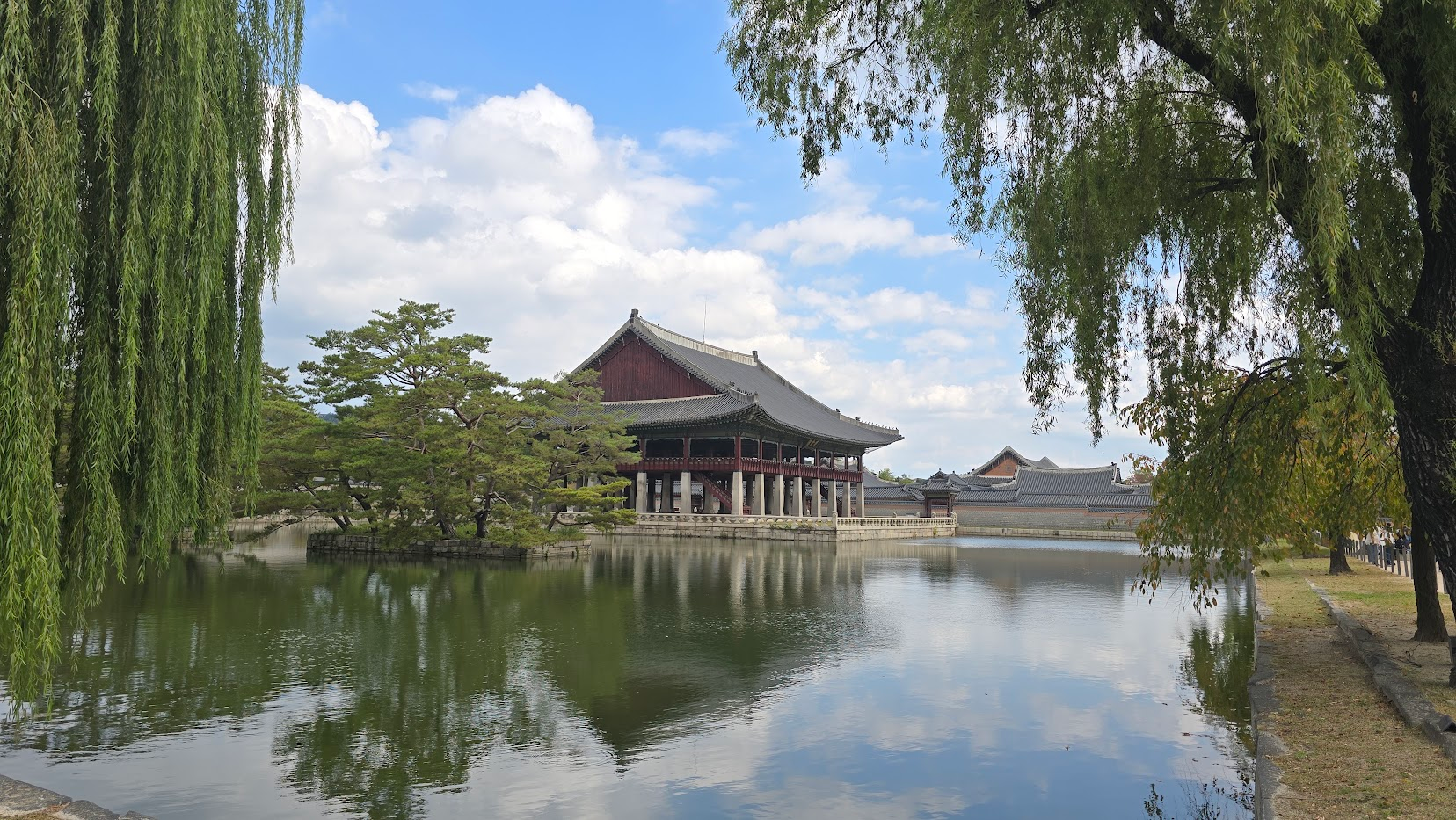
Seoul So Far
We have five nights in Seoul on this tour. It seems like a lot, but five nights is just four days. it’s amazing how quickly the time is going and how little I feel I’ve seen and experienced halfway through my time here.
Since I’m trying to cram as much as I can into the available time, I don’t have time to write much, so I’ll skip the history lesson I usually do and just touch on the highlights of my two days so far.
I’ve created two photo albums, if you want to skip the narrative:
- Museums (includes the National Museum of Korea and the Leeum Museum of Art)
- Everything else
Gyeongbokgung Palace
This palace was established in 1395. It burned down completely in the 1590s, when Japan invaded. Restoration didn’t take place until the 1890s. Then, in 1910, Japan colonized Korea and demolished most of the 500 structures of the palace. They even built a new government palace on the site.
Starting in the 1990s the South Korean government embarked on a restoration plan that is set to continue until 2045.


The photo at the top of the page is Gyeonghoeru Pavilion, the royal banquet hall.
Cheong Gye Cheon
In the afternoon we took a walk along a section of this 10.9 urban creek.
After the Korean War, South Korea was one of the poorest countries in the world. (The story of how it has become one of the wealthiest will have to wait for another day.) Many families built small houses (panjachon) along Cheong Gyecheon using wooden boards and tents.

In the 1960s and 1970s the stream was covered over with concrete and topped with an elevated highway. The highway was dismantled in 2003 and an open urban landscape was created.

DDP
Dongdaemon Design Plaza (DDP), opened in 2014, designed by British-Iraqi architect Zaha Hadid (1950–2016), winner of the 2004 Pritzker Prize, with the concept of “Metonymic Landscape”. Metonymy refers to a method of describing a specific object indirectly, and Hadid integrated historical, cultural, urban, social, and economic aspects of Seoul deduced from this method in order to create a scene of the landscape.


Apparently it’s a controversial building that many Seoul residents don’t like, but it’s also very popular, so efforts to tear it down have gotten no traction.
Home-Hosted Lunch
OAT always has home-hosted meals, where the group (usually divided into smaller groups) visits local families, usually for dinner. But in this case, we had lunch. My group ate with a lovely young woman named SeEun. She made us bibimbap.


Museums
I won’t say much about the museums. The photo album I linked to above has the highlights of what I saw.
The National Museum of Korea is something like the third most visited museum in the world (after the Louvre and the Vatican). We had less than two hours, and I wished for another two.
The Leeum Museum is owned by the Samsung family. It has some traditional Korean art and also does some very modern installations. One such exhibit (which mostly defied photography) was a collection of immersive works by women (such as a room full of feathers and a box filled with very hot and bright lights shining on a big black metal box). Our group activity yesterday afternoon was a visit to a market, but I skipped that so I could go here.
Both museums had outstanding collections of celadon and porcelain pottery.


There was a lot more, so be sure to check the album if you haven’t yet.
Street Food
Across the street from our hotel is a fabulous street filled with street vendors selling mostly various enticing, aromatic foods. Last night was a free night, so I hit a few stands for some goodies.


Oh, and though I didn’t buy any, I had to explore the almond department store. This store has two floors of almonds.


More South Korea to come. Today we’re heading out of the city to a historic village. And tomorrow we go up to the border with North Korea.