
My last three days in Ulaanbaatar
After our three days in the Gobi Desert, we came back to Ulaanbaatar for four nights (three full days). Here’s a rundown of the things I did and saw and experienced.
I hope you’ll enjoy reading my dull accounting of all this, but I invite you to skip the details and just look at the photos if you prefer.
Gandan Monastery
The full name of this monastery is Gandantegchinlen, Tibetan for “complete rejoicing.” Founded in 1809, the monastery was closed by the Communist regime in 1939, and much of it was destroyed. It reopened in 1944 to 1989, when it was the country’s only active monastery. Today, it is the center of Buddhism in Mongolia. The monastery has more than 100 resident monks and numerous Buddhist treasures. We saw plenty of both, including a chance to meet a monk and hear a little about his life.
I didn’t actually find this monastery particularly magnificent, especially compared to those I’ve seen in other Buddhist countries. It doesn’t help that most of it is post-Communist reconstruction. There are just a few older structures that the Communists didn’t destroy.
Vajradhara Temple


Migjid Janraisig Temple
The 8th Bogd Khan (1869–1924, the last religious and political leader of independent Mongolia) suffered from severe and progressive blindness during the latter half of his life. “Migjid Janraisig” means “The Lord with All-Seeing Eyes,” and this deity is associated with healing. It was all built as a religious petition to help restore the Bogd Khan’s eyesight. But it didn’t work. He remained nearly completely blind until his death in 1924. (You might recall from a previous post that I visited the Bogd Khan’s Winter Palace on my first day in Ulaanbaatar.)


Batsagaan Temple
This is the newest temple in the Gandan Monastery complex. The original dates from 1706, but the Communists destroyed it. The current temple dates from 2018.

Zanabazar Museum
The next item on our itinerary was a visit to a cashmere factory. But I opted out, and instead went to visit The Fine Arts Zanabazar Museum.
This museum opened in 1966 and houses nearly 20,000 objects in its collection, only a small fraction of which are on display. In 1989 the National Gallery of Art (which I visited on my first day in Ulaanbaatar) opened, housing the museum’s modern art collection.
The museum’s namesake is Öndör Gegeen Zanabazar (1635–1723), a direct descendant of Genghis Khan. In addition to serving as the first Bogd Gegeen, spiritual and political leader of Buddhist Mongolia, Zanabazar was a gifted polymath, with skills in numerous visual arts as well as architecture, poetry, and linguistics. Several of his works are on display in the museum.


Known as the Bodhisattva of Wisdom and is one of the three Protectors of Knowledge (Manjushri, Vajrapani and Avalokiteshvara)
gilt bronze
Thangka
The Zanabazar Museum has an impressive collection of thangka painting. I first learned about this art form last year in Dharamshala, when I visited the Norbulingka Institute. A thangka is a traditional Tibetan Buddhist scroll painting on cotton or silk, depicting deities, mandalas, or sacred scenes, used as a spiritual aid for meditation, teaching, and rituals, featuring intricate details, specific iconography, and vibrant natural pigments, traditionally kept unframed and rolled up like a scroll. Discovering this art form here in Mongolia was a treat! And because Mongolian Buddhism is closely tied to Tibet, much of the art here has the same subjects as what I saw in Dharamshala.


Appliqué
Mongolian appliqué is an intricate textile and needlework art form. Cut pieces of silk, brocade, felt, or leather are layered and meticulously stitched onto a larger fabric base.


(19th century)
Marzan Sharav
Balduugiin “Marzan” Sharav (1869 – 1939) is considered the father of modern painting in Mongolia. His most famous works, however, a collection called “A Day in Mongolia,” are in a traditional zurag style, which depicts secular nationalistic themes in a flattened perspective. (In fact, there is a resurgence of zurag painting, as I saw at the National Gallery.)


The Mongol Empire
Genghis Khan (1162–1227) was the founder and first ruler of the Mongol Empire, the largest continuous empire in the history of the world. At its height it stretched from the Sea of Japan to Eastern Europe, from Siberia into the Indian subcontinent, and reached as far west as the Levant and the Carpathian Mountains.
As happened with many ancient empires, the khans of the Mongol Empire had many wives. Many wives meant many sons who laid claim to the throne. By the end of the 13th century, the Empire began to break apart. Historians mark the end of the Mongol Empire in 1368, though some fragments remained as rump states until the late 17th century.
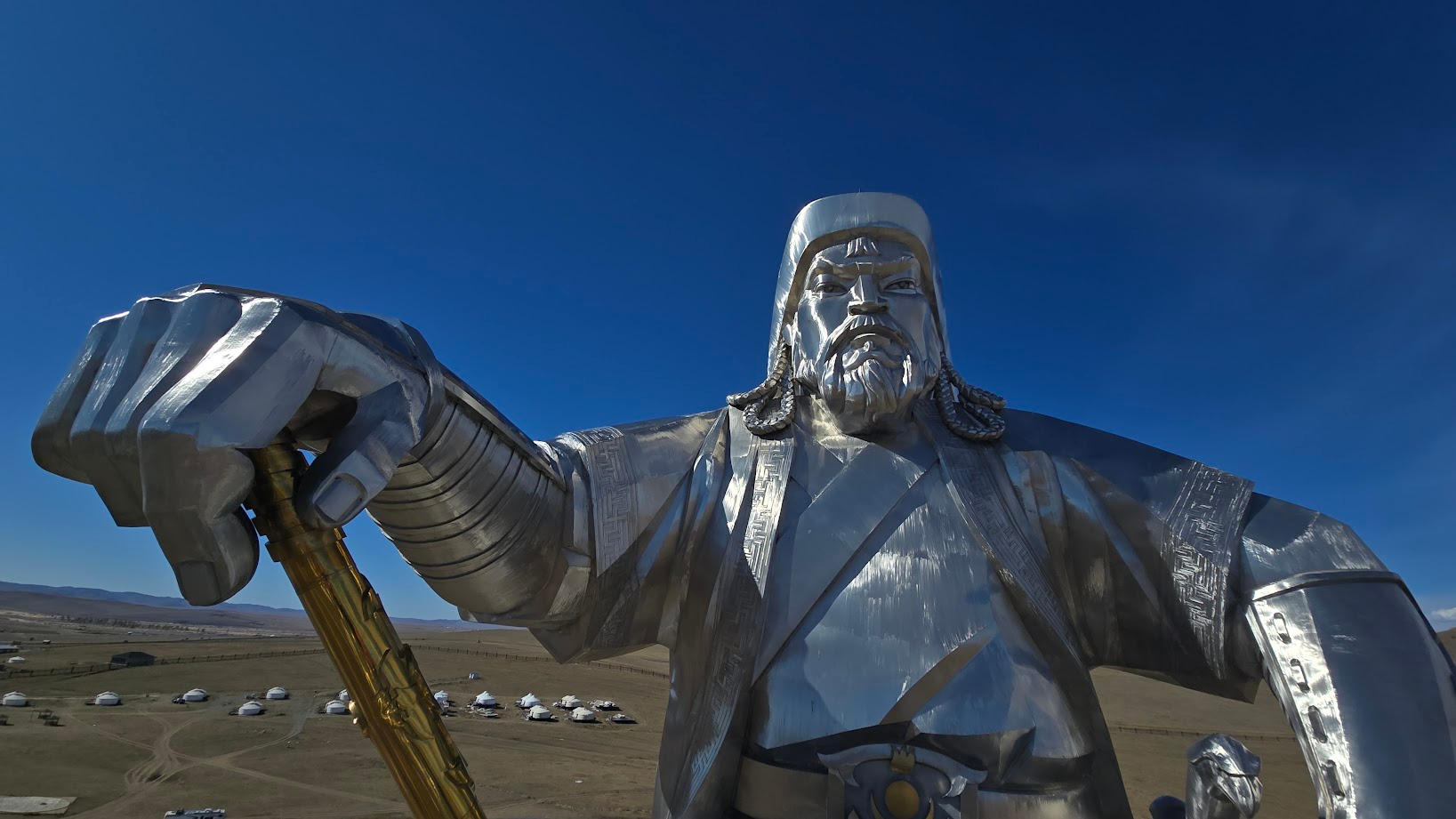
We visited the huge statue of Genghis Khan (also known as Chinggis Khan, a spelling that more accurately reflects the Mongolian pronunciation) about 60 km east of Ulaanbaatar. The statue stands on top of a museum with some information and artifacts of the Mongol Empire. You can see a photo of the statue at the top of this page. This is the view you get if you climb (or take the elevator) up through his horse’s legs and belly.

Ger District
About 70% of Mongolians live in informal housing like ger districts. Less than have actually live in a ger; most live in traditional detached houses, usually made of brick. But there are no utilities other than electricity: no water, no sewage, and no heat. The residents have to go to a central water facility to retrieve water for drinking, cooking, and bathing. And they burn coal for heat and for cooking in this cold climate. (There aren’t many trees in Mongolia, so wood is not plentiful.)
Though the residents mostly have houses, many of them will build a ger in the summertime, when heat is not needed.
Air pollution is a huge problem for Mongolia. Ulaanbaatar is in a valley, so when all these coal fires are burning, smoke and soot settle in. Respiratory disease is commonplace, not just for ger district residents. But much like the slash-and-burn farming I learned about in Madagascar, this is the only way for poor people to survive.

Kazakh family
Our first stop in the ger district was a Kazakh family. Just the wife was there for most of our visit, but her husband came home before we left. She served us a lunch of soup and dumplings. After lunch she showed us some of her embroidery and appliqué work, for which she has won awards. She also talked a little about how it is to be a Muslim in a primarily Buddhist country. She is a third-generation Mongolian, but still often feels like an outsider.


Magic Land
Our next stop was at one of five “Magic Land” community centers in Mongolia. This is a network of child protection, development, and community centers in Mongolia founded by the NGO Lantuun Dohio. The center we visited is also supported by the Grand Circle Foundation, charitable arm of OAT.
The first Magic Land opened in 2017. The second, which is the one we visited, opened in 2020.Their mission is to protect neglected and abused children, prevent human trafficking and domestic violence, and offer safe spaces, counseling, and free kindergarten or education services in underprivileged areas. Many of the kids supported by these centers have parents who are alcoholics, and many of the kids suffer from abuse, neglect, and various health problems.
We didn’t meet too many kids while we were there, but the ones we did see were clearly benefitting tremendously from the programs provided.


Mongolia and its neighbors
Our next stop was at the National University of Mongolia, where we met with a professor of international relations. She talked with us about the challenges involved as a nation sandwiched between two global superpowers — Russia and China. The question is whether to align with one or the other of them, to try to maintain a balance, or to look more to the west and to the democratic countries to the east, in particular the US, Europe, South Korea, and Japan.
There’s no easy way forward. For now, it seems Mongolia is trying to maintain a balance, keeping both their neighbors as friends, but at arms’ length, and also establishing good economic relationships with the rest of the world. It’s hard to see this as a long-term approach, but for now, it’s the only workable option.
Narantuul Market
Our final day began with a visit to Narantuul Market, Mongolia’s largest outdoor market. What an impressive array of goods for sale!!!


I also bought a vase for my collection!

After the market, we had our final meal together, lunch at an excellent Chinese restaurant. And then we went to an upscale department store. And that’s the end of my time in Mongolia. Tomorrow we leave for the airport before sunrise and fly to Seoul to begin the next part of the adventure in South Korea.
If you haven’t already looked at my photo album, this is your last chance, because soon there’ll be more photos from other places. There’s lots more than what I’ve posted here. So check it out!