
Oeam Village and Modern Art
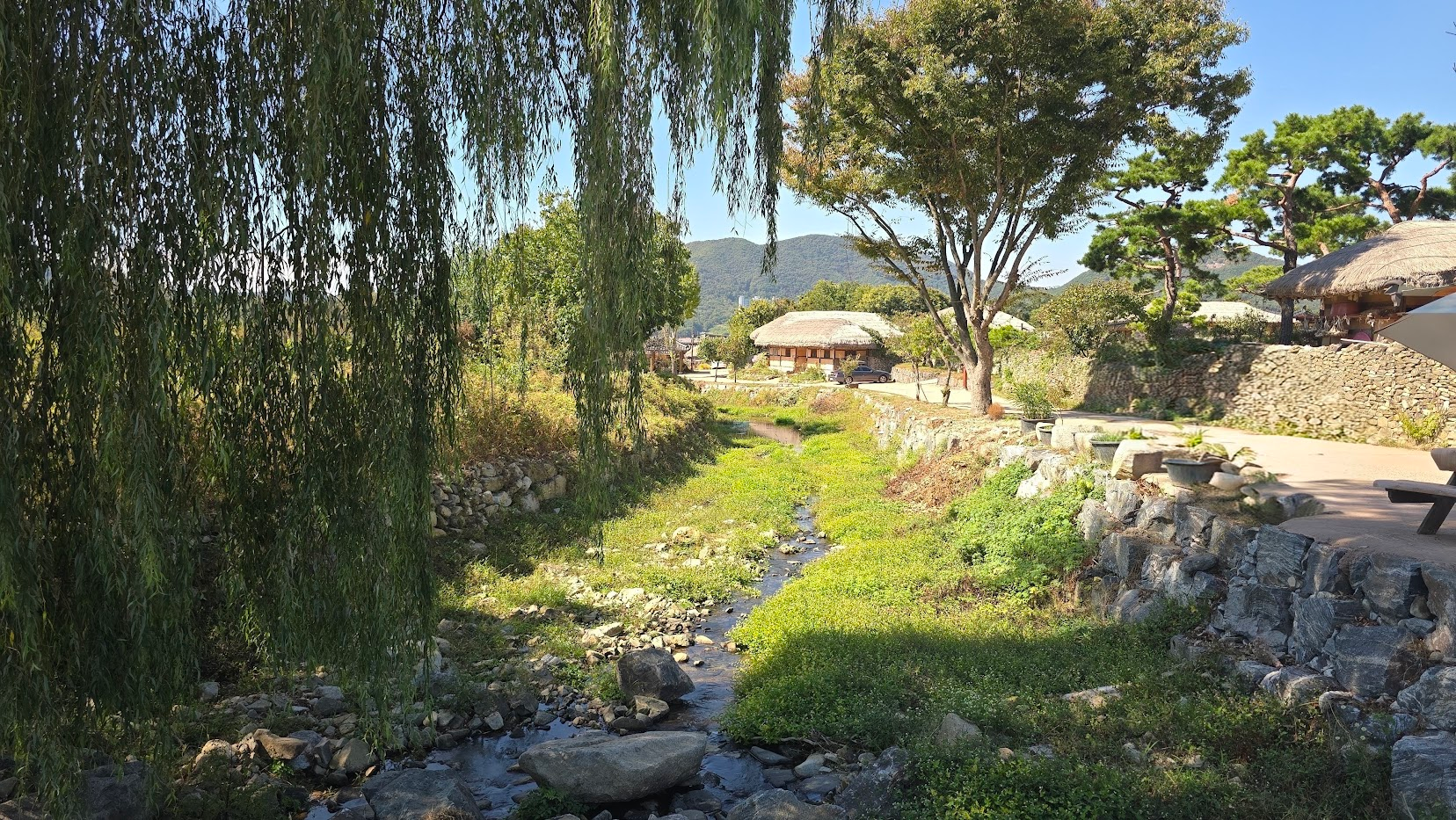
Yesterday we visited Oeam Village, about 90 km south of Seoul. This was like taking a voyage back to a time of quiet, simple, traditional life. And when we got back, I still had time to visit another museum. So it was a good day for me.
I made a new album with photos of Oeam Village. And I added additional photos to my Seoul album and my museum album.
Oeam Village
Oeam Village is on the UNESCO Tentative List. I’m not sure what it will take to get it onto the World Heritage List, but I guess they’re working on it.
Here’s what signage at the village has to say:
Oeam Village is home to many well-preserved traditional houses and gardens established by the Yean Yi clan, who have lived here since the mid-16th century.
This village was originally home to several clans. The first person from the Yean Yi clan to settle here was Yi Sa-jong, who came here in the mid-16th century to live with his in-laws after marrying the eldest daughter of Jin Han-pyeong. Generations of Yi Sa-jong’s descendants continued living in the area, which eventually became a prosperous upper-class village and produced many talented and influential individuals.
The village is situated at the southwestern foot of Seolhwasan Mountain, and thus the land’s altitude increases eastward. Due to this topography, most houses in the village were built facing south or southwest and are surrounded by stone enclosure walls that protect them from the seasonal northwestern wind. Passing through the village is an artificial water channel that carries clear water from Seolhwasan Mountain. Gardens and dense forests were built in various places along the channel to create a beautiful landscape. The village includes both upper-class houses with tiled roofs and lower-class houses with thatched roofs, preserving the characteristics of traditional houses in the Chungcheong-do region.
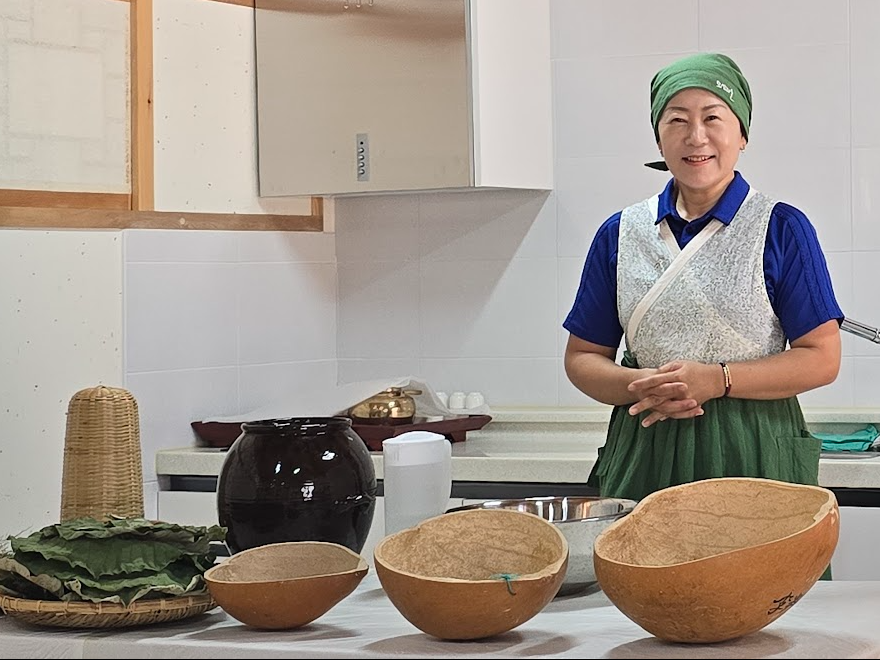
There are 69 households in the village, more than half of which engage in farming. The total population is under 200. Walls made from stones from the fields demarcate the houses. And the villagers preserve their heritage through things like making gochujang and lotus leaf wine (about which we hand hands-on learning experiences), cooking traditional foods, and brewing herbal teas. There are no restaurants and no shops.




Modern Art
The ride back to Seoul seemed quick, probably because I napped much of the way. We were back to our hotel by 4pm, which gave me plenty of time to visit the National Museum of Modern and Contemporary Art, which is open late (until 9pm) on Wednesdays. (It’s also free after 6pm.)
Sculpture garden
I decided to walk. It was a beautiful afternoon, and I didn’t want to arrive before the free admission started. Along the way, I enjoyed the architecture, and when I got to Yeollin Songhyeon Square, a park close to the museum, I encountered some interesting sculpture, an exhibit called “Riding a Gentle Breeze.”

Jaeho Kim

Junho Bang

Debbie Han

Hyungkyung Bae
MMCA
When I got to the museum, I was confused about tickets and what was on exhibit. It turns out there is no permanent exhibit at MMCA. It also turns out that it’s extremely popular on free Wednesday nights. The museum was very crowded!
The exhibit that most were there to see is a show by Korean artist Do Ho Suh (b. 1962). There was a quick display of selected early works, showing his growth from more traditional media toward techniques that expand ways of thinking about what art is. Suh is well known for re-creating architectural structures and objects using fabric in what the artist describes as an “act of memorialization.”
Suh studied Korean painting at Seoul National University and then attended the Rhode Island School of Design (RISD). He graduated with a Bachelor of Fine Arts in painting from RISD in 1994, and went on to Yale where he graduated with a Master of Fine Arts in sculpture in 1997. He worked in New York and moved to London in 2010.

This full-size recreation of the main gate of the hanok (traditional Korean house) in Seongbuk-dong where the artist grew up marks the beginning of the exhibition as a symbolic passage connecting different spaces, times, and memories rather than merely separating inside from outside. The medium is thread and painted gelatine tissue embedded in handmade cotton paper.
The use of thread embedded in handmade paper was one of the major themes of the exhibit


Rubbing/Loving
The next section of the exhibit was works that are part of a series called “Rubbing/Loving.” Here’s what the statement about the work said:
Suh’s notable series Rubbing/Loving demonstrates his distinctive methods for remembering places. These homes are ones that he has left behind, including the hanok in Seongbuk-dong, or some that are soon to disappear. The title of this series derives from the similar pronunciation of the English words “rubbing” and “loving” to many native speakers of Korean. The artist explains, “I connected these two words because the act of rubbing itself felt like an act of deep love.”
To create the pieces, Suh first attaches traditional Korean mulberry paper to the surfaces of the homes, and then extensively rubs the paper with graphite and colored pencils. The resulting impressions are not merely images reproducing the homes, but tactile landscapes that record the passage of time during which the body and place become intertwined.


The structure is held up using only stainless steel wires.
The artist regards Rubbing/Loving: Seoul Home as a portrait of himself and his father. As the time connecting the generations seems to soak into the surface of a home, the home becomes like a living body that carries deep memories.
Here are two short excerpts from a video playing at the museum, showing how he did the rubbing and how he removed the paper from the house.
Fabric
Some of Suh’s work uses fabric, rather than paper. “His most recent fabric work combines in a single space architectural elements from several homes he has inhabited, including doorknobs, electric outlets, and light switches. It unfolds as an architectural autobiography in which time and place intersect.”

Polyester and stainless steel


outlets represent different locations.


Floor
What do you see in this installation from 1997–2000, one of Do Ho Suh’s most well-known and popular works?

In an interview, Suh said, “Everything starts from an idea of personal space—what is the dimension of personal space. What makes a person a person, and when does a person become a group?” For Suh, Floor physically manifests this blurry boundary. An individual figure is recognizable up close, but when stepped back, it entirely disappears into a mass, asking where the “I” ends and the “We” begins.
In Korea, where Suh grew up, society was collectivized. Individual identity was routinely minimized for the sake of the group. His mandatory military service further reinforced this societal norm. But then he moved to the west, where there is an aggressive focus on individualism and personal space. Floor was his way of exploring this cultural clash. By reducing the figures to an indistinguishable sea of bodies, he captured how it feels to have one’s identity swallowed by a massive societal structure.

Walking on this piece made me uncomfortable. In fact, I couldn’t bring myself to do so, and from the first photo, you can see that most people were avoiding it. And I think that’s the point. When do our normal physical activities (such as walking) become statements of privilege, responsibility, and social hierarchy?
Other stuff in the MMCA
I didn’t take too much time to look at other exhibits. There was one exhibit called This Is (Not) Conceptual Art, which was all conceptual art. I have to admit I struggle to appreciate or derive value from this kind of work, but here is one of the few pieces I thought were interesting.

Kim Beom (b. 1963)
There’s lots more of Oeam Village and lots more modern art in my albums, so be sure to take a look.
Next up, my final post from Korea: a visit to the DMZ.