
Réunion: More beauty per square meter than your average island
I had no idea what to expect on the island of Réunion. I don’t know anyone who’s ever been here, and I didn’t really do a lot of advance research. But what I’ve discovered is that this is one of the most beautiful places in the world. Or at least it’s one of the most beautiful places I’ve ever visited. For an island that’s a little smaller than Luxembourg or the state of Rhode Island, it packs in all this beauty so tightly! Even getting to the stunning vistas I’ve seen involves driving through stunning scenery.
A lot of this has to do with that fact that Réunion island is relatively new, geologically speaking. But wait. I can tell you more about this.
The Geology of Réunion Island
Réunion and Mauritius are the two largest of the Mascarene Islands, a chain of that includes several smaller islands, reefs, and atolls formed from volcanic activity. This island group got its name from the Portuguese navigator Pedro Mascarenhas, who visited them in 1512.
Réunion formed between 2 and 4 million years ago. By comparison, Mauritius is about 8 million years old. And some Pacific islands, like Fiji, formed more than 100 million years ago. The world’s oldest island is nearby Madagascar, which is not volcanic in origin; it broke off from Africa about 150–160 million years ago.
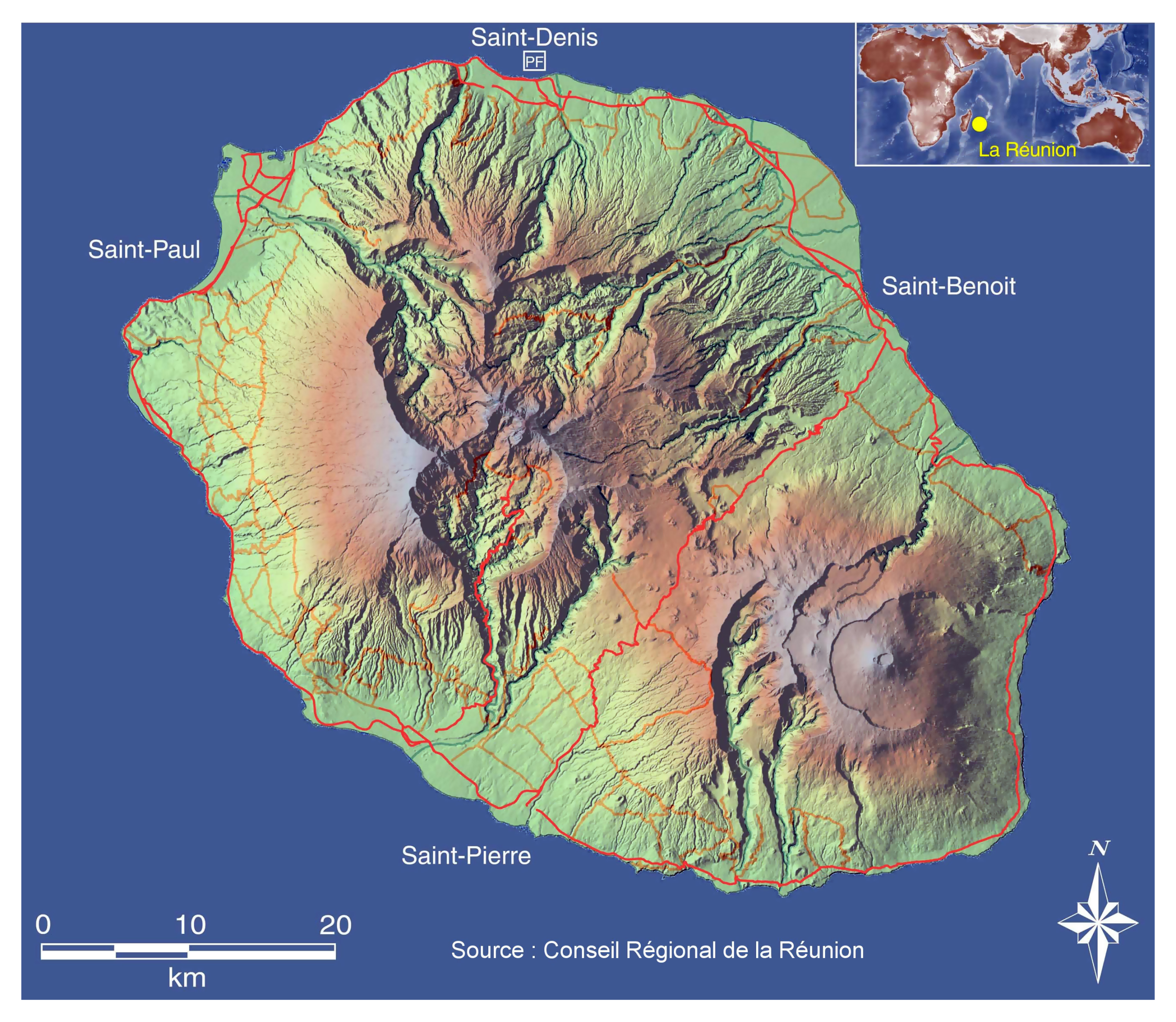
The peak near the southeast corner of the island is Piton de la Fournaise, 2,631 meters (8,632 feet) above sea level. It is one of the most active volcanoes in the world, often erupting multiple times in a year. It has already erupted twice in 2026. These eruptions can last anywhere from several days to several months. They are not explosive, but they create spectacular lava flows which create steam upon reaching the ocean.
The tallest mountain on the island (and in the Indian Ocean) is Piton de Neige, at 3,070 meters (10,070 feet). It has been dormant for 20,000 years. Piton de Neige is surrounded by three calderas (cirques in French) which are clearly identifiable on the map. Cirque de Mafate is northwest, Cirque de Salazie is northeast, and Cirque de Cilaos is to the south.
A little history
I can’t pass up an opportunity to share some history of Réunion.
Like Mauritius, Réunion was uninhabited when the Portuguese came through at the beginning of the 16th century. They had no interest in settling here, so it remained uninhabited until it was claimed by France in 1642. They named the island Île Bourbon and established a penal colony here. That only lasted until 1649.
Colonization began in 1665, and the French East India Company established a plantation economy that depended on slave labor. Coffee was the primary crop. Slaves came mostly from Madagascar, Comoros, and the African mainland. Between 1769 and 1793, 80,000 slaves were brought to Île Bourbon.
During the French Revolution, the island adopted the name Réunion. Though France abolished slavery in 1794, the local population here rejected this. When Napoleon Bonaparte became First Consul in 1799, he supported slavery in Réunion, and it remained legal.
Sugar cane replaced coffee as the primary agricultural commodity after two cyclones destroyed much of the coffee crop in 1806 and 1807. Then, on July 7, 1810, the British invaded, and two days later French forces capitulated. The British renamed the island as Bourbon Island.
Under the Treaty of Paris in 1814, the British returned the island to France. The slave trade continued until 1848, when the French Second Republic was born and the island’s name once again was changed to Réunion. Though slavery was abolished, it was replaced by an indenture system that was equally harsh.
The opening of the Suez Canal in 1869 brought about an economic downturn, as ships no longer needed to stop here on voyages to the far east. Europe also shifted from sugar cane to sugar beets. Agricultural workers shifted to construction projects, developing a railroad, road network, and an artificial harbor.
In 1946 Réunion became a French department, equal to the departments of mainland France. Starting in the 1980s, tourism began to replace agriculture as the leading economic driver of the island.
My visit to Réunion
I had three full days here, and I booked three private tours.
Réunion really tells its best stories visually, so I will mostly let the photos do the talking. You can skip to my album if you want. But there’s a few things below that you won’t find it my photo album.
Day One: Maïdo
Maïdo is a volcanic peak that overlooks the Cirque de Mafate. It took a little over an hour to get there, first on the highway to the west side of the island, and then up a twisting road through tamarin forest.
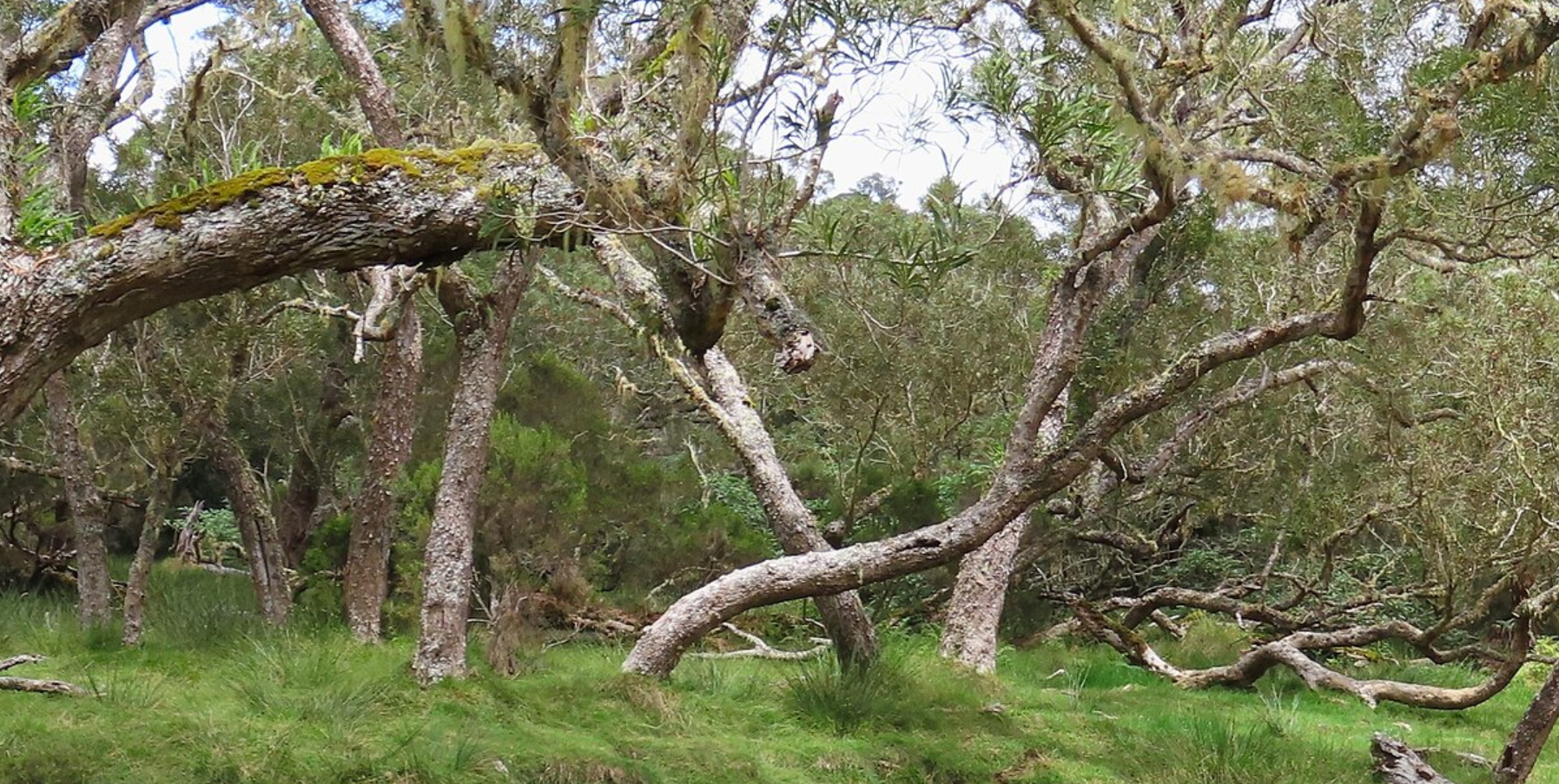
The scenery at the Maïdo viewpoint was breathtaking.


Also Day One: Saint-Denis
The Maïdo tour was just a half day, so when I got back to Saint-Denis, the main city where I’m staying, I took myself on a little walking tour.


I also visited an excellent art museum in two buildings, one that had an exhibition of a living Réunion painter, Hugues Savalli, born in 1953. I loved his work.

The other building had a collection of works, many of which were artists from Réunion, or who visited here.


Pont de la Savane, sur la rivière du Mât à Salazie (Savannah Bridge, over the Mât River at Salazie), 1870–1880
(On Day Three I was here.)
Day Two: Volcano
This tour was a full day, with a two-plus hour drive to the southern part of the island.
The scenery was breathtaking. (A redundant but essential theme of this trip.)


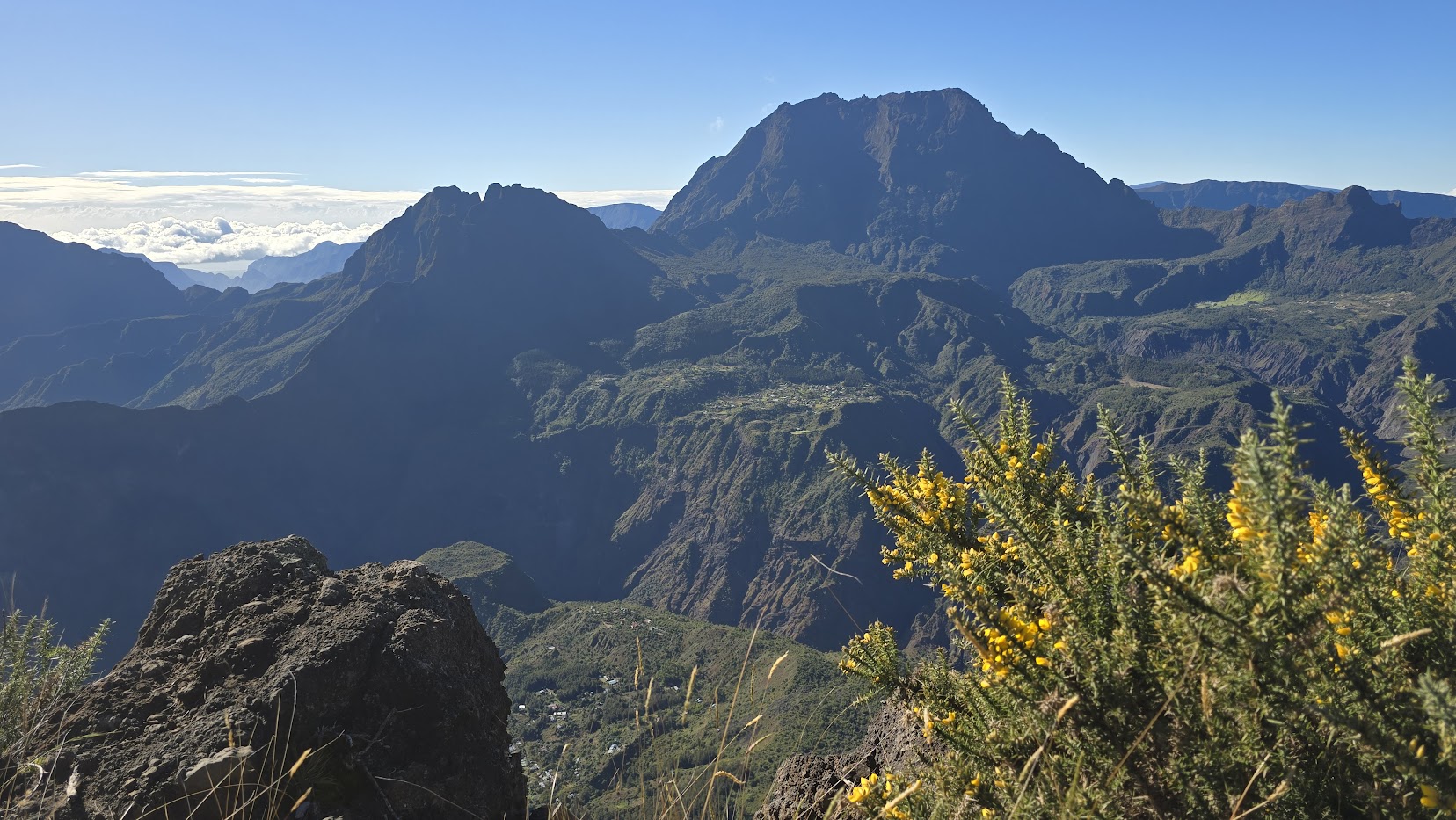
The cone-shaped peak in the distance is Piton de la Fournaise (Furnace Peak), a currently active volcano that has had two eruptions earlier this year.


I was just about to start the hike down to the little crater, Formica Leo. It was about 600 steps down the side of the cliff. And 600 steps back up again.
Of course I didn’t get to see the actual eruptions of Piton de la Fournaise, but here are some videos:
After the visit to the actual volcano, I went to a volcano museum.
Day Three: Salazie
My last day was a tour to Cirque de Salazie. Here I actually got to drive into the cirque. We visited two villages, Salazie and Hell-Bourg, and I saw some scenery that was.. what’s the word?


If you look closely, you can see that there are many separate falls, and none of them come from the top of the cliff. They come from underground streams.

“Water Chicken” is the literal translation of the French name for a moorhen. There are moorhens living around the lake, but they stay in the underbrush.


I also visited a vanilla cooperative. Vanilla comes from Mexico, which was the leading producer of vanilla until the 19th century. In 1819, the French brought the fruits to Réunion with the hope of producing it here. But there was a problem: no bees. No bees, no pollination. No pollination, no vanilla pods.
In 1841 a 12-year-old slave named Edmund figured out how to pollinate the vanilla orchids by hand. After that, Réunion became the world’s top producer of vanilla. And this is the method still used today.
The vanilla produced here, Vanilla planifolia, is commonly known as Bourbon vanilla. It’s a different species than the vanilla from Mexico. Vanilla is one of the most expensive spices in the world, second only to saffron.
My final stop was at Cascade Niagara.

Yes, that’s a torrential waterfall, at least during the rainy season.
That’s it for Réunion. I’ll be heading to the airport shortly for my flight to Madagascar. See you there!
Thank you. What a “beautiful” treat to read your story and view your photos.
Thank you Tim!
Beautiful pictures and descriptions Lane. Thanks for sharing!
Thanks Cheryl! I’m glad you enjoyed my photos.
Thanks for the history lesson and beautiful photos!
Thank you for reading!
I also love the Savalli painting. And amazing that a 12 year old developed hand pollination!
So fascinating! I hope you had a chance to see all the Savalli paintings in my album.
https://photos.app.goo.gl/BVZpvJYnZyd8MGni9
Looks like a FASCINATING trip, Lane! Keep enjoying ❣️
It is, Sandi! Thanks for your comment!