
Madagascar Part Seven: Tsingy de Bemaraha
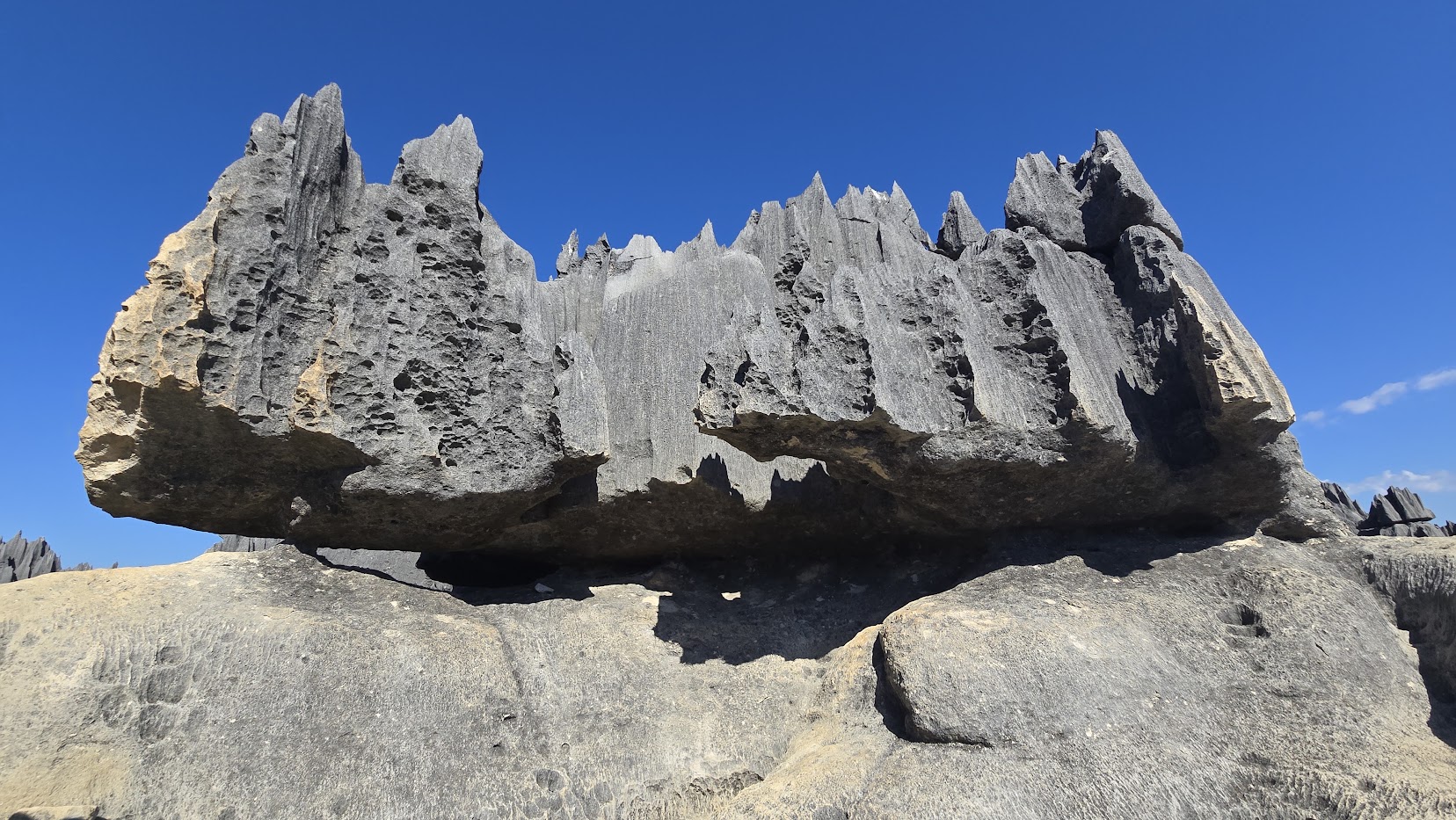
In my life, I’ve been to two places where I thought I might be on another planet. The first was Wadi Rum in Jordan. As I wrote at the time, the only word I could come up with to describe it was “otherworldly.” And now I have another otherworldly place that is beyond my vocabulary: Tsingy de Bemaraha National Park in Madagascar.
Since I have no words, I will have to let photos do the storytelling.
But I can tell a little about the journey to get there and describe some of the logistics.
Getting to Tsingy de Bemaraha
The tour I did with Explore! ended in Antananarivo last Friday. Then on Saturday morning I flew to Morondava, one of the smallest airports I’ve flow through, and when I arrived I met my guide, Annico, and driver, Hery. We loaded into the Toyota Land Cruiser that would get us to Tsingy and back and were on the road by 11:30.
It turned out that there was a bit of confusion about the agenda. I thought I would spend the first night in Morondava so we could get an early start on the drive to Tsingy the next morning. But it turned out we did the long drive directly from the airport. This gives me two nights in Morondava at the end, which is where I am now, enjoying a pleasant breeze on the beach. A much better itinerary than I anticipated.
I’ll save the sights and experiences on the journey to and from Tsingy for a separate post. Because we were getting a late start, we pushed hard to get there before it got too late. It was a long drive on a dirt track that would be impassable except in a 4x4 with high clearance. Hery’s expertise was mindblowing! He knew that road like the back of his hand, and he moved through as fast as possible. It was about 185 km, with two ferry crossings.
My hotel
My hotel, Olympe du Bemaraha, was a collection of very rustic cabins. The main building had a nice restaurant, a lovely pool with water that was frigid (I tried but failed to get in past my waist), and a super friendly staff. I had some really nice meals at the restaurant, and I sat there when I had free time to use the wifi. They walked me to my cabin, but since it was dark, I got lost trying to find my way back to the restaurant for dinner. And then I needed to get someone to help me find my cabin again. By the next day, I had it figured out.


Canoe ride on the Manambolo River
My first day at Tsingy de Bemaraha started with a canoe ride. The Manambolo River runs through the southern edge of the park just a few kilometers south of where I was staying. It creates a gorge 80 meters deep and has several caves we explored.
Annico and I picked up Gilbert at the park office next to the river, and we embarked on our two-hour excursion up and back down the river. (I have to say how privileged I felt having a local punter, a local guide, and a tour leader, as well as a driver, all working just for me. And that doesn’t count the two members of the gendarmerie who rode part of the way to Tsingy with us; I’ll share more about that in a future post.)


Cave #1

Also, note the tree root in the clay. That’s from a live tree on the cliff outside the cave.


Cave #2


Lunch break
We got back to the hotel by around 10:30, and I spent the hottest part of the day relaxing, organizing photos, and finishing my blog post from Antananarivo.
Which reminds me: I haven’t been mentioning sleep in my recent posts. And that’s because I am finally in a good sleep pattern. My Fitbit tells me I’m having the quality sleep I need. So I haven’t needed to take a nap any of the last few days.


Little Tsingy
Tsingy de Bemaraha National Park features two geological formations: Little Tsingy and Great (or Big) Tsingy. This afternoon, past the worst part of the hot sun, we hit Little Tsingy. The entrance was right at the same spot on the river where we began our canoe ride.
What’s a tsingy?
Millions of years ago, where the tsingys are now, the land was a limestone karst. What’s a karst? I’m glad you asked.
A karst is a landscape made up of soluble rock such as limestone or dolomite. In many parts of the world, such as much of Florida, karsts are plateaus. And millions of years ago, the land in this area that is now tsingys was all plateau. But because limestone is soluble, rain and groundwater can erode it relatively fast. Sometimes debris on the surface or non-soluble rock strata can confine the erosion below the surface. Examples of this in the United States are Mammoth Cave in Kentucky and Carlsbad Caverns in New Mexico.
Other famous karstic places in the world are Ha Long Bay in Vietnam, the Yorkshire Dales in England, the cenotes of the Yucatán peninsula in Mexico, and Niagara Falls.
The erosion pattern of the karst in western Madagascar created unique rock formations. They are said to be razor-sharp, but from what I could tell, they a little less sharp than that.
The word “tsingy” is Malagasy. It means “the place where one cannot walk barefoot.” Little Tsingy is where the trees are taller than the tsingys. Big Tsingy is the opposite.
The hike through Little Tsingy


Big Tsingy
It took about 1 1/4 hours to drive to Big Tsingy. We wanted to get there early so we could finish our hike before the hottest part of the day, with temperatures expected in the mid 90s. And the plan was to have a picnic lunch in the park at the end of the hike.
So Annico and Hery picked me up at the hotel at 6:30, and we picked up Gilbert in the village of Bekopaka. When we arrived at the parking area for Big Tsingy, there were no other cars there. We were the first.
I was nervous, because Gilbert was carrying climbing equipment: harnesses with carabiners. I had no idea what I was getting into.
We hiked through the forest for about an hour at the beginning. This was already magical, even though were weren’t at the tsingy area yet.
Critters
After about twenty minutes, we came upon a small group of Decken’s sifakas (Propithecus deckenii). This was the fourteenth lemur species I have seen on this trip.


And not long after that, a number of other critters.


Climbing
Soon we caught up with towering limestone formations. These were only a hint of what was awaiting me.


Tsingy Viewpoint #1


I also made a video panorama. You can watch it on YouTube.
More climbing


When we got to this bridge, I gave my phone to Gilbert and asked him to take a picture of me on the bridge. I then started across. After I took about four steps, he yelled at me to stop. You’ll notice that there are three cables across the bridge, two of which actually support the bridge. And the third is to attach your carabiner. Which I hadn’t done.


Once we were all across, we came across this critter:

Tsingy Viewpoint #2


Climbing down


And soon we were done, arriving back at the parking area by 11:30. I don’t know if they were just being kind, but Gilbert and Annico seemed genuinely impressed at how well I did. That I finished in under four hours (considering all the stopping for photos) was apparently faster than typical. The description of the hike said it’s about five hours.
We were supposed to have a picnic along the way, but since we got done so fast, I suggested we just head back to the hotel. That way I got to take a shower and get into some clean clothes and then enjoy my picnic lunch by the pool.
We got one final greeting from one of Tsingy’s magnificent creatures as we drove out of the parking area.

This visit to Big Tsingy was one of the greatest experiences of my life. I am so glad I did it. It was the perfect capstone experience to a trip filled with amazing things.
Wow! Fabulous photos of an amazing place.
Thanks Carroll!
What an incredible journey you have been on. Thank you always sharing your unique adventures!
Thank you for reading, Liz. It was incredible and unique in so many ways.
Lane! You are a badass!!!
I had no choice, Raeanne. They brought me here and made me do it all. I had no idea it was going to be such an adrenaline rush!
WOW!!! These photos and the story alone have put Madagascar on my MVBID list — must visit before I die!
Tim, do it while you’re still healthy and fit.
You’ve inspired me to visit many places; I’m glad to return the favor.
God Lane, I’m glad you lived to tell the tail and to send us the pictures!
Oh Susan, so am I!!!!!
Just WOW!!!!!
I couldn’t agree more, Tammy!
This is also why I like private tours.….…you would not be doing this with OAT or most other tour companies. Maybe an adventure company like Mt. Travel Sobek, but really, what an adventure!
Fabulous, Lane! I loved every second of my time reading about your trip and enjoying the pics of the amazing rock formations!
I especially loved that Tsingy swingy bridge. It would be such fun to cross over it. My other favorite was the pic of you looking through the rocky hole. You look great!