
Madagascar Part Five: To the beach!
After almost two weeks of mostly nature and villages, constantly on the go, we arrived at the beach on Monday evening, and we’ve had two full days of relaxation. Never has that felt so good! This Madagascar beach is so pleasant! The weather has been cool and breezy, perfect for lounging around by the pool at this lovely hotel, or walking on the beach. I’ve enjoyed catching up on organizing all my photos so far, chatting with my travel mates, napping, and taking copious photos of the sunset.
The road to the beach
Getting here was a different story.
We left Isalo Monday morning at 7:30. After a couple of hours, we stopped at Zombitse National Park for one last trek. From there it was another nine hours or so on the worst roads we’ve encountered. And that’s saying a lot, because the roads have been consistently bad, with deep potholes and places where the asphalt is completely broken up.

To give you an idea, about eight hours of the day was actual driving. And over those eight hours, we covered about 180 kilometers (112 miles). You can do the math to see our average speed.
It was grueling.
Zombitse National Park
The stop at Zombitse was nice, even if we didn’t get to see one of the lemur species (Verreaux’s sifaka) we were hoping to encounter. We did, however, see a couple of Zombitse sportive lemurs. They are nocturnal, but we saw them resting at the top of the hollow trees where they dwell.

With this, I have now seen members of four of the five lemur families and roughly ten or twelve different species.
We saw several other critters as well, including a pair of white-browed owls (also nocturnal, and also resting or sleeping, which makes them easy to photograph).

You can find more photos from Zombitse in my online album.
Poverty
Aside from being a slow, grueling slog over a terrible road, the drive west took us past some of the most abject conditions I’ve ever seen. We’ve seen humble dwellings throughout this trip, but on this day the poverty was heartwrenching. A few times when we stopped for a break, we were swarmed by children (and some adults) begging us for money or food. It was bothersome, because they were infinitely persistent, but also so sad, because you know there is nothing you can do that will make any difference.
I mostly avoided taking photos of these people. But I want to remember what I saw, so I did take a few, without expecting them to pose for the camera.


Mahafaly tombs
We passed a few areas with Mahafaly tombs. The Mahfaly, an ethnic group of about 200,000 who live as farmers and raise zebu (humped cattle). They do not bury their dead below ground; rather, they build elaborate enclosures, lay the body in the middle, and cover it with large rocks. They decorate the enclosure with scenes reflecting the life of the deceased and aspects of Mahafaly culture and local landscapes.


At the beach
There’s really not much to say about the last two days, which have mostly been a time of leisure.


And a few other critters:


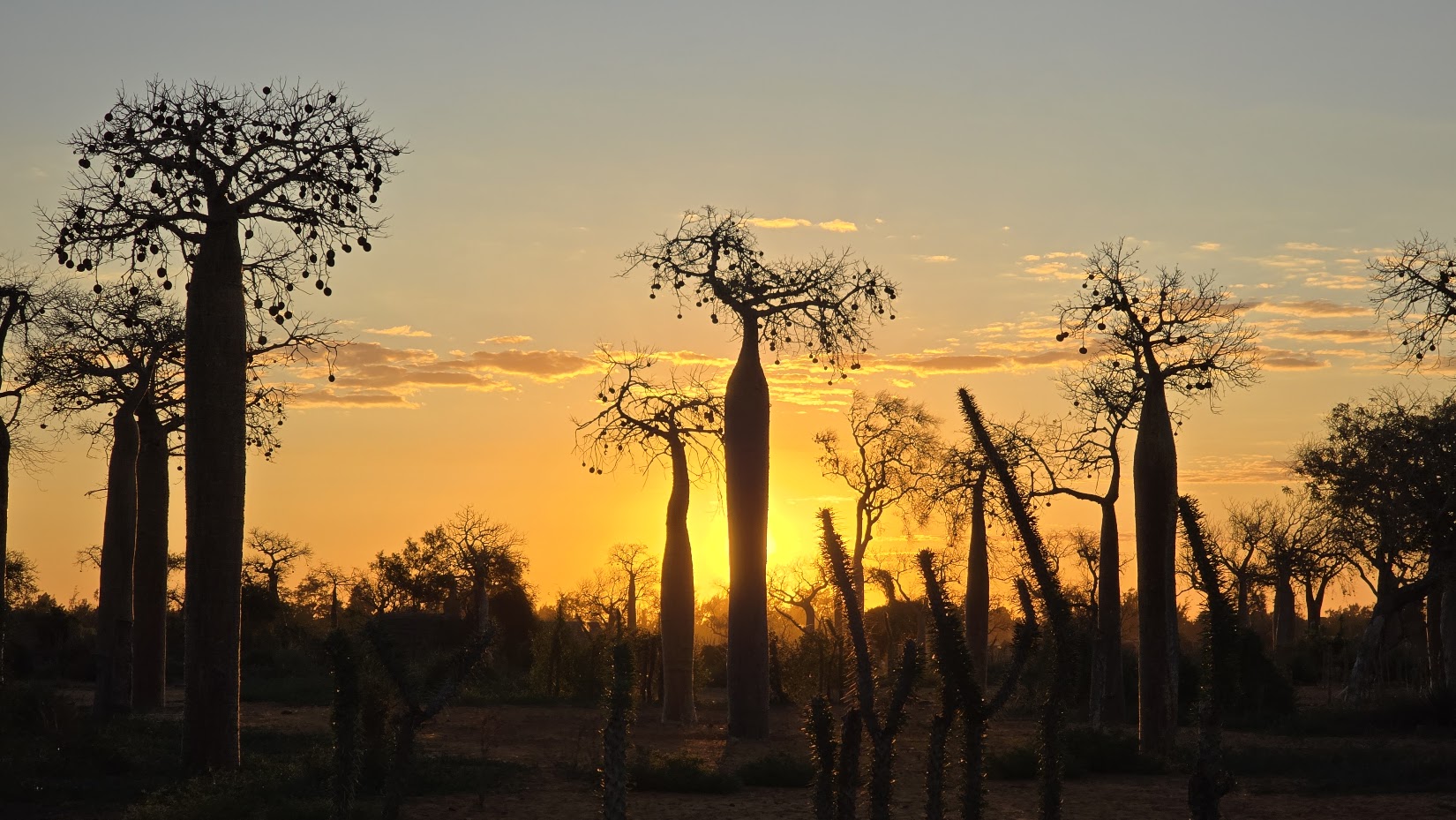
We did take one excursion, to Reniala Reserve, in the nearby village of Mangily. We saw nothing interesting or new there, except a lot of baobabs, including one that is 1,400 years old.

The reserve also has a Lemur Rescue Center that is supported by the Fondation Brigitte Bardot.
The highlight of that field trip was not the reserve, but the stop afterwards to see the sunset among the baobabs. You can enjoy it too via the photo at the top of this page.
This afternoon we fly back to Antananarivo, and that’s where our tour ends. We have a few more activities there tomorrow. Then on Saturday I will fly to Morondava and start my private tour to Tsingy de Bemahara National Park.
I am not yet ready to share more photo albums. I’ve done a lot of culling over the last few days here at the beach, but I have a long way to go to get them all captioned.

Stay tuned for more from Madagascar!
So many lovely and thought provoking photos.
Thank you Raeanne!