
I made it to Mauritius (with some Mauritius history)
It took from early afternoon Monday to early afternoon Thursday (albeit with a ten-hour time change), but I finally made it to Mauritius. I want to share a little about the journey and how I’ve settled in, and I want to take this opportunity to write just a little about Mauritius history.
From Ajijic to Pointe aux Biches
The reason it took me three days to get here is not that the flights are so long. It’s the time between flights that is so long. Though the flights are pretty long too.
Here are the steps I took to get from there to here:
- I am an anxious traveler, so I like to get to the airport very early rather than worry about missing my flight. Plus there is always a good possibility of delays on the highway from Ajijic to the airport, whether because of traffic or because someone decides to set up a blockade. So I had a 12:30 pickup for a 15:50 departure. The drive to the airport is 40 minutes when there’s no traffic. And this time there was no traffic. So I had more than two hours’ wait.
- The flight from GDL to MEX is about an hour and ten minutes actual flying time. For some reason (which they announced in Spanish but which I failed to comprehend), they had to do some circling, so it was closer to an hour and a half from takeoff to landing.
- My flight from MEX to IST departed the next morning (Tuesday) at 09:00. So I spent the night at a hotel by the airport.
- The flight from MEX to IST stops in Cancún for about two hours. Then it’s another eleven hours flying time from CUN to IST. With the nine-hour time change, I arrived in IST at about 08:00 (Wednesday).
- My flight from IST to MRU departed the next morning (Thursday) at 02:00. Fortunately, Turkish Airlines offers a free hotel room for passengers with a long layover. My 18-hour layover definitely qualified.
- The flight from IST to MRU took nine hours. I lost just one more hour, and my flight landed around 12:45.
- I had a ride pre-arranged to my hotel, an hour’s drive across the island from the airport, which is on the southeast side of Mauritius. By the time I got settled into my room, it was close to 14:30.
Settling in
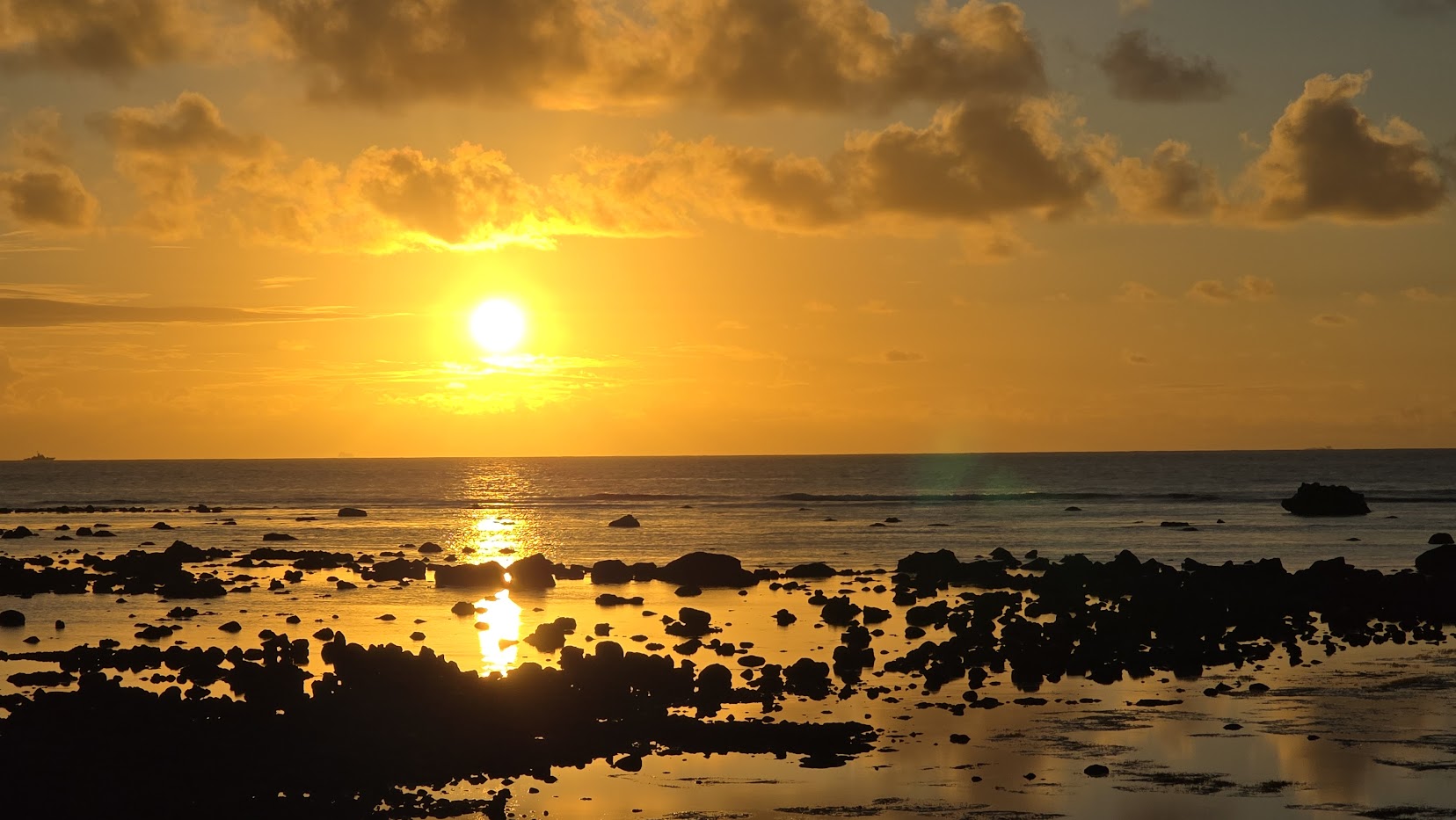
My hotel is charming, right on the beach on the northwest side of the island. It’s not really in a town, but there is some civilization in the area — a few shops and restaurants and other tourist lodging. After I got settled in, I went for a walk and found the local market, which sells everything from clothes to souvenirs to groceries. Then, after a nap, I had a drink at The Skipper, the hotel restaurant, and enjoyed the sunset (photo up top).


Sleep
One of my big challenges as I have gotten older is jet lag. On previous trips it has taken me weeks to get into a decent sleep schedule. And even then, I often wake in the middle of the night and find myself unable to get back to sleep. I don’t sleep well on the plane, even with fully reclining seats in business class.
Though I try to avoid sleeping during off hours in order to get back to a nighttime sleep schedule, I needed that nap in the afternoon. When I bedded down last night, around 10:00, I knew it was doubtful I’d sleep through the night. And I did wake up several times, first at 11:30. Each time I thought I’d never get back to sleep, but I did, and I ended up getting a good 5 1/2 hours with a sleep score (according to my Fitbit) of 84.
It doesn’t mean I’m back on track, but it’s a good start.
Mauritius History
And now, I’ve kept you waiting long enough. Here’s the history I promised.
I got most of this from my driver on the way from the airport to the hotel, and I supplemented it with some online research. But I’ll keep it high level. It’s actually pretty interesting, and different from a lot of other places I’ve traveled to.
Uninhabited
Arab sailors were aware of the islands in this region as far back as the 10th century, but Mauritius remained uninhabited when it was discovered by the Portuguese. Along with other nearby islands, it appears on maps dating from the beginning of the 16th century.
Though Portuguese explorers visited the island, they had no interest in settling here, as they were already established on the African mainland (Mozambique) and in Asia. They sailed the Mozambique Channel (between the mainland and Madagascar), and since Mauritius is east of Madagascar, it served no purpose to mariners.
Dutch
In 1598 a Dutch expedition to Indonesia consisting of eight ships ran into foul weather after rounding the Cape of Good Hope. Three of the ships made their way to Madagascar; the other five landed on this island and named it after Prince Maurits of the House of Nassau. (“Mauritius” is the Latin version of the prince’s name.)
For a while Mauritius served as a stopover for Dutch seafarers on the long voyage to the east. Then in 1638 they set up their first colony here. They brought Malagasy slaves, and they dedicated themselves to the harvest and export of wood from ebony trees, which grew abundantly here. But many hardships–weather, pest infestations, and illness–led them to abandon the island in 1658.
They tried again, several times, establishing some agriculture. They finally gave up for good in 1710.
The Dutch legacy here, other than naming the island, was bringing about the extinction of the endemic dodo through the introduction of invasive species and the destruction of habitat. The last dodo was sighted in 1662, just fifty years after there discovery. The Dutch also introduced sugar cane to the island.
French
The French arrived here in 1715 and named the island “Isle de France.” Over the course of the eighteenth century, the French developed the island, bringing in laborers from India and slaves from Africa. When the revolutionary French government in Paris attempted to abolish slavery in 1796, the local colonists broke away from French rule and expelled government envoys. By the early 1800s there were 60,000 slaves on the island, accounting for 80% of the total population.
At the beginning of the nineteenth century, corsairs on the island used it as a base for conducting raids on British commercial vessels. Finally, the British sent a large force, and in 1810 they captured the island.
British
The Treaty of Paris, signed in 1814, formally renamed the island as Mauritius. The British also agreed to respect the language, customs, and laws of the inhabitants. That’s why, today, most place names here are French, which is also the main language spoken by residents.
The British finally abolished slavery here in 1835. They generously compensated the plantation owners, most of whom lived back in England and had never even set foot on the island. The Mauritian owners received a total of over 2 million pounds sterling (the equivalent today of 2 billion US dollars today). This compensation of the slaveowners rather than the victims allowed the sugar plantations to remain in the hands of wealthy families and deepened structural inequalities that have persisted until today.
Incidentally, the British government borrowed 15 million pounds in 1835 to compensate slave owners across all their colonies. They didn’t finish repaying the debt until 2015.
Slave labor was quickly replaced by indentured laborers from India and the far east. Today, almost half the population are of Indian descent, and Hindu is the most commonly practiced religion in Mauritius.
Independence
Gradually, steps toward self-rule during the first half of the twentieth century led to a strong push toward independence. British rule finally ended on March 12, 1968, a date chosen because it commemorates Gandhi’s Salt March on March 12, 1930.
An amendment to the Constitution, ratified in 1991, established the Republic of Mauritius within the British Commonwealth. The last vestiges of UK sovereignty in the country ended in 2024.
Today Mauritius has the second highest GDP per capita of any country in Africa (after Seychelles). According to the Economist’s Democaracy Index, it is one of 26 nations in the world, and the only one in Africa, that is a “full democracy.” At 21 on the list, it is ahead of Spain (22), France (26), and the USA (a “flawed democracy” at 34).
And Now
It’s my first full day, and I have a full-day tour booked to explore the northern part of the island. I think this is the more historical part of the island, including the capital “city” of Port Louis, and I should get to see some colonial-era buildings. I’ll be back later to tell you all about it.
Photos
I’ve started a photo album for my visit to Mauritius. I’ll be adding to it over the next few days. But feel free to get a head start.
Wonderful Lane.
So interesting, Lane. What a great tour and fascinating history lesson. I loved it!
Thank you Joy!