
Typhoon in Taiwan
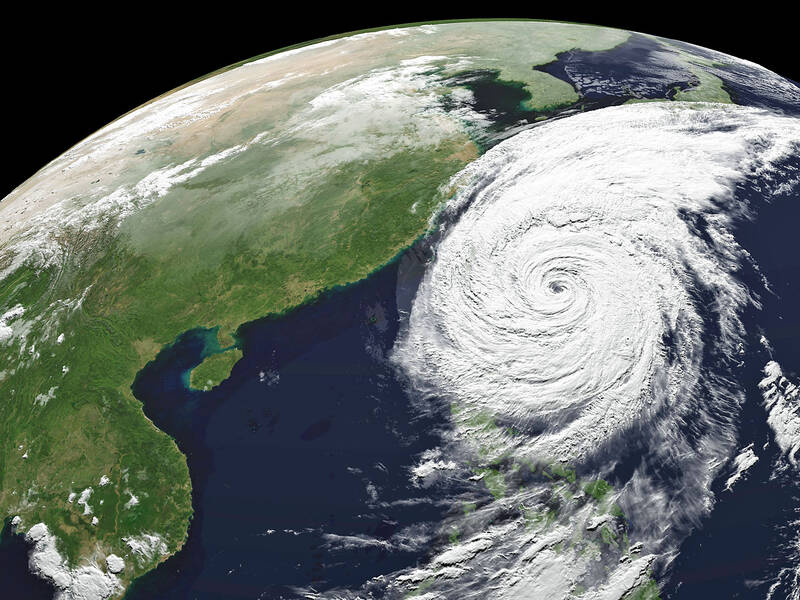
I got to Taipei on Wednesday afternoon, and I had a free day yesterday. Today is the day my tour of Taipei was supposed to begin. But Typhoon Champi had other plans for my group. I am hunkered down in my hotel as most all of Taiwan has canceled school and work today.
I visited three museums yesterday. They were not what I was expecting or hoping for, but there was at least a little something of interest in each of them. And last night I went to an excellent concert by the National Symphony Orchestra. More about all that later.
Lucky (or unlucky) for you, this storm means I have plenty of time to write a detailed history of Taiwan before I tell you about my day yesterday.
Taiwan History
Some things I have just learned:
Taiwan is not China
Historically, Taiwan was not part of China. Indigenous people lived here for over 5,000 years before Chinese and Japanese traders visited.
The Dutch East India Company established the first permanent colony on the island in 1624. They brought farmers and laborers from China to Taiwan. Around the same time, Han Chinese pirate-merchants established settlements along the western coast.
After the Qing dynasty overthrew the Ming dynasty in China in 1644, Ming loyalists came to Taiwan. In 1662 they overthrew the Dutch and expelled them. They established the first ethnic Chinese government on the island, the Kingdom of Tungning.
Taiwan is China
In 1683 the Qing dynasty defeated the Tungning kingdom and annexed Taiwan. Throughout the 18th and 19th centuries, the Chinese presence on Taiwan grew, overwhelming and assimilating the indigenous population through intermarriage and land displacement. In 1887 Taiwan was elevated to full status as a province of China. By that time, the vast majority of the island’s population was ethnically Han Chinese.
Taiwan is not China
In 1894–1895, Japan and China engaged in the First Sino-Japanese War for control of Korea. Japan won decisively, and China ceded Taiwan. But the Chinese inhabitants resisted, declaring an independent Republic of Formosa on May 23, 1895. Japan overthrew that government in October, and Taiwan became a Japanese colony.
Back on the mainland, Sun Yat-sen established the Republic of China in 1912 following the Xinhai Revolution (also known as the 1911 Revolution), which overthrew the Qing dynasty. (You’ve seen The Last Emperor?)
In 1927 the Kuomintang (KMT), ruling party of the ROC, led by Chiang Kai-shek, initiated a purge against the Chinese Communist Party (CCP), led by Mao Zedong. This began a protracted Civil War. The KMT and CCP formed an uneasy truce in 1937 to fight against Japan in World War II.
Taiwan is China
After Japan’s defeat in 1945, Taiwan once again became part of the Republic of China (ROC). The ROC was a founding member of the United Nations. But the Kuomintang (KMT) government and military suffered from widespread embezzlement, extortion, and appointment based on personal loyalty rather than competence, and Chiang Kai-shek did little to rein it in.
Full-scale Civil War between the KMT and the CCP had resumed immediately after the war. Mao’s army engaged in guerilla warfare, and the nationalists were unable to respond successfully.
Is Taiwan China?
In 1949, the CCP forced the KMT to retreat to Taiwan, and Mao declared the founding of the People’s Republic of China. No peace treaty or armistice was ever signed, leaving the political status of Taiwan in limbo to this day.
In 1971 the United Nations General Assembly passed Resolution 2758, which recognized the People’s Republic of China (PRC) as the only legitimate representative of China to the UN.
Today, only twelve countries in the world have formal diplomatic relations with the Republic of China.
228
Yesterday I visited the Taipei 228 Memorial Museum, and I learned about something I’d never heard of before.
During fifty years of Japanese rule, the Taiwanese people experienced economic development and an increased standard of living. Nevertheless, KMT troops were broadly welcomed when they arrived in Taiwan. But the KMT’s corruption quickly led to discontent. The KMT set up state-run monopolies of most industries, leading to a large black market. They producers to sell them commodities on the cheap and then shipped those commodities to mainland China to meet the Civil War shortages. There the government sold them at a very high profit, furthering the general shortage of goods in Taiwan. By January 1947, the price of rice rose to 400 times the price at the end of the war.
On February 27, 1947, the Tobacco Monopoly Bureau’s enforcement team confiscated contraband cigarettes from a 40-year-old widow named Lin Jiang-mai at a Taipei teahouse. When she demanded their return, one of the men struck her in the head with the butt of his gun. Locals challenged the enforcers, forcing them to flee. One of the agents fired a warning shot that accidentally hit a bystander, who later died.
The next day, 2/28, a crowd surrounded a local police station, demanding that the shooter be punished. Large demonstrations broke out. Soldiers opened fire, killing several protestors. The situation quickly spiraled out of control.
Some demonstrators seized the Taiwan Radio Station and broadcast messagines condeming government brutality, calling on the people to Taiwan to rise up. (The headquarters of the Taiwan Radio Station is now the location of the 228 Memorial Museum.)
Martial Law
At 3pm on February 28, a temporary martial law was declared. On March 1, Chen Yi, the governor of Taiwan, announced measures to address the situation: punishing the perpetrators, providing relief to victims, lifting martial law, and establishing a special committee to investigate the incident. But at the same time, he secretly sent telegrams to Chiang Kai-shek requesting troop reinforcement.
On March 7, Wang Tien-teng, a member of the Taiwan Provincial Assembly, broadcast nationwide to explain the truth of the 228 Incident and outline 32 Demands, aiming to resolve the political tension. A few days later, he was arrested, interrogated and tortured, and subsequently executed by military police.
An estimated 8,000 to 28,000 people were killed or disappeared in the immediate aftermath of the 228 Incident. And martial law continued in Taiwan until 1987. Known as the White Terror, between 3,000 and 4,500 people were executed, and approximately 140,000 to 200,000 people were imprisoned or detained in those 39 years.
Transition to democracy
Taiwan’s transition to democracy began with the formation of the Democratic Progressive Party (DPP) in 1986. With the lifting of martial law on July 15, 1987, came the removal of bans on new political parties and independent newspapers. New elections of the entire legislative body came in 1991 and 1992, and the first ever direct presidential election took place in 1996.
Today the Economist Group ranks Taiwan 15th out of 167 countries, and 1st in Asia, on the EIU Democracy Index.
My Day in Taipei
As I mentioned before I was rudely interrupted by my history report, I visited three museums yesterday. In addition to the 228 Memorial Museum, I went to the Taipei Fine Arts Museum and the National Taiwan Museum. I was hoping to see some art.
TFAM
At the TFAM, the art I saw was weird. There was nothing I recognized as art.
I understand that the definitely of art is broad, but when I go to a museum, I like to see work that is beautiful or, if not beautiful, then evocative or provocative.
What I saw at TFAM was none of those things. I wish I could tell you what it all was, but it’s hard to describe. Lots of strange video, lots of weird installations, and one thing where someone gave me a card and a hole punch, and after I punched holes in the card I passed them through a music box to make musical sounds.
There was an exhibit called Wang Yahui: Voyager, a retrospective of work by Taiwanese artist Wang Yahui (1973–2023). Here’s what the museum’s website says about her work:
Wang was known for transforming subtle observations of daily spaces and nuances of everyday experiences into imagined scenes, with low-tech methods or handcrafted props. Her work blended the abstract with the concrete, the material with the immaterial, the three-dimensional with the two-dimensional, the real with the illusory, and the temporal with the spatial, expanding viewers’ perceptions from microcosmic details to cosmic scales through a poetic lens.
I don’t know what any of that means. But if it was meant to expand my perceptions, I’m sorry to say it failed. I guess my perceptions are stuck in microcosmic details.
My two favorite works at the TFAM were out in front.


NTM
The NTM was good if you like that kind of museum. It was more about natural history than anything else, though there was some cultural history as well.
I just don’t have much interest in history museums. I love history, but I prefer to read it at home. Standing and reading and looking at artifacts that aren’t in themselves particularly beautiful or evocative or provocative isn’t interesting to me. And my back hurts when I stand for a long time, so if I’m going to spend hours at a museum, I want it to satisfy me aesthetically.

There were a few pieces in the museum I did enjoy seeing. They’re in my photo album.
National Symphony Orchestra
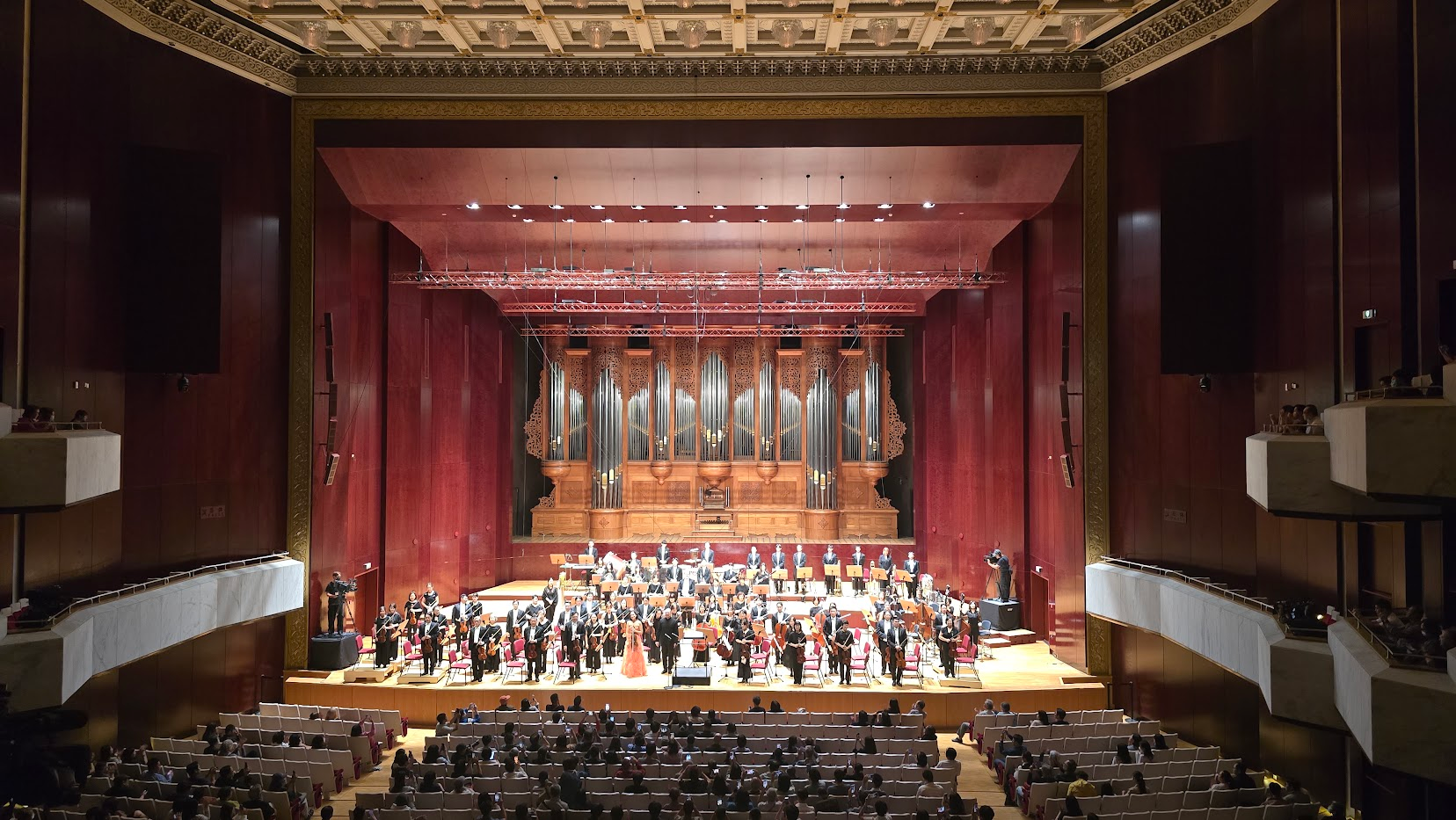
The highlight of my day yesterday was the concert I attended by the National Symphony Orchestra. They play in a beautiful concert hall.

The program was Britten’s Young Person’s Guide to the Orchestra; Haydn’s Symphony No. 94 in G, “Surprise”; Zhe-Yu Yang’s A Dialogue between Wind and Poetry (One-minute Symphony Project, world premiere); and Britten’s Violin Concerto. The orchestra played very well, and the violinist, Viviane Hagner, was excellent. But as you can see from the photo at the top of the page, the attendance was very sparse. I asked Alexis, our trip leader, about this. I thought maybe it was the weather that kept people away. But he said there’s just not great interest in symphonic music from the public in Taipei. Sad to have a fine orchestra play to such a small audience.
Well I think that’s enough. I’m going to walk over to 7‑Eleven to get something to drink and then watch some Netflix.