
Mauritius by boat, plus a day of rest and a smidgen of history
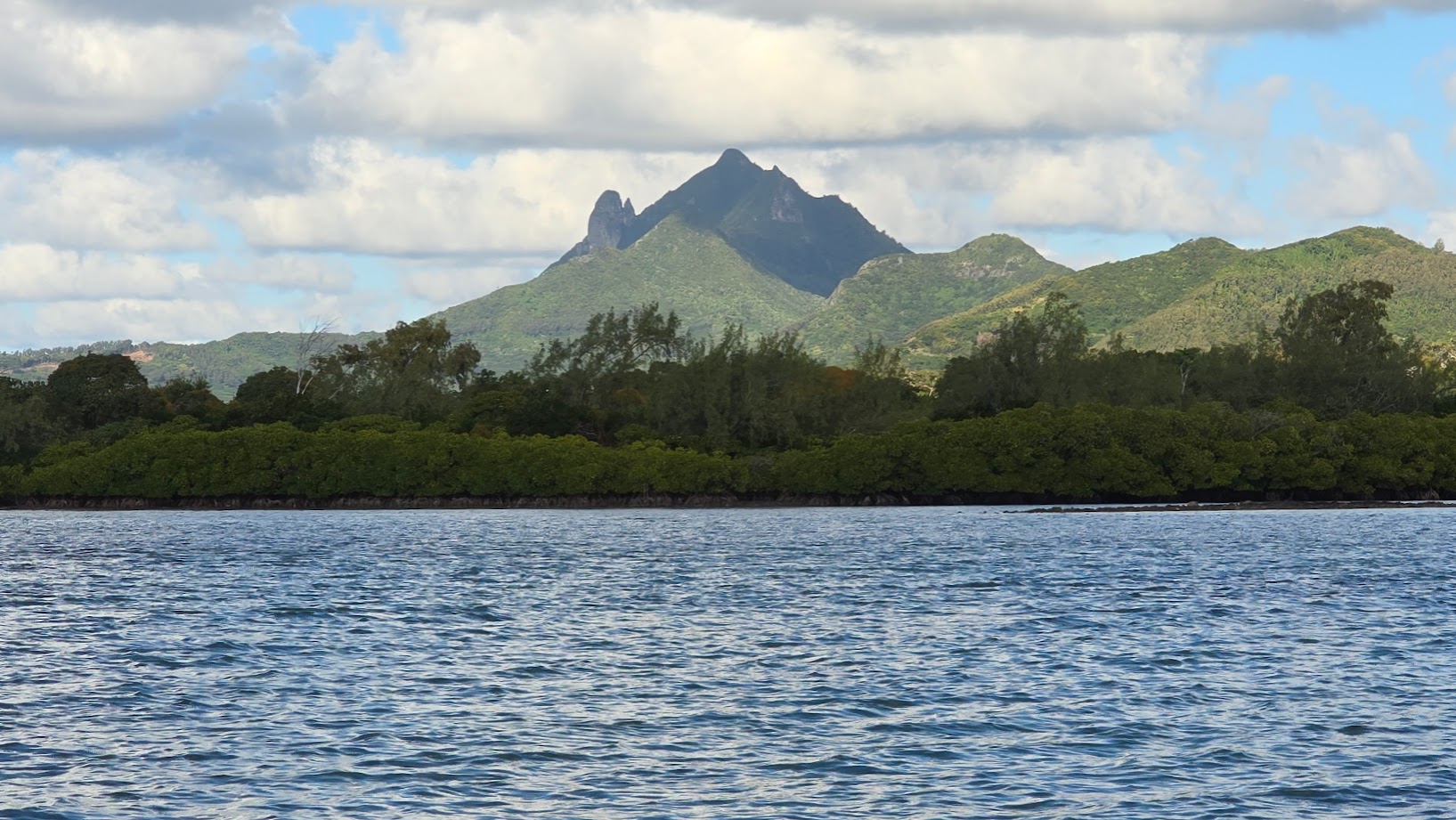
My last two days in Mauritius included a day of rest, a speedboat tour of neaerby islands, and a visit to Aapravasi Ghat. I sorely needed the day of rest. Seeing Mauritius by boat was definitely worth doing. Aapravasi Ghat gave me a welcome dose of history.
I have nothing much to say about my rest day. I spent it sitting outside or, when the mosquitoes became too annoying, in my hotel room. In the afternoon I took a walk on the beach, and I think I had two naps over the course of the day. And I ended up the day with my favorite dinner in Mauritius, a lamb curry at a small eatery called Sindra Snack a few blocks from my hotel.

Five Islands
I booked this tour based on reviews and because I read that the area where they do snorkeling is some of the best in Mauritius. And the tour was enjoyable, but the snorkeling was disappointing. Perhaps it’s just the way it is that the world’s coral is bleached and broken. And there also weren’t a whole lot of fish, and none that were particularly colorful. The same thing was true at the Great Barrier Reef in 2024. But the good news is that the water was crystal clear, so it was fun swimming among the fish that were there.
I enjoyed visiting the islands. Ile aux Cerfs had a nice beach; I think it’s a very popular place to spend the day for folks who have more than four days in Mauritius. There are eateries, lots of lounge chairs and umbrellas set up, and a craft market.

Lighthouse Island
Ile au Phare (Lighthouse Island) has a lighthouse. Go figure. I guess if an island is named Lighthouse Island, someone is obligated to build a lighthouse there. The British did in 1864. It supported ships entering a nearby port. But in the early 20th century they moved all shipping to Port Louis, on the other side of the island, and they abandoned the lighthouse here.
(Actually, the official name of the island is Ile aux Fouquets, named for the fouquet or wedge-tailed shearwater that is resident on the island. But I didn’t see any fouquets. Just a lighthouse.)


Two more islands
We didn’t actually go onto the next two islands, Ile de la Passe and Ile aux Aigrettes. We stopped for snorkeling and swimming (and drinking rum, a favorite beverage on an island that produces so much sugar). Then we entered the mouth of the Grand River South East (GRSE) to see a waterfall and some monkeys.


One more island
The fifth island on the Five Island Tour was Ilot Mangenie, where we had a BBQ lunch.
One of the reviews I read said there were just five of them on a nine-passenger boat. I thought it would be nice to have a small group. But it turned out we had 18 on a 19-passenger boat. Half were French and the rest were mostly British. I’m pretty sure I was the only American. But with such a large group, it was hard to get to know everyone.
Aapravasi Ghat
My flight to Réunion was not until 4:30 yesterday afternoon. I had a driver arranged, and I asked ahead of time if we could stop at Aapravasi Ghat, a UNESCO World Heritage Site. When I was in Port Louis last Friday, we drove right past it but didn’t stop.
The word “ghat” comes from Sanskrit, and in India it refers to a broad flight of stairs leading down to a riverbank. For years Aapravasi Ghat was known as “Coolie Ghat,” but the name was changed in 1989 because of the derogatory connotation of the former name. “Aapravasi” is the Hindi word for “immigrant.”
The Grand Experiment
After the British abolished slavery across its colonies in 1834, they tried a “Grand Experiment”: contract laborers brought in to work in the sugar plantations. Because it was so successful in Mauritius, they implemented it across their colonies, and it continued into the 1920s. About 462,000 indentured laborers came to Mauritius. The vast majority came from India, but some also came from China, the Comoros, Madagascar, Mozambique, Southeast Asia, and Yemen. Some 70% of the population of Mauritius today are descendants of people who arrived at Aapravasi Ghat.
There’s an excellent museum describing the history, the poor conditions under which they worked, and the low wages they earned. In many senses, it was not much better than the slavery system in replaced. Many came with hope for a better future, or were deceived about what life would be like. The workers were under contract, and breaking the contract was not possible. If they missed one day of work, they were docked four day’s pay. Not all were treated so harshly; conditions varied from one sugar plantation to the next, and many employers were fairer and more humane.
Because of the success of the Grand Experiment in Mauritius, the indenture system expanded around the globe. A total of 2.2 million immigrants came as indentured servants to the Caribbean, South America, Southeast Asia, and the South Pacific.


All my photos from Mauritius are in my album.
I’m in Réunion now. I’ll be back with stories and photos from here.
Sleep
Still not going well. Waking up early early early. I hope I get back on track before I get to Madagascar.
Loved the history lesson, Lane!
What a beautiful place. I can see why you wish you had stayed longer.
Thank you! Keep enjoying your travels.