
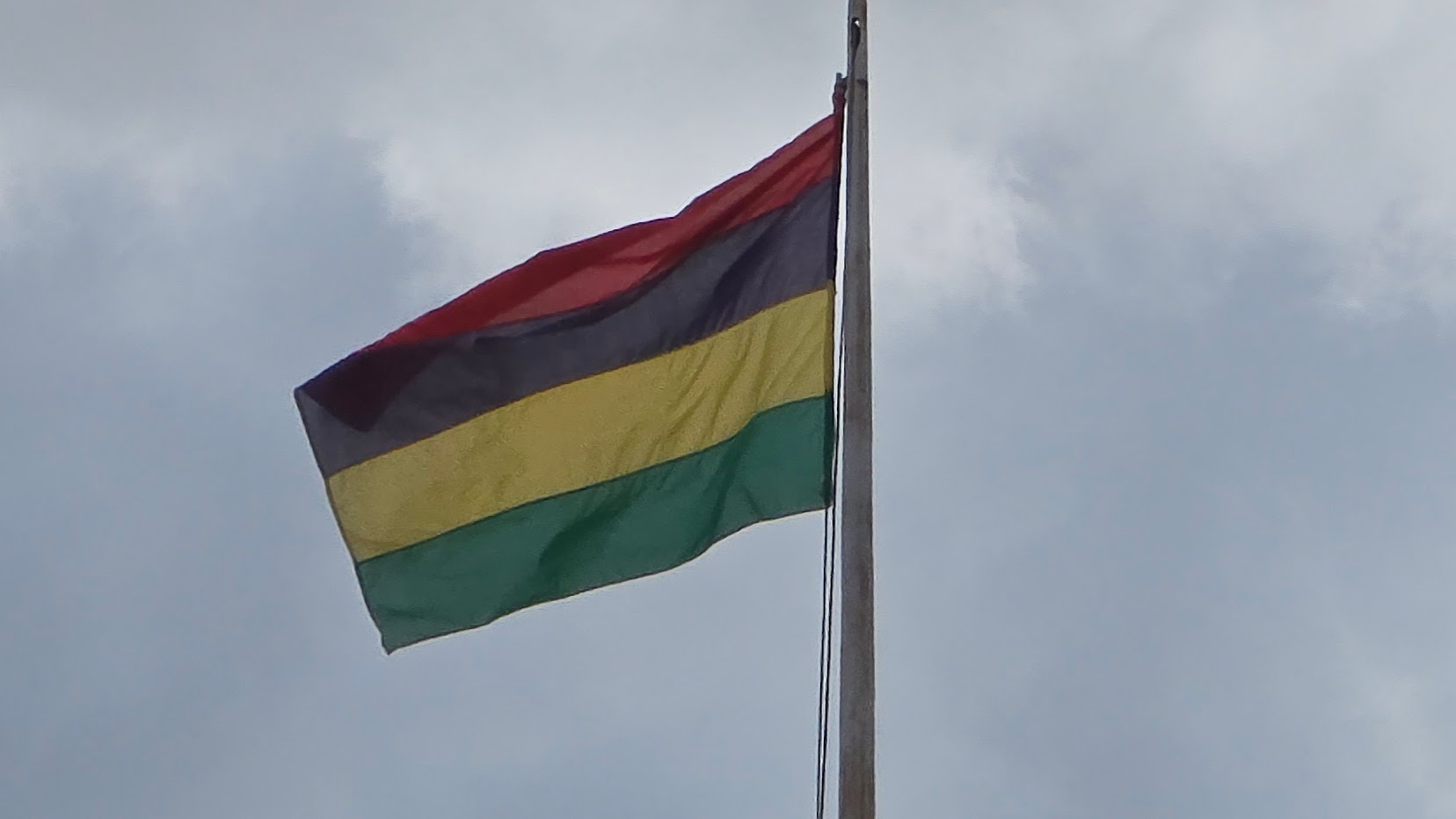
Mauritius: “The North” and “The South”
Mauritius is small enough that you can drive from one side or one end to the other in about an hour. And based on the road signs I’ve seen, it is divided into two zones: “The North” and “The South.”
On Friday I had a tour of “The North.” (The hotel where I’m staying is also in The North.) And on Saturday I toured “The South.” My driver/guide for both days was Swaraj. (He was more a driver and less a guide, but that’s fine.) Here it is a roundup.

The North
Port Louis
I’ve seen it written with and without a hyphen, and I wondered why, so I looked it up. Depends if you’re reading French or English. It’s hyphenated in French.
Port Louis is the capital of Mauritius, and it sits on the northwest coast. It is also the major port. It’s where slaves arrived to support the sugar industry, and after slavery was abolished, where indentured servants arrived. It’s where sugar was (and is) exported, and where virtually everything from cars to household products arrives.
My driver for the day, Swaraj, picked me up at my hotel and we drove about 45 minutes to arrive in Port Louis.
Port Louis has a population of about 140,000. (The entire country’s population is about 1.3 million.) Swaraj told me about 100,000 people who live outside the city commute in every day. Aside from being the center of government, it is also the main commercial, economic, and industrial hub of Mauritius.
The Citadel
Our first stop was The Citadel, officially Fort Adelaide. Swaraj told me the French built it to protect against the British. But that would place it in the 18th century, and it really didn’t look like an 18th-century fortress. So I looked it up, and it turns out the British built it in the 1830s to protect against the French. In the end, though, they never used it in any military action. Today it serves mainly as a viewpoint.


Caudan Waterfront
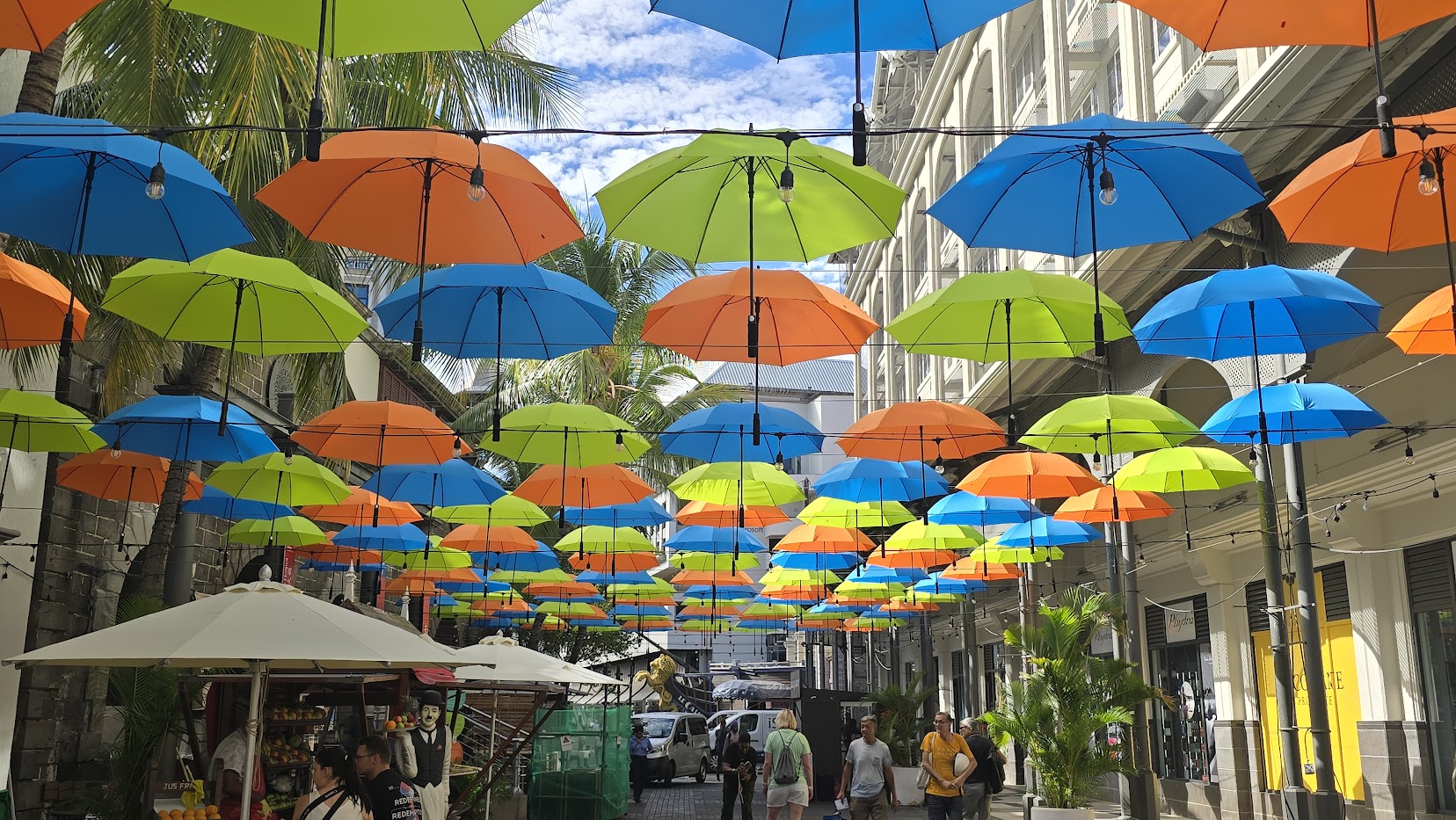
From there we drove through the heart of the city to the Caudan Waterfront. I would have enjoyed wandering around the city, but that didn’t happen. I did enjoy the waterfront, though. It was previously the commercial port, but that moved further out in the harbor in 1980. Then in 1996 they opened this shopping and dining (and touristy) complex that was actually very pleasant. Swaraj gave me time to wander around on my own, and I enjoyed the craft market, which actually had some handmade crafts in addition to the usual t‑shirts and refrigerator magnets. I bought a little dodo made from sheets of copper; the artisan was there working so I knew “made in Japan” didn’t apply. I also bought a painting on silk, also directly from the artist.




Central Market
Like almost all the markets I’ve ever visited, this one has a vast array of fruits and vegetables, many of which are unfamiliar to me, and some of which are so familiar they seem out of place halfway around the world. It seems apples are available everywhere, including at Port Louis’ Central Market, but they certainly don’t grow them in Mauritius.


8000 Mauritian rupees, by the way, is about $170 USD. They’re actually 80.00, or $1.70 per kilo.


Sir Seewoosagur Ramgoolam Botanical Garden
Sir Seewoosagur Ramgoolam was the first Prime Minister of the Republic of Mauritius. He is considered the nation’s founding father. The airport is also named after him.
The Botanical Garden is heavy on green and light on color. I’m not sure if that is seasonal; this is winter here. Though the difference in temperature between winter and summer is minimal.
Swaraj dropped me off and waited in the car, and I spent a little over an hour wandering through the park.


There were also some critters at the Botanical Garden.


L’Aventure du Sucre
The Dutch introduced sugar cane here in the 17th century, and it became the lifeblood of the island. Still today the crop covers about one third of the island.
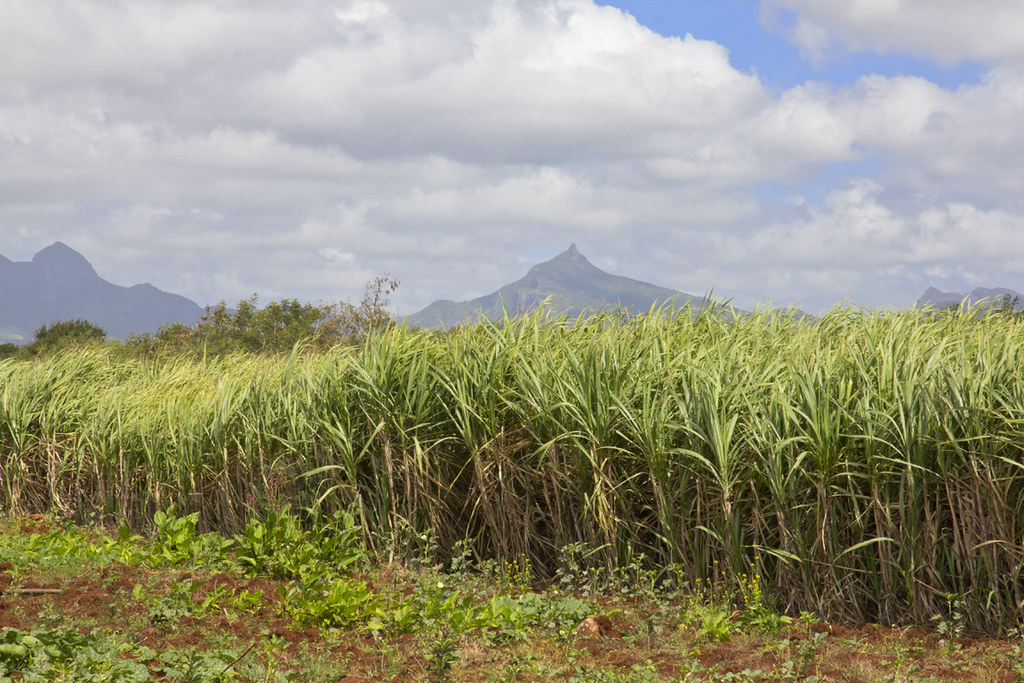
At its peak in the mid-19th century, there were 288 sugar factories on the island. Today there are just 3, primarily because smaller family estates merged into more efficient, large-scale commercial facilities.
One of the former factories has been turned into a museum about sugar, and that was the next stop on my tour of “The North.” L’Aventure du Sucre occupies the former Beau Plan factory, which began operations in 1797 and closed in 1999. The displays describe the history of the sugar industry on Mauritius. In addition, they talk about sugar farming, processing, refining, commerce, and environmental impacts. There is a lot about how slavery was part and parcel of Mauritian sugar farming under the Dutch and the French, and how the plantations adapted after the British abolished slavery in 1833.
In fact, though I started out reading everything, it wasn’t long before I suffered from information overload. I think there’s only so much a person can read and understand about any topic on day two of vacation. It was interesting, but a bit much. I was happy to get to the sugar tasting and the rum tasting at the end.

The Red Roof Church
At the northern tip of Mauritius is Cap Malheureux (Unfortunate Cape). It is so named because various maritime accidents took place in the treacherous waters.
I’m not sure why, but they didn’t ever build a lighthouse here. Instead they built a church with a bright red roof. Makes sense!

End of the tour
I got back to the hotel in time for sunset, which was much prettier than the night before.

The South
Trou aux Cerf
This volcanic crater is about 300–350 meters in diameter and 80 meters deep. It formed about 2 million years ago, and last erupted about 700,000 years ago. Though it is dormant, experts say it could become active again anytime in the next thousand years, so hurry up and come see it before it’s too late.

Vallé Advenature Park
This geo park offers ways to visit via quad bike, zip line, or walking. I opted for the walking trail, having already done quad biking (in Scotland) and zip lining (in Mexico). This gave me time at my leisure to enjoy the scenery and the nature in the park. Swaraj dropped me off and waited in the car.
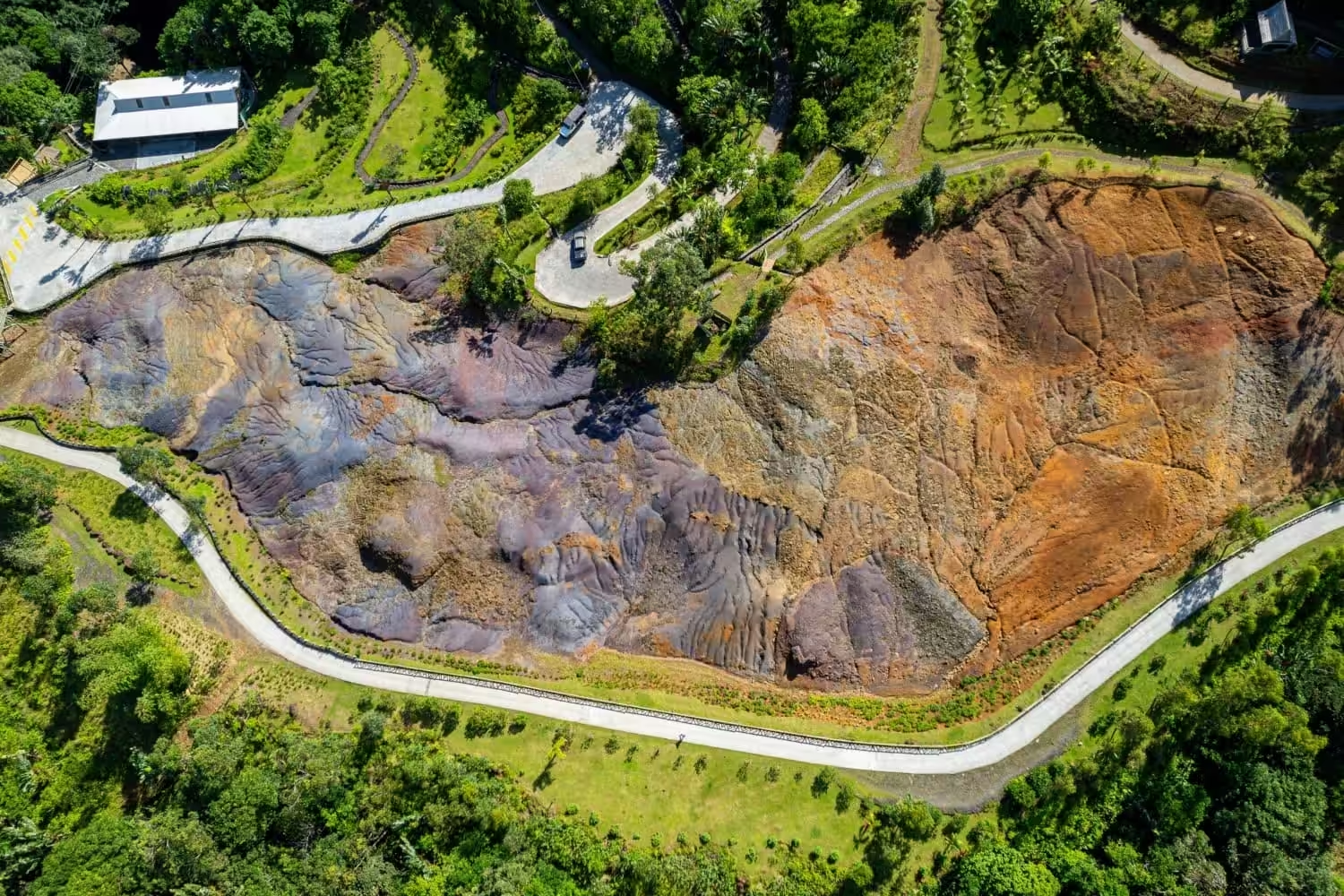
There were several waterfalls and some interesting plants, including more flowers than were at the Botanical Gardens. But what I was most eagerly anticipating, was the 23 coloured earth. And that turned out to be much less colorful than I expected.


Black River Gorges National Park
The next few stops were in this large park. I really should have given myself more time in Mauritius, because there are a lot of hiking trails through this park (and all around the island). I really only got to see a few of the highlights.
The Black River (so named because of the black volcanic rock along its course, although Swaraj told me it’s named for the escaped black slaves who hid here) runs from here to the west coast, for a distance of just 12 km. It cuts a deep gorge through the volcanic rock, and our first stop was a viewpoint.

The other stop was at Alexandra Falls. The falls themselves were not very dramatic, as there hasn’t been much rainfall lately.


Ganga Talao
The largest Hindu temple in Mauritius is Ganga Talao, or Grand Bassin. It gets its name from a volcanic lake that is considered sacred for the large Hindu population (about half of the entire population of Mauritius). We stopped here and Swaraj showed me the various statues of Hindu gods.

This is Shiva, the god of destruction. This is an important pilgrimage site for local Hindus. They come here for Maha Shivaratri, which takes place over several days in February or March. It is the largest Hindu pilgrimage outside of India, drawing hundreds of thousands of devotees who walk from all over the island to the sacred crater lake.

This is Blue Shiva. He turned blue because he consumed a deadly poison called Halahala to save the universe during the churning of the cosmic ocean. Behind him is the sacred lake, Ganga Talao. Someone (or probably many someones) brought back water from the Ganges and poured it into this lake.
Sleep
I was optimistic after my first night of sleep here, but the last two nights have not gone well. I’ve fallen asleep early, woken up very early, and been unable to get back to sleep. I’ve taken naps in the afternoon. I’m hoping I will get back on schedule in the next few days.
Photos
I’ve added lots of pics to my album. What’s posted here is just a small sampling. Check them out!
Next up
Tomorrow is my last full day in Mauritius. I have a very early start, heading over to the west side of the island for a boating and snorkeling excursion.