
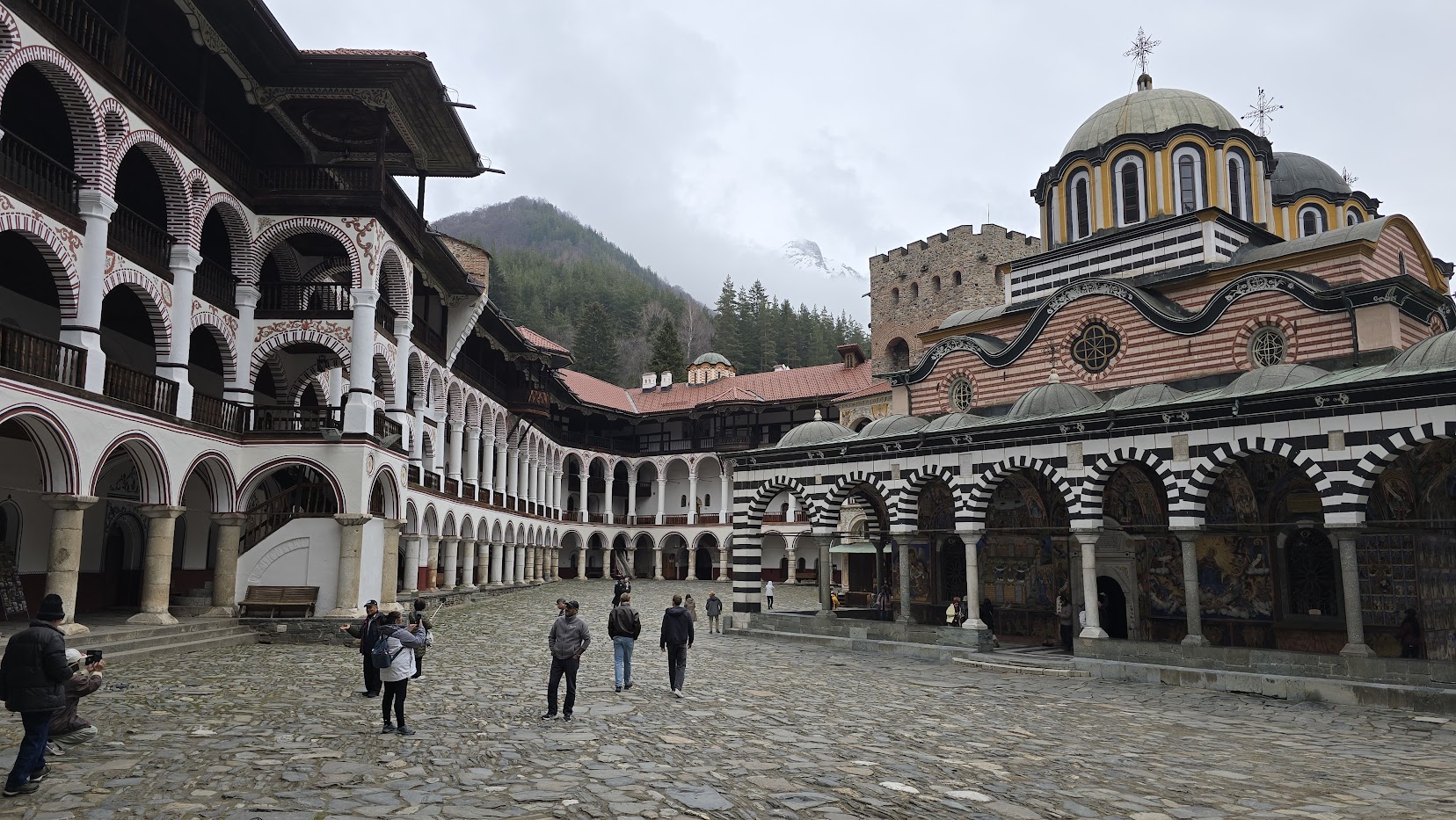
Rila Monastery
Yesterday we drove from Sofia to Rila Monastery, about two hours’ drive south of Sofia.
I think I have neglected to mention that it has been very cold. Walking around Sofia was brutal. And walking around the monastery was also brutal. I didn’t pack for really cold weather. I have layers (sweater and sweatshirt), but no hat and gloves. Even the people on the tour who were prepared for the cold were freezing. I think it’s been in the low 40s or maybe upper 30s (Farenheit), but with the wind it’s been a challenge.
Still, the monastery was a special place, and despite the cold, it was a great day.
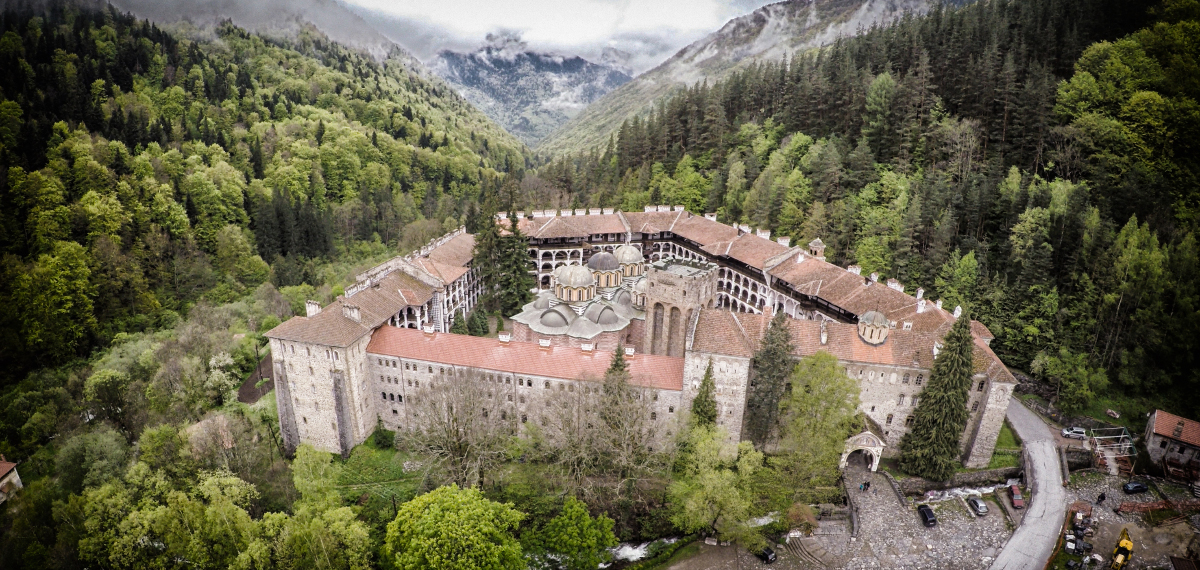
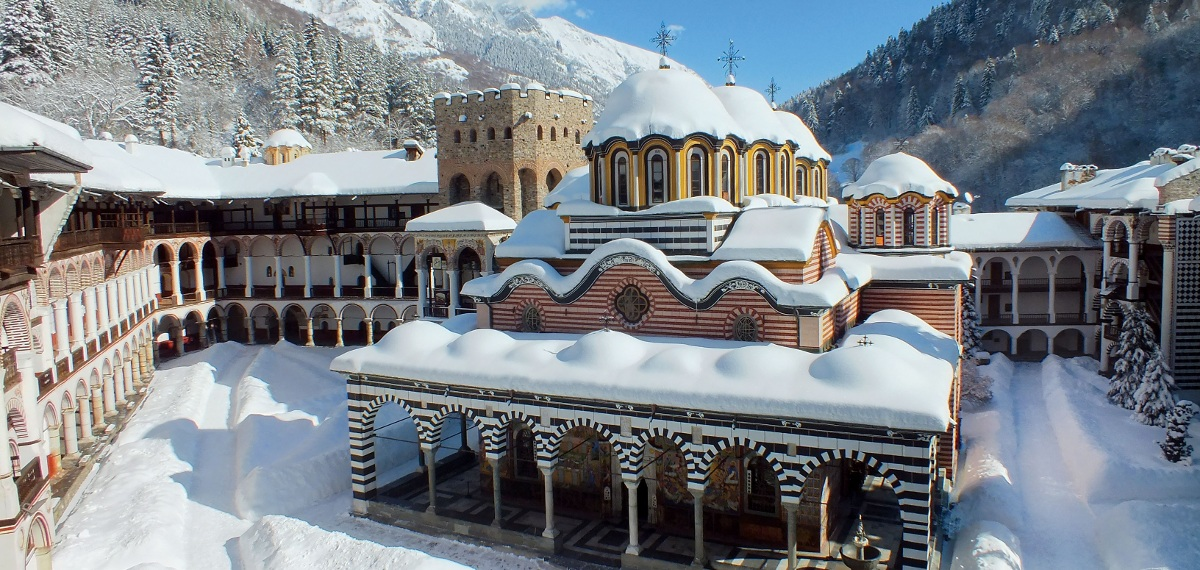
History
I always like to start with a little history. Here’s a plaque I found by one of the entrances to the monastery:
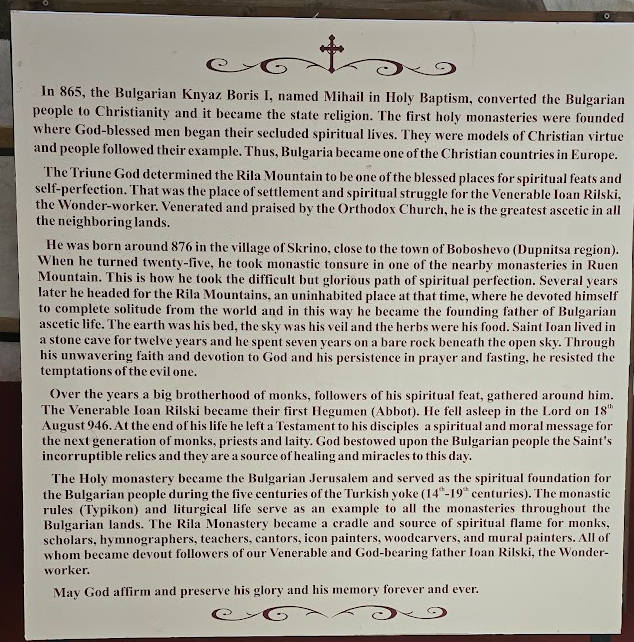
I was amused by the pious language, so I wrote a more objective “translation”:
In 865, the Bulgarian Knyaz (king) Boris I, named Mihail in Holy Baptism, converted the Bulgarian people to Christianity and it became the state religion. The first holy monasteries were founded where the new Christians began their secluded spiritual lives.
The Rila Mountain was selected as a holy place for spiritual feats and self-perfection. Ioan Rilski, “The Wonder-worker,” born around 876, got a monk’s haircut in one of the nearby monasteries and embarked on a path of spiritual perfection. Several years later he headed for the Rila Mountains, an uninhabited place at that time, and became a hermit. In this way he became the founding father of Bulgarian ascetic life. The earth was his bed, the sky was his veil and the herbs were his food.
Saint Ioan (John) lived in a stone cave for twelve years and he spent seven years on a bare rock beneath the open sky. Over the years a big brotherhood of monks, followers of his spiritual feat, gathered around him. Ioan Rilski became their first Hegumen (Abbot). He died on 18 August 946.
Rila Monastery became the Bulgarian Jerusalem and served as the spiritual foundation for the Bulgarian people during the five centuries of Ottoman rule (14th ‑19th centuries). Rila Monastery became a spiritual center for monks, scholars, hymnographers, teachers, cantors, icon painters, woodcarvers, and mural painters, all of whom became devout followers of Ioan Rilski.
In the nineteenth century the community at Rila Monastery grew to about 200 monks, plus supporting staff. Then in 1833 a fire destroyed the monastery. It was rebuilt between 1834 and 1862 with 300 rooms, but today only six monks still live there.
Rila Monastery was inscribed to the UNESCO World Heritage List in 1983.
Photos
Check out all my photos from our visit to the monastery.
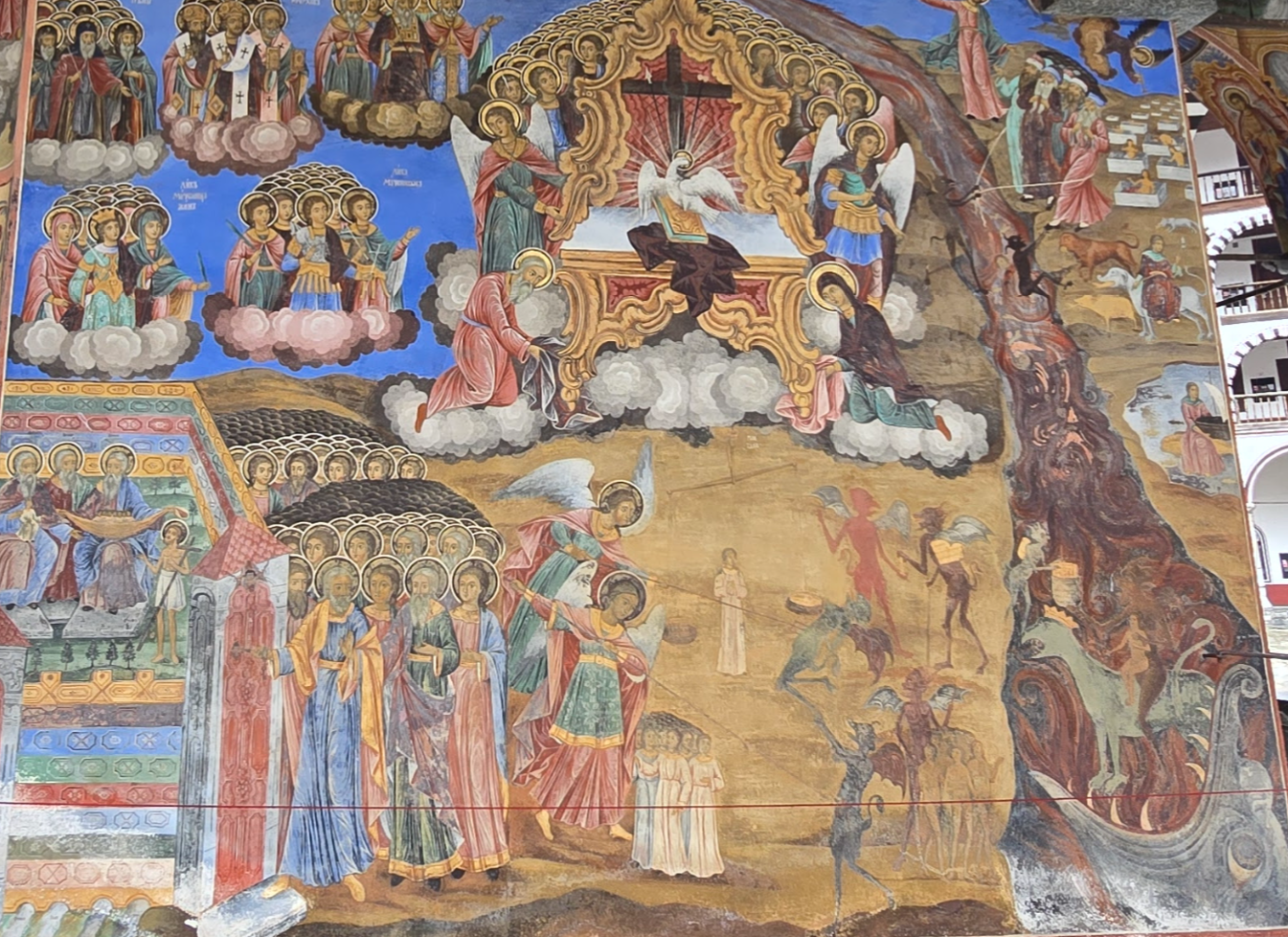
Here’s a small selection:




After the monastery
After we left the monastery, we stopped for lunch.

Then we stopped at a “Junk Museum” in the town of Kocherinovo.


It definitely lived up to its name.

Finally, we drove to Plovdiv, where we are spending two nights (last night and tonight). Today we will be exploring this historic city, one of the oldest in Europe. It’s still supposed to be cold, plus it’s drizzly. I think it’s finally going to warm up tomorrow, when we head to our final destination in Bulgaria before crossing into Romania.
I’ll be back to share my impressions and photos of Plovdiv.