
Khiva: Beautiful Inside and Out
My OAT trip leader said that the real beauty of Khiva can be found inside the buildings. But I can’t agree.
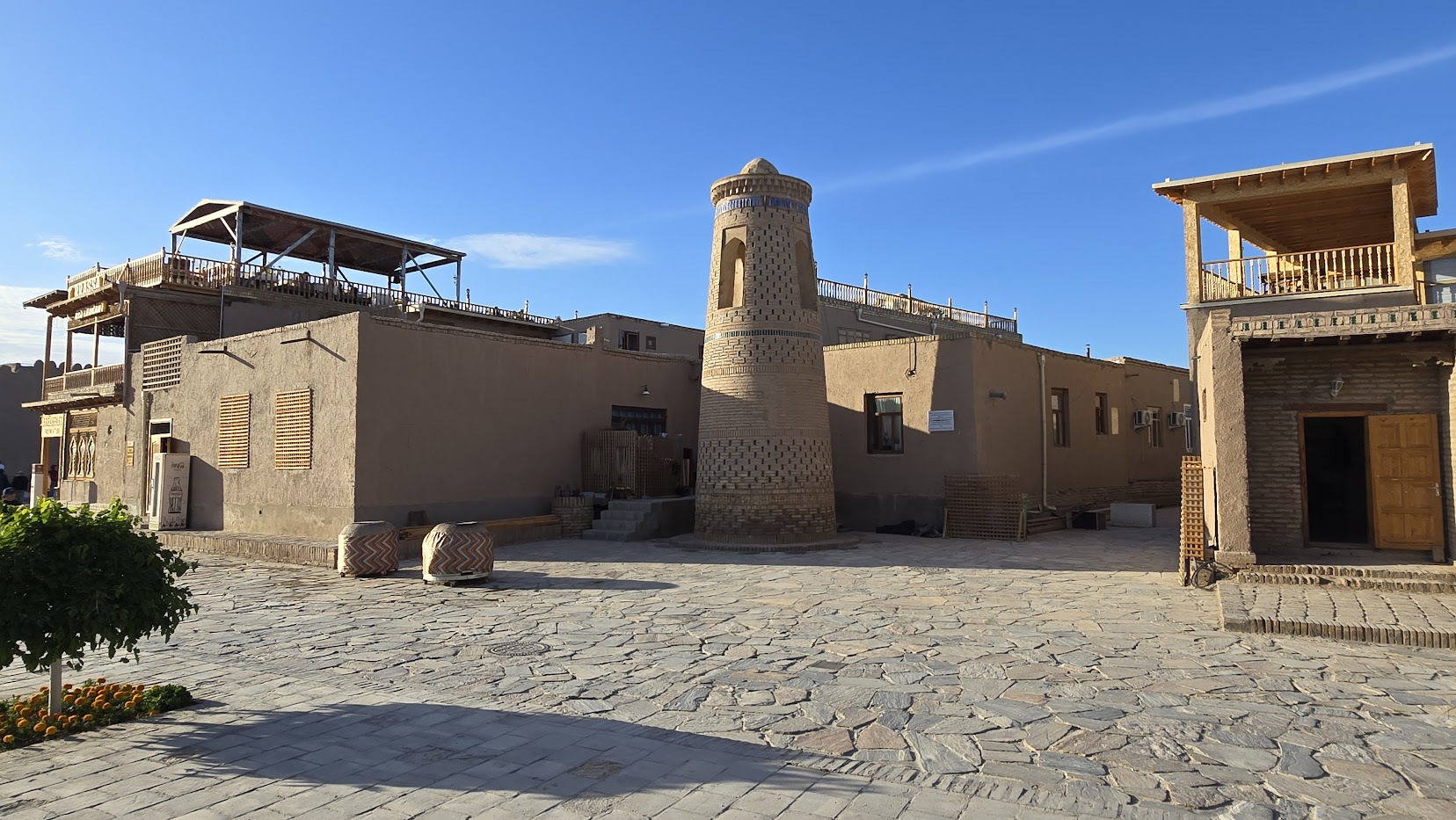
It’s true that entering many of the monuments reveals glorious, colorful tile work. And most of the exteriors are dull, monochromatic, adobe-like, and mud-colored. But for me, I’m not sure I didn’t appreciate the cityscape more than the brilliant decor. There is an effect achieved by the drabness that won me over before I entered a single building.
The Khiva Cityscape
I shouldn’t give the impression that Khiva is colorless from the outside. There are certainly splashes of color. But the color scheme is mostly of a town that arose from the desert sands that surround it.
Here’s what I fell in love with on our first walk through the walled old city of Khiva:


And at night, the feeling was the same.

Yesterday afternoon I climbed up to the watchtower on the city walls. The view from there offers the full effect:

This morning I took an early walk to enjoy some final impressions by the light just after sunrise. And I came away with the same feeling.


The colors of Khiva
Yesterday we had a tour that took us into the palaces, madrasas, mausoleums, mosques, and courtyards of the city. The colors are almost entirely blue and white, but it’s really amazing how the effect is almost kaleidoscopic after walking through the monochrome streets.


If you want to know what all these beautiful buildings are, I’ve included names and descriptions of some of them in my photo album. But for the most part, I think Khiva is a place to let go of names and descriptions. It’s a place to appreciate color, shape, light, shadow, and texture.

Wow, gorgeous Lane!
I agree that the outside buildings are so gorgeous. In fact, it was after seeing photos of Khiva online that I really became aware of Uzbekistan, and I think it was those photos that really made me push to visit there. Of course, I haven’t seen the inside of the buildings yet, except from your photos above, which are beautiful. Everything just looks wonderful.
I’m glad I have sparked a new bucket-list destination for you, Mardee!
Fantastic photos!