
A Day trip to Szentendre
I had six days in Budapest, and I filled the first five with tours and musical events and museum visits. I purposely left the sixth day open, and I still had some things I hadn’t yet done in Budapest. But it was a beautiful day, so I decided to take a train ride to the town of Szentendre, about 45 minutes north of Budapest along the Danube River.
It turned out to be a perfect way to spend my final day in Hungary.
Szentendre Artists’ Colony
Szentendre has been the home of generations of Hungarian artists since the early 20th century. The Szentendre Artists’ Colony, established in the 1920s, transformed the town into a hub for modern Hungarian art. Drawing inspiration from the Nagybánya tradition, it blended surrealist, constructivist, and non-figurative styles, focusing on local, natural, and built scenery.
Nagybánya, in what was then eastern Hungary, was the predecessor of Szentendre as an artists’ colony. Established in 1896, the Nagybánya Artists’ Colony was a center for Hungarian artists. But after World War I and the Treaty of Trianon, Nagybánya became part of Romania, and eventually the colony dissolved.
Szentendre Museums
I was in museum heaven during my visit to Szentendre. Three museums beckoned, and I spent a good bit of time in each of them.
Ferenczy Museum
The first museum, close to the train station, has an outstanding exhibition of works from many of the artists who lived and worked in Szentendre. It’s name is that of a family of artists, and some of their works were on display.
Károly Ferenczy (1862–1917) was born in Szentendre and was a founding member of the Nagybánya Artists’ Colony. While the focus at Nagybánya was plein air painting, his greatest works are his studio paintings.
Károly’s wife, Olga Fialka (1848–1930), was also a painter. After they married and started a family, she gave up her art. She remained in Nagybánya (later Baia Mare, Romania) until she died.
Károly and Olga’s three children were also artists, most notably Béni Ferenczy (1890–1967), who was a sculptor. His wife, Erszi, who lived until the age of 96 and died in 2000, founded this museum and donated much of the family’s work.
I only saw one work of Károly Ferenczy at the museum, but many more are available at the Wikipedia article about him. I really like them, so if you’ve enjoyed seeing the art I like you should enjoy checking them out.


The Fialkas (1874)
The subjects of the picture are her mother, Caroline von Fialka, née Hanslick, her brothers Zdeněk and Jaroslav, and her sister, Milada. Olga Fialka depicted herself at some distance from her family, in the right corner of the composition, engrossed in the act of painting.
I saw several of Béni’s sculptures, both in the museum and around the town.

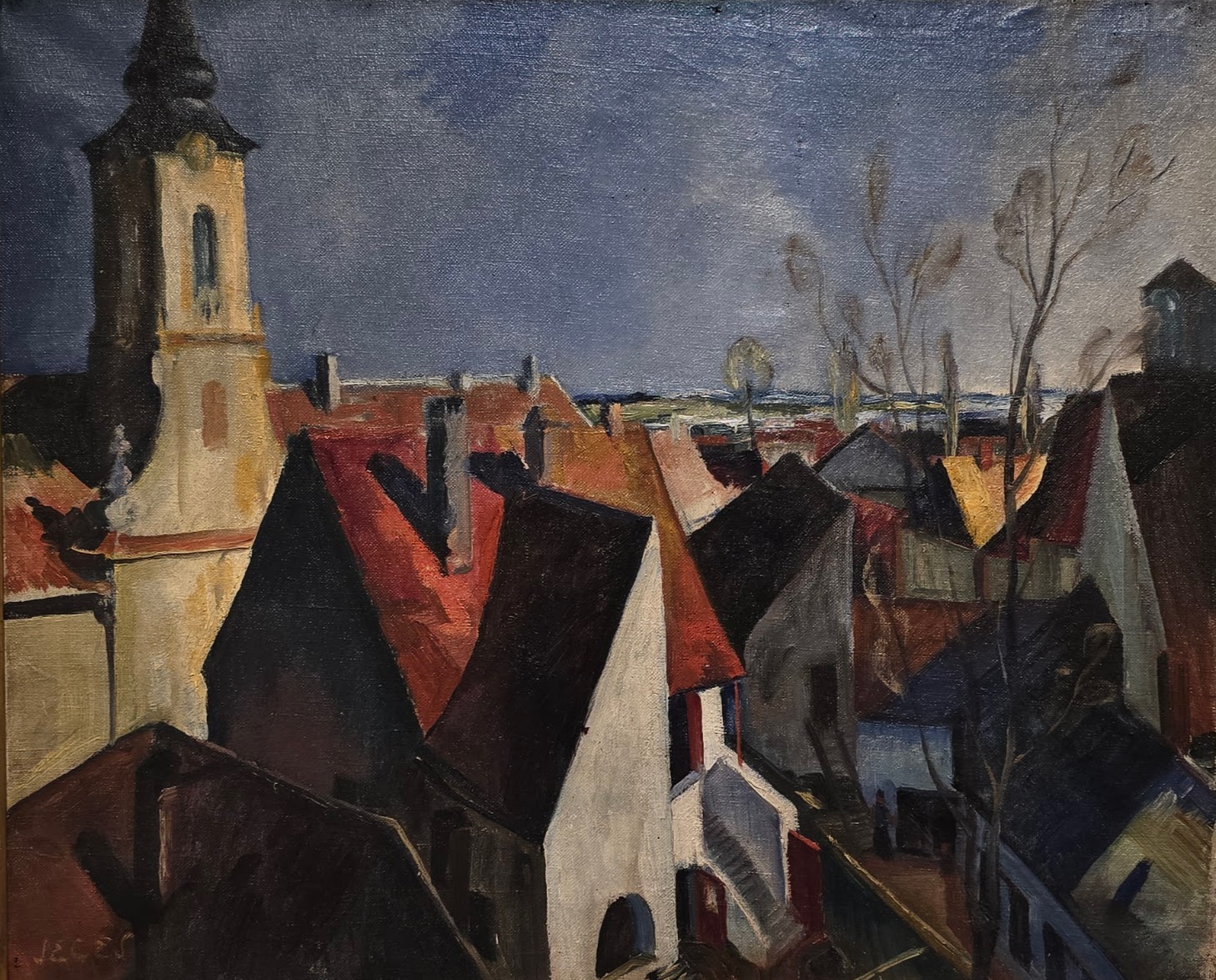
The photo at the top of the page, on display at this museum, is by Ernő Jeges (1898–1956). It’s called
View of Szentendre, from 1930. And it seems to be the same view as this picture I took (in 2026) while wandering around town.

Kmetty Museum
Another painter I discovered at the Ferenczy Museum was Jenő Barcsay (1900–1988).

But I had no idea until I hit the next museum that I’d have a great opportunity to get to know his work in depth. At the Kmetty Museum, right in the center of Szentendre, the exhibition is a retrospective of Barcsay’s work. Entitled “Structure from the View: Transformations of the landscape and the body in the art of Jenő Barcsay,” the exhibit “attempts to show the process in Jenő Barcsay’s work wherein the view becomes a structure, the organic turns geometric, and the contingent transforms into a consciously constructed order.”
To be fair, I’m not sure if I was able to identify that process by looking at Barcsay’s works. But there is clearly something geometric about them, and that really spoke to me.


Margit Kovács Ceramic Museum
The third museum was dedicated to the ceramic art of Margit Kovács (1902–1977). Though she lived and worked in Budapest, she started spending summers in Szentendre in the 1960s, and she helped establish the museum, donating the work displayed there.


I was especially intrigued by this last work, as it was inspired by a piece of the same name by Bela Bartok. I studied this piece while in grad school at the University of Colorado. It tells of nine brothers who go hunting and, upon crossing a magical bridge, are transformed into stags.
Szentendre (the town)
Other than the great art I got to see, I walked the entire length of Szentendre and enjoyed the views, the cityscape, and the shops.


All my photos from Szentendre, including lots more of the art I saw and lots more of the town, are here for you to enjoy. I hope you like it as much as I did.
We also enjoyed a day trip to Szentendre!