
Intro to Ulaanbaatar
I had a free day yesterday, so I used to to give myself an intro to Ulaanbaatar. And now I can give you an intro too!
This morning I will meet the other four people who are on the Mongolia pre-trip, and we’ll begin our tour. But yesterday I was on my own. I did meet our trip leader, Eric, who was hanging out in the hotel lobby. Eric’s real name is Uugan-Erdene, but he invited us to call him Eric, assumedly because we’d butcher his real name. And at breakfast yesterday I met a woman who is doing the same itinerary, but is on a different tour. She’s on the last day of the pre-trip, and she raved about her experience in Mongolia, so I’m very excited about the experiences that await.
National Art Gallery
I knew our hotel was close to the Mongolian National Art Gallery, but I didn’t realize how close. It’s literally right across the street.
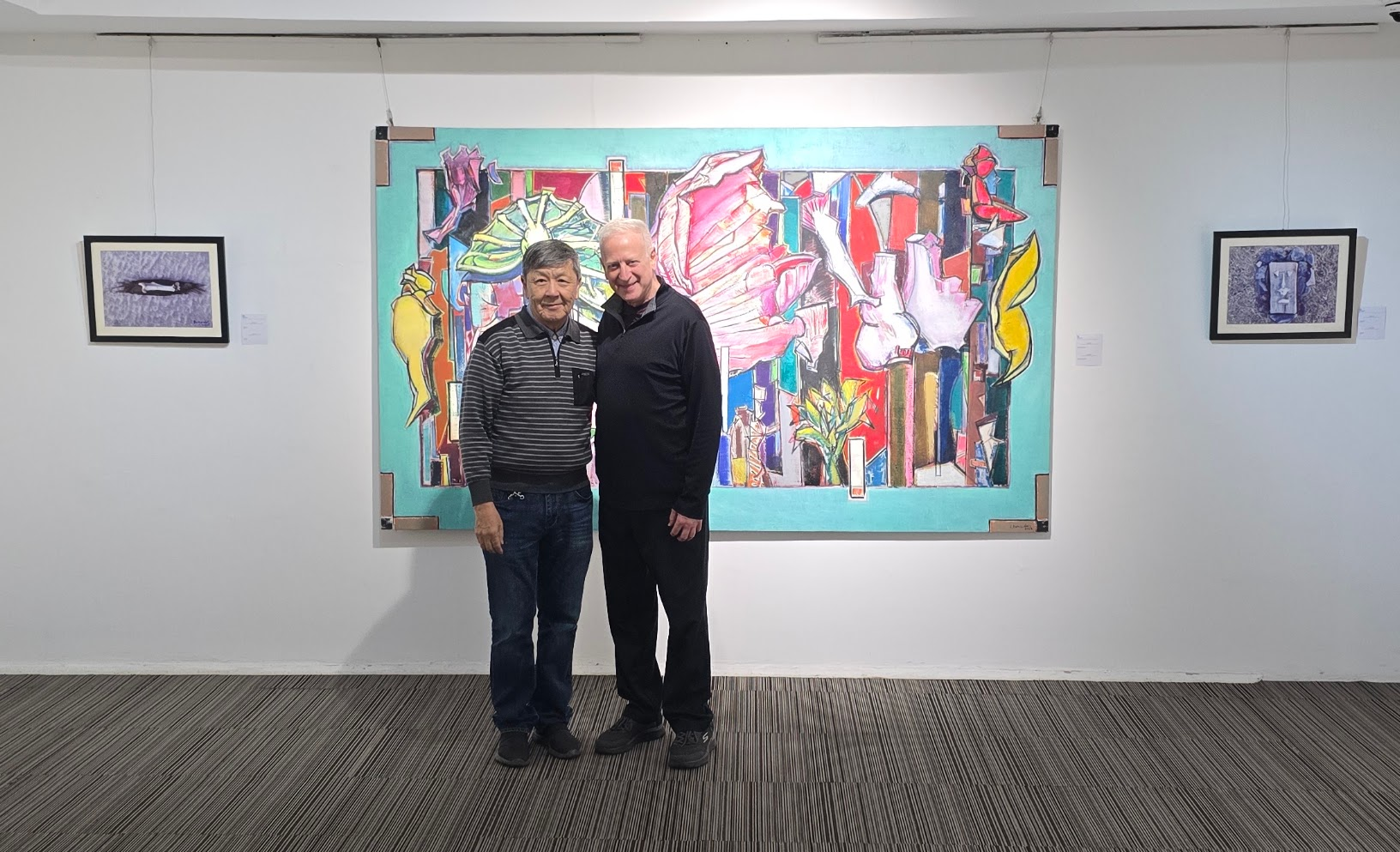
The collection is all Mongolian modern art. Before my visit yesterday morning, I couldn’t have named a single Mongolian artist. Now I can. I don’t think I could name more than one, because a lot of Mongolian names are long and unpronounceable. But I can name one, because I met him, and we’re already Facebook friends!
The collection at the National Art Gallery is pretty small. There are about 4,200 works in their collection, only a small fraction of which are on display. And much of the art I saw yesterday seemed to be special exhibits.
Mongol Zurag
The first exhibit I encountered was called Mongol Zurag. This distinctive form of Mongolian painting assimilates Buddhist art traditions and the techniques and craftsmanship of traditional artisans.
Mongol Zurag is characterized by its ability to incorporate multiple figures, objects, events, and spatial relationships within a single plane; its reliance on the refined rhythm of line and form; and its combination of vivid, saturated colors, ornamental patterns, and planar representation. At the same time, it employs artistic means to convey a sense of space, movement, and the passage of time. These characteristics have made it a particularly suitable artistic language for depicting Mongolia’s natural environment, everyday life, livestock, festivals and Naadam [Mongolia’s largest festival, comprising competition in wrestling, horse racing, and archery], family, labor, and traditional customs.
from the exhibit statement


Masterpieces of Mongolian Fine Art
The works in this exhibit were included in 1913 by the government of Mongolia on a “List of Precious and Unique Historical and Cultural Heritage Objects.” There were just a handful of paintings in the exhibit, and several of them really captured my heart.


Moment and Space
This exhibit was watercolors by Batmunkh Choijilnamsrai (1931–2015). I’m not usually a huge fan of watercolor, but some of these were really lovely, and they depicted the Mongolian landscape so beautifully. I was completely taken by them.
Here’s what was posted about the exhibit in the Gallery:
The watercolours of Ch. Batmunkh, Honored Artist of Mongolia, form a unique body of work that captures the vast landscapes of Mongolia and moments from the everyday life of its nomadic people. Watercolour is a demanding medium. Because the paint dries quickly, it requires the artist to work with great sensitivity and confidence. Batmunkh has mastered this medium with remarkable skill. A key feature of his technique is the classical alla prima method, in which colours are applied directly and blended in a single process, without repeated layering. He also makes effective use of the white surface of the paper as a source of light, giving his paintings a clear and transparent quality while creating a sense of depth.
Rather than simply copying the light and shadows he sees in nature, Batmunkh captures the atmosphere of a particular moment through subtle changes of colour. He conveys the moisture in the air, the strength of the wind, and the changing light of the landscape with great sensitivity.
Whether depicting horses at pasture, hayfields, or people on the move, these paintings reflect the artist’s keen eye for the simple and natural moments of everyday life. Through a few confident lines and delicate washes of colour, Batmunkh conveys both the quietness of nomadic life and the openness of the Mongolian landscape.

This is a mountain range in western Mongolia


Meaning “tent rock,” this formation is in eastern Mongolia.

“BUM ART”
This large exhibit comprised paintings (and a few other media) by Lkhagva Bumandorj. There was no artist’s statement and no information about him. But I really loved the work.


Ger districts in Ulaanbaatar are sprawling, low-density residential outskirts where over 60% of the capital’s population—around 840,000 residents—live in traditional felt yurts (gers) or self-built detached houses enclosed by wooden fences (khashaas). Reminds me of townships in South Africa or favelas in Brazil. According to Wikipedia, these districts have no running water or sewage, and since Ulaanbaatar is, on average, the coldest capital city in the world, they have to burn wood and coal to stay warm, causing severe pollution. It’s not as romantic as it appears in this painting and the untitled one above.


As I was admiring the works in this exhibit, a man came over to me and introduced himself as the artist. He spoke very little English, but better than my Mongolian. He did speak a German, and I recognized a few words as he tried to tell me a little about his work. After I finished my tour of the exhibit, I went back to ask him why there was no information about him or the exhibit. He called his manager, who speaks English, and put me on the phone with her, and I passed along my email address so she could send me his bio.
Lkhagva Bumandorj (b. 1954) is a distinguished Mongolian painter, graphic artist, educator, curator, and art administrator, with a career spanning more than four decades. He is regarded as an important figure in the development of contemporary Mongolian visual art and has played a significant role in both artistic practice and art education in Mongolia.
Bumandorj received his formal art education in Mongolia and later studied Graphic and Book Art in Leipzig, Germany, graduating in 1987. Throughout his career, he has combined traditional Mongolian artistic heritage with modern approaches to painting and graphic art. His work is characterized by a strong interest in Mongolian history, culture, landscape, and visual traditions, while also reflecting his experience with European and international art.
In addition to his own artistic practice, Bumandorj has made an important contribution to Mongolian art education and cultural institutions. He has served as a lecturer and art director, Rector, and Director of the School of Fine Arts at the Mongolian State University of Arts and Culture. Since 2013, he has worked as a consultant at the Mongolian National Gallery while continuing his independent artistic practice. He has also been the curator of BUM ART Gallery since 2016 and has served as Honorary President of LAM 360 Mongolian since 2019.
His artistic career has been recognized internationally. He has participated in numerous exhibitions in Mongolia, Europe, Asia, and the United States, and has presented several solo exhibitions, including Silk Road (2016), exhibitions in Daejeon, Hohhot and Changchun (2017), and Bum (2023). His major awards include the First Prize at the Berlin Triennale (1984), the Korean Grand Prix (1995), and the UMA Award (1999), among other distinctions.
For me, he represents a generation of Mongolian artists who have connected Mongolia’s traditional visual culture with broader international developments in modern and contemporary art. His long career as an artist, educator, curator, and cultural administrator makes him an especially significant figure within Mongolia’s art community.
It was a real thrill to meet him and to see his art.

The tour that wasn’t
After the Gallery I went back to the hotel lobby to meet Eric. We chatted for a bit, and I told him I had booked a tour of Narantuul Market in the afternoon. He said he was planning on taking us there during some of our free time, but I said I was okay seeing it twice.
I quickly grabbed a sandwich and coffee at a café and headed to the meeting spot.

Sükhbaatar (1893–1923) was founding leader of the Mongolian People’s Party and a key military commander in the 1921 Mongolian Revolution. I can actually see this out the window of my hotel room.
Unfortunately, I waited in vain, because my guide was a no-show. I contacted GetYourGuide, and after a quick chat with an AI bot who told me where I was supposed to meet my guide, it put me in touch with a real person who promised to issue me a refund. Since Eric will be taking us there later, it worked out fine.
A lot of people are averse to booking travel activities through aggregators like GetYourGuide, Viator, and WithLocals. But if I had booked this directly, there’s no telling how, if at all, I’d arrange a refund for a no-show.
Bogd Khaan Palace Museum
A few weeks ago Eric sent a sheet listing several suggested free-time activities. I went through his list and settled on the Bogd Khaan Palace Museum, about a half-hour walk.
History
I have to confess I know very little (essentially nothing) about Mongolian history, and going to this historical site without context was a bit of a folly. I enjoyed what I saw, but it made me realize I needed to get some of that missing context.
So thanks to Google Gemini, here’s what I have now learned:
Mongolia’s history spans thousands of years, defined by nomadic empires, the rise and fall of the Mongol Empire, and modern independence.
Ancient and Early Nomadic Tribes (Pre-1206)
- Xiongnu Empire (3rd Century BCE–1st Century CE): The first major nomadic confederation in the region, often in conflict with China’s Han Dynasty.
- Turkic Khaganates (6th–8th Century CE): Nomadic empires established by Turkic-speaking peoples across the Mongolian plateau.
- Uyghur and Khitan Empires (8th–12th Century): Successor states that controlled trade routes and developed early writing systems before fracturing into rival clans.
The Mongol Empire (1206–1368)
- Genghis Khan (1206): Temüjin united the warring Mongol tribes and took the title Genghis Khan, founding the Mongol Empire.
- Expansion: Under Genghis Khan and his successors, the empire grew into the largest contiguous land empire in human history, stretching from Eastern Europe to the Sea of Japan.
- Pax Mongolica: A period of secured trade, communication, and cultural exchange across Eurasia.
Post-Empire and Qing Rule (1368–1911)
- Northern Yuan Dynasty (1368–1635): After the Yuan Dynasty fell in China, Mongols retreated to their homeland, eventually splitting into western (Oirat) and eastern (Khalkha) factions.
- Manchu Control (Late 17th–Early 20th Century): Facing internal divisions and external pressures, Mongolian nobles submitted to the Manchu Qing Dynasty of China.
Modern Era (1911–Present)
- Independence and Revolution (1911–1921): Mongolia declared independence after the fall of the Qing Dynasty. It established a constitutional monarchy under a holy Buddhist leader, the Bogd Khan. But both White Russian (anti-Bolshevik) and Chinese armies attempted to occupy Mongolia.
- The 1921 Revolution: Led by Damdin Sükhbaatar, who sought help from the Soviet Red Army, revolutionaries successfully expelled foreign forces in July 1921 and established a permanent independent government.
- The Mongolian People’s Republic (1924–1990): When the Bogd Khan died in May 1924, Comintern (Communist International) agents and radicalized members of the MPP blocked the selection of a successor. Mongolia became the world’s second communist state. This era brought rapid modernization, industrialization, and high literacy rates, but it was also marked by severe Stalinist purges in the 1930s that destroyed hundreds of Buddhist monasteries and executed tens of thousands of citizens.
- The 1990 Democratic Revolution: Inspired by changes in Eastern Europe, peaceful hunger strikes and mass protests in Ulaanbaatar led to the resignation of the communist politburo without a single gunshot.
- Modern Democracy (1992–Present): Mongolia adopted a new constitution, established a multi-party democracy, and transitioned to a market economy. Today, it pursues a “Third Neighbor” foreign policy, balancing its relationships with its two massive neighbors, Russia and China, by building strong ties with nations like the US, Japan, and the EU.
During my walk to the Bogd Khaan Palace Museum, I saw all the signs of economic development in the form of modern highrises, big shopping plazas, and tons of new construction.

Interestingly, I didn’t see any of the blocky apartment buidings that are still a big part of the urban landscape in many of the former Communist capitals I’ve visited.
Bogd Khaan
Agvaan Luvsan Choijinnyam Danzan Vanchüg was born in Tibet in 1869. At the age of 4 he was identified as the newest incarnation of the Bogd Gegen, spiritual leader of Tibetan Buddhism Mongolia, and in 1874 he arrived in in Urga (modern day Ulaanbaatar).
He was pursuaded to lead the government of Mongolia in 1911, becoming Bogd Khaan. He lost power when the Chinese took control in 1919, but was allowed to remain as a figurehead until his death in 1924.
Bogd Khaan had four residences in Urga. The Communists destroyed three of them, but they allowed the Green Palace to remain, and it became Mongolia’s first museum in 1926.
The Green Palace
Most of what remains of the Green Palace are in the Buddhist style. But the Winter Palace had architects from Tsarist Russia, and its architecture is European, with Buddhist decorative elements tacked on.


We have one day as a group before heading to the Gobi Desert tomorrow, but then we’ll be back in Ulaanbaatar for four more days, so I should have plenty more to share. I’ve started a photo album with all the above and more, and I’ll be adding to it during my days in this city.
My first impressions of Ulaanbaatar are mixed. There so much new construction that feels generic and vaguely western, hiding much of what would have characterized this as a more exotic destination. We can blame the communists in part, since they destroyed a lot of the classical Buddhist architecture. But we also have to hold free-market economic development to account. Still, there are some hints of that hidden exotic character, and I think I will enjoy ferreting it out in the days ahead.