
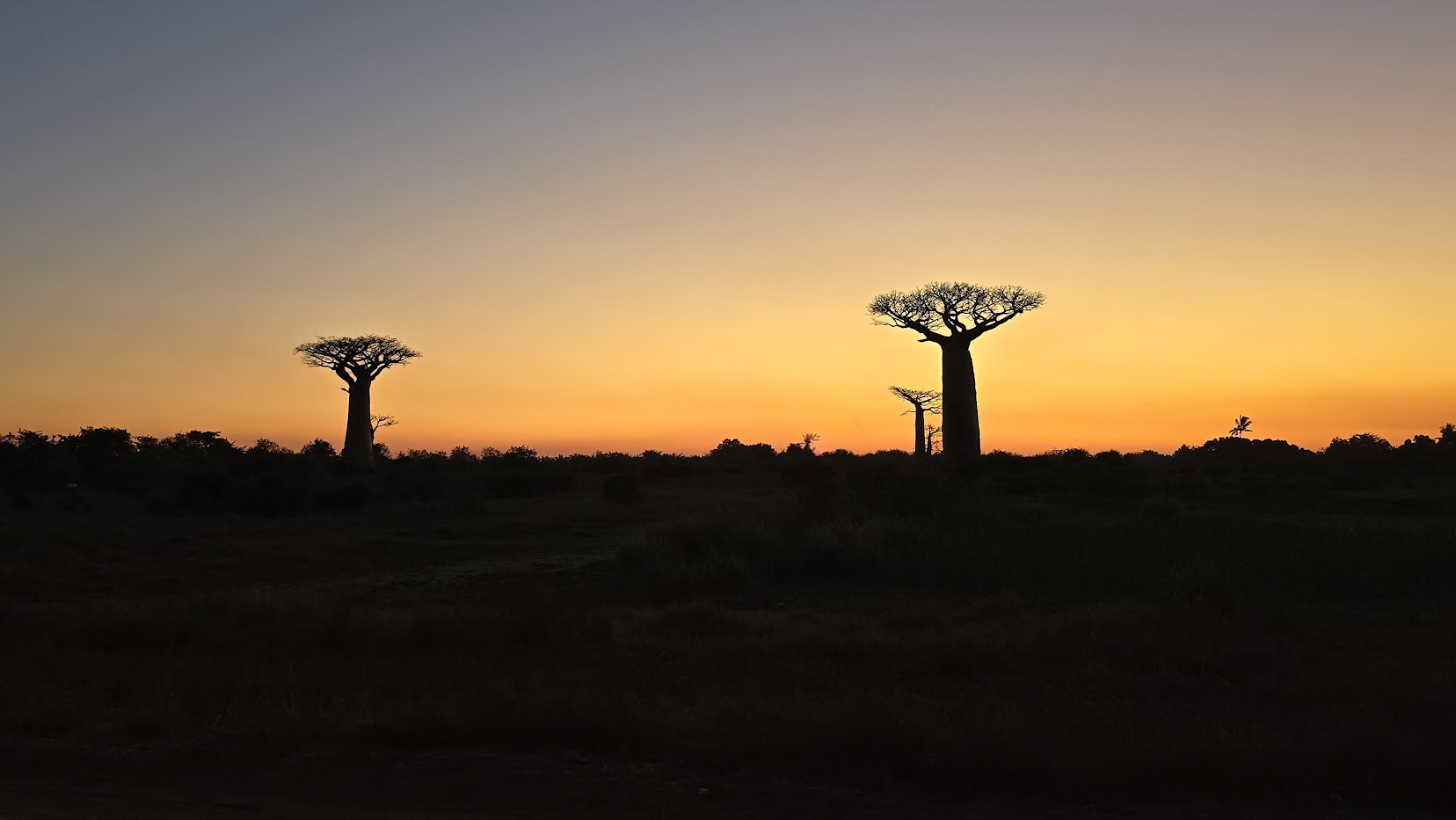
My last few days in Madagascar involved heading back down the “road” from Tsingy de Bemaraha National Park to Morondava. The long, bumpy drive included some nice encounter with baobabs, including the renownded sunset at the Avenue of the Baobabs. I already had several nice sunset experiences on this trip, including one with baobabs in Ifaty, but this still did not disappoint.
Back in Morondava, I had a full day to relax there at the beach, which I mostly spent going through the mountain of photos I took on this trip and trying to eliminate the ones that were less than spectacular. Alas, so many of them were spectacular. The task was monumental, and I don’t think I have succeeded. By rough count, after all the culling, I have somewhere north of 1,200 photos from this trip. I still need to create some highlights albums, but that will be so hard. I don’t know how I will pick the best photo of a diademed sifaka or a ring-tailed lemur or a sunset with baobabs. (Actually, I think my favorite sunset photo is the one above, and I took it further down the road after we left the Avenue of Baobabs.)
Where am I now?
I’m now flying Turkish Airlines from Istanbul to Mexico City, taking advantage of the free, unlimited, but slow wifi on board. I don’t sleep well on airplanes. I think I’ve gotten a couple of hours so far, and I’m going to try for some more before I get too far on this post. We still have six hours til arrival.
It’s a couple of hours later. I feel refreshed after a nap. 3 1/2 hours to go. Then I have an 8‑hour layover in Mexico City before my flight to Guadalajara. (Originally Turkish Airlines had an earlier flight from IST to MEX, but they canceled it. So I had a very long layover in IST, and this flight gets in too late to make my original flight to GDL.
Anyway, back to baobabs and the beach.
From Morondava to Tsingy de Bemaraha
It’s about 185 kilometers between Morondava and Tsingy. But there is no road. Just a dirt track that would be completely inaccessible to a normal car. It requires a 4x4 with a high ground clearance. Fortunately, our Toyota Land Cruiser was up to the task.
My flight from Antananarivo arrived in Morondava at 11:30, and because of the lack of a normal road, as well as two ferry crossings, our ETA at my hotel in Bekopaka, where the park entrance is located, was 7:30 pm. Hery, my driver, did an amazing job. He seemed to have the road memorized, knowing when it was possible to move at a clip and when he had to slow to a crawl.
We stopped at the Avenue of Baobabs, about a half-hour outside Morondava, and Annico and I got out and walked through. Hery met us at the far end. I took a few photos, but Annico promised I’d have more time on the way back.

To save time, Annico showed me the menu for a restaurant up the road a ways, and I preordered something to eat in the car. How I was supposed to eat in the car while we were bumping around like crazy, I didn’t know. And it turned out it wasn’t easy. I should have just ordered finger food. (Hery kindly slowed down for me during lunchtime. It helped a little.)
I tried to get a photo of some of the typically bumpy parts of the road. But they were too bumpy.
Ferry #1
The first ferry crossing was about the halfway point of the journey. When we arrived at the edge of the river, I got out of the car to wait while Hery loaded onto the ferry.

Several young men were waiting there, and they engaged me in conversation. They told me they like to come here to meet travelers and practice their English.

The Tsiribihina River isn’t very wide across, but we also had to travel downriver a ways. The crossing took a half hour. The boys rode with us and we continued the conversation. They live in Belo Tsiribihina, the town on the other side of the river, and the largest town we passed through on the drive.
They asked me where I’m from and how I like Madagascar. I asked them about their lives. Even though they are in their early 20s, they are still high school students. I asked if they would like to go to university, but there’s no money for that. They will probably stay in Belo and help on their families’ farms. But they said they are interested in tourism, and they asked Annico how long it takes to become a guide.
(Annico later told me he knows these boys; they ask him when he’s coming with travelers they can talk to. So they were waiting specifically for me.)
They asked me what is the main food of Mexico. I told them tacos. Now tell me, how do you explain tacos to people who have probably never eaten any composed dish? I first had to describe a tortilla. Then I asked them what their favorite foods were. Their answers: “rice,” “corn,” and “casava.”
Of all my experiences on this trip, nothing put my privilege into clearer focus than this.
Walking
After we arrived on the north side of the river, the boys said farewell and asked me when I’d be coming back through so they could chat with me again. I told them I’m staying three nights, and I hope I’ll see them after that. Then they started walking toward town.
It was a 4 km walk for them. For me, 4 km in the Land Cruiser. I asked Annico about how I constantly saw people walking along the roads, a long way from any city or town or village. He said this is how people get around. They might use a zebu cart to carry goods to or from a market, but otherwise, they walked. From a young age, girls learn to carry things on their head. Women might walk a long distance with a 20-liter container of water on their head, or a basket of fruit or vegetables. Men carry firewood on their shoulders. (Some men carry things on their head, but that is not typical.) Sometimes their journeys on foot last all day, or even several days.
Annico also told me how gender roles are very specific in Malagasy culture. Women perform domestic duties and tend gardens; men do more physical farmwork and take care of the zebus.


Belo

Belo Tsiribihina has a population around 70,000. Eighty percent of those work in farming and raising livestock. Ten percent are fishers. And the rest work in services in town. Because this is the midpoint of the drive between Morondava and Tsingy de Bemaraha, many of those services are tourism-related. This is a common stopping point on the drive. On the way back we stopped here for lunch.


The prices were also touristy, though still cheap by western standards. Annico and Hery did not eat here. They ate across the street at a place more popular with locals. They had rice and chickpeas. Annico told me he doesn’t feel like he’s eaten properly if he doesn’t have rice with just about every meal.
But this meal was on the return trip. On the way up, we stopped just once in Belo.

Here we picked up two armed uniformed officers who rode the rest of the way with us. They were for my protection, since we would be traveling after dark. Once again, I was reminded of my privilege. Here I was, traveling for pure personal enrichment, with my own entourage of driver, guide, and security team.
Ferry #2
The rest of the drive was still a long slog, and by the time we got to the Manambolo River for the second ferry crossing, it was dark. The Manambolo actually runs through the national park. At this point we were just a few kilometers from my hotel. And the ferry crossing was quick, straight across the river.

From Tsingy back to Morondava
We got an early start, 6:45, so that we’d be sure to get to the Avenue of Baobabs before sunset. Our gendarmerie contingent weren’t able to get a ride back to Belo, so we had them with us until there.

When we got to the Tsiribihina River, I looked for my buddies, but they were nowhere to be found. While we were waiting, a ferry came up from the other side of the river, and Annico saw them onboard that ferry. I told him I felt betrayed. Oh, the disloyalty!
It took a long while to get loaded onto the ferry. For some reason, they kept connecting ferries to other ferries. Then they had Hery move our car on, but then another ferry arrived, loaded with cars.

We next stopped at a forest of baobabs.

This didn’t used to be a forest of just baobabs. Farmers practicing slash-and-burn agriculture destroyed all the other trees. But baobabs are fire resistant, so they’re all that remains. I have to admit, it is a very pretty sight.

It’s a real problem for Madagascar, because it’s hard to convince people that it’s a bad practice when they are so poor and this is how they have been farming for generations. In fact, it’s been the practice for centuries, and this is why so many lemur species have gone extinct or are on the verge of extinction.
Sacred baobab
In the village of Kirindy we stopped to see a sacred baobab.
Traditionally, the Malagasy people believe that the soul never dies. Earlier on my trip I saw Mahafaly tombs, created so that the soul would have a place to dwell for eternity. Other ethnic groups believe that baobab trees are the dwelling places for their ancestors. The sacred baobab in Kirindy is, well, sacred. I’m not sure why it is more sacred than other baobabs. I think it may be older than other baobabs in the area.

Sadly, many of the oldest and largest baobabs in Madagascar are dying. You may have read about Tsitakakantsa, an estimated 1,200 years old, which is close to dying, the result of climate change, prolonged droughts, and fungal infections. That is located about 200 km south of Kirindy.
Baobab Amoureux
Our next stop, a short onward drive, was the Baobab Amoureux. I think you can guess why it’s called that.

There’s supposedly a legend that goes with this tree (or is it trees?):
According to a Malagasy legend told by the Sakalava people of the Menabe region, these trees were once two young lovers forbidden to unite by their rival families.
Determined to stay together despite the obstacles, they prayed to the gods—Zanahary, as the locals call them—to be reunited for eternity. Touched by their pure and sincere love, the gods transformed the young lovers into two baobab trees, their branches joining in an embrace meant to last forever. Since then, these majestic trees have been known as the Baobabs Amoureux, a symbol of indomitable love and eternal connection.
Today, the Loving Baobabs have become almost sacred to some visitors, and couples or newlyweds sometimes come to ask for blessings for their union and for a love that will endure through time.
https://www.vivytravel.com/do-you-know-the-legend-of-the-baobab-amoureux/
Avenue of Baobabs
We made it to the Avenue of Baobabs by around 4:30, giving us more than an hour before sunset.
While we waited, we visited a baobab nursery.

While we waited for sunset, Annico took me by a baobab nursery.

For 20,000 ariary (about $5 US), you can buy a baby baobab and plant it in the area. They will record the location and take care of it. And if you come back in ninety years, it will be about as tall as you are.
As sunset time approached, all the tourists gathered. I think there were more tourists there for that sunset than in all the rest of Madagascar combined!


I edited all the people out of this photo. I’m not sure why people were standing around on the road. You wouldn’t be able to see the sunset from there.
By 5:38, the sun was down and everyone drifted away. But as I said, my favorite photo was the one I took later, a kilometer or so down the road, up at the top of the page. That was at 5:55 pm.
Morondava
We arrived at my hotel in Morondava by 6:30, and I said goodbye to Annico and Hery.
Hotel Le Vezo Beach was very nice, and after the spartan accommodations up at Tsingy, I was glad for the higher level of comfort.
I didn’t do much in Morondava. Mostly sat outside to work on organizing photos. I did go for a walk on the beach and on the street around the hotel. There were several shops selling crafts — lots of wood carvings of lemurs and baobabs — but I didn’t buy anything.


The day slipped by, and somehow I completely forgot to check out my final Madagascar sunset over the Mozambique Channel.
The next day the hotel provided a ride to the airport, and I began my three-day journey home.
I actually have a photo album ready to share. And I’ll soon post links to all my photo albums from the entire trip.
This was the trip of a lifetime, and even though it’ll be good to get home, I’m never going to forget the lovely people, the fascinating wildlife, and the extraordinary beauty of Madagascar.
Leave a Reply