
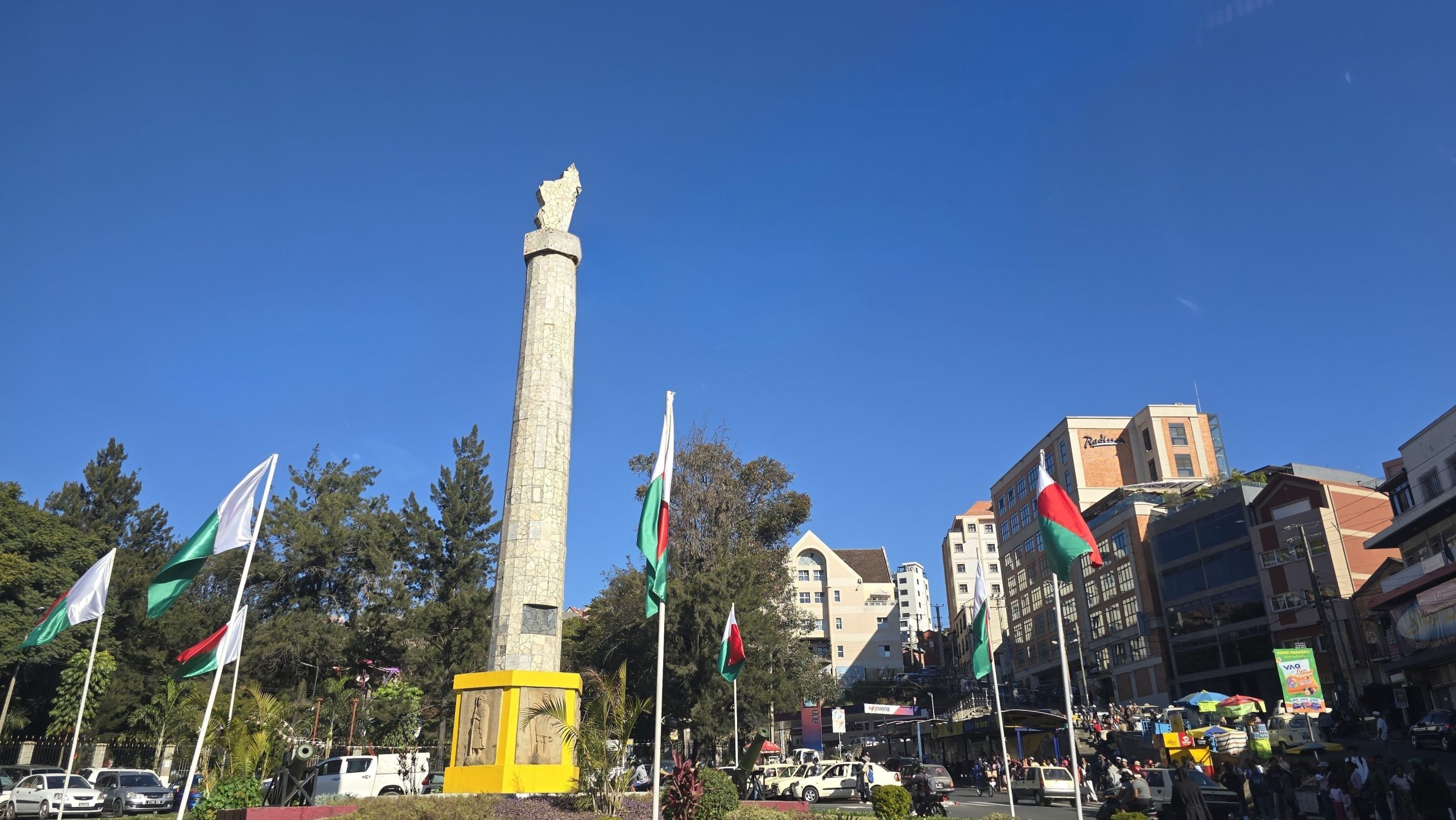
Madagascar Part Six: From the beach back to Antananarivo
After driving well over 1,000 kilometers, starting in Antananarivo two weeks ago, we’re back in the capital city once again. We flew from Toliara Airport in the afternoon after enjoying three leisurely days by the beach on Madagascar’s southwestern coast.
Today we did some touristy things here in Antananarivo, and this is the end of the Explore! tour. Tomorrow I fly to Morondava to start my private tour to Tsingy de Behamara National Park.
Flying here
There’s really not much to say about the flight on Madagascar Airlines. It took about an hour and a half, in a prop plane. I can tell you, though, that Madagascar has a lot of rivers. They kept catching my eye because the sun reflected off all of them.

I do have to mention, though, the airport experience at both Toliara and Ivato, here in Antananarivo. When we arrived at the airport, as soon as our driver opened the back of the van, four porters grabbed our bags out of the vehicle and carried them into the terminal, all of about 30 feet from curb to the check-in area. And they expected tips for this, of course.
After arriving, we carried our own bags out to the waiting van. When I got to the van, a porter literally grabbed my roller-bag out of my hand and lifted it into the back. More tip. I find this kind of thing one of the petty annoyances of travel in a third-world country, and I’m determined to avoid it tomorrow when I fly to Morondava.
Madagascar history
The main activity today was a visit to the UNESCO site at Ambohimanga. And this now provides a brilliant opportunity to do something I haven’t yet done during my visit to Madagascar: share some history!
The beginning
Madagascar was part of Gondwanda, the southern half of Pangaea. About 165–160 million years ago, Madagascar, along with the Indian subcontinent, Antarctica, and Australia, broke apart from Africa and drifted east. Then, around 125 million years ago, the Madagascar-India landmass and the Antarctica-Australia landmass separated. Finally, starting around 90 million years ago, India broke away and headed north, ramming into Asia and leaving Madagascar stranded in the Indian Ocean.
This, of course, explains why there are so many endemic plant and animal species on Madagascar.
There is some fossil evidence of human activity on Madagascar island as far back as 10,000 years ago. Humans probably visited the island from time to time, but there is no evidence of human settlement until, at the earliest, 500 BCE.
The Malagasy people, scholars believe, originated from across the Indian Ocean, from islands now part of Indonesia and Malaysia. Early settlers practiced slash-and-burn agriculture, destroying native forest to cultivate taro and rice. The result of this practice led to habitat loss and extinction of several endemic species, including giant lemurs, elephant birds, and the Malagasy hippopotamus, within the last 1,000 years.
Around the year 1000, newcomers to the island from mainland Africa introduced zebu, a species of domestic cattle with a fatty hump on their shoulders. Because of the need for pasture, much of what was once forest is now barren grassland. To this day, zebu are a major component of livestock farming in Madagascar.
Europeans
The first European to set foot on Madagascar was a Portuguese mariner who landed here in 1500, when his ship was blown off course in foul weather. But the Portugese had no interest in establishing a colony here (as they didn’t on Mauritius).
Throughout the 16th and 17th centuries, the English and the French tried — and failed — to establish colonies on Madagascar island. Disease, hostile climate, and hostile Malagasy were repeated causes of abandoned settlements.
Madagascar became a pirate stronghold at the end of the 17th and beginning of the 18th centuries. It also became a source of slaves, as European slave traders captured Malagasy people and brought them to Mauritius and Réunion to support the sugar cane plantations on those islands.
Kingdoms
As various local clans vied for dominance, they began to establish regional kingdoms throughout the central highlands of Madagascar. One of those kingdoms, Imerina (the kingdom of the Merina, Madagascar’s largest ethnic group), was ruled by Andrianampoinimerina (whose name means “the king in the heart of Imerina”) from 1787 until his death in 1810. He expanded his kingdom into neighboring territories, initiating a unification of Madagascar under Merina rule which continued under his successors.
Over the course of the 19th century, Madagascar transformed from a small local kingdom to a modern state, internationally recognized. In the 1820s the Malagasy language adopted the Latin alphabet. Some industrialization began in the 1830s. In 1864 in Antananarivo, a hospital and modern medical school opened. The first newspaper appeared in 1866. Madagascar signed a treaty of peace, friendship, and commerce with the United States in 1881.
The last three queens of the Merina Kingdom, in succession, married the Prime Minister, Rainilaiarivony, who ruled Madagascar behind the scenes. The last queen was Ranavolana III, who ruled until 1895.
French colonization
French colonists met continued resistance through the 18th century, but finally settled in Madagascar in the 19th. In 1885 Queen Ranavolana III signed a treaty with the French, granting them a protectorate over some neighboring islands and areas of far northern Madagascar island. But disagreement on the terms of the treaty led the French to invade in 1895. The following year Madagascar was established as a French colony. At first the queen remained as a figurehead, but after a rebellion in 1896–97, the French exiled her to Algeria.
The Malagasy people were not treated well by the French. Further uprisings took place in 1904-05 and 1947–49. The French responded brutally, committing serious atrocities such as mass executions, torture, rape, torching of entire villages, and throwing live prisoners out of airplanes.
Independence
In the 1950s the French instituted reforms and allowed the Malagasy people to transition toward independence. In 1958 the Malagasy Republic was established as an autonomous state, and in 1960 it became fully independent.
Madagascar’s path since then has been rocky. The anti-Communist government of the Malagasy Republic was forced out of power in 1972. The Second Republic adopted socialism, and the economy tanked. Didier Ratsiraka, who came to power in a 1975 coup, outlawed all political parties except his own, and he remained in power until 1992, when the country adopted a new, democratic constitution.
The first president of the Third Republic, Albert Zafy, moved Madagascar back to a free-market economy. But Zafy attempted to expand his power, and he was impeached in 1996. In the ensuing election, Ratsiraka was returned to the presidency. But opposition to Ratsiraka quickly grew, and he was defeated in the election of 2001. After disputing the election result, he was forced into exile in France. He was tried and convicted of embezzlement in absentia.
Since then, the transfer of power after subsequent elections has been anything but peaceful. Accusations of election fraud, attempted coups, impeachments and removals from office, and widespread protests against the government’s ongoing failure to improve economic conditions have been the story for the last 25 years.
Last September, frequent water and power outages led to violent protests during which 20 people died. The president was impeached and removed from office, and the military seized power. An army colonel, Michael Randrianirina, was sworn in as president on October 17.
The Economist Democracy Index ranks Madagascar at 88 out of 167 countries, a hybrid regime.
Royal Hill of Ambohimanga
With that out of the way, now I can write about Ambohimanga. But I have to report that it is now Saturday, a day later than when I started. I’m now in Bekopaka at L’Olympe du Bemaraha. I’ll write about this part of my trip in the next post. So let’s just pretend it’s still yesterday and I’m still in Antananavaro.
According to UNESCO,
The Royal Hill of Ambohimanga constitutes an exceptional witness to the civilization which developed in the ‘Hautes Terres Centrales’ in Madagascar between the 15th and 19th centuries and to the cultural and spiritual traditions, the cult of kings and ancestors which were closely associated there. The Royal Hill of Ambohimanga is the cradle of the kingdom and the dynasty that has made Madagascar a modern state, internationally acknowledged since 1817. It is associated with strong feelings of identity and emotion relating to the sacred nature of the site through its venerated royal tombs, its numerous holy places (fountains, sacred basins and woods, sacrificial stones) and its majestic royal trees. Religious capital and sacred town of the kingdom of Madagascar in the 19th century, the Royal Hill was the burial ground for its sovereigns. The site retains clear archaeological proof of the former exercise of power and justice. It is still today the centre of the religious practices for many Malagasy people and constitutes a living memory of the traditional religion.
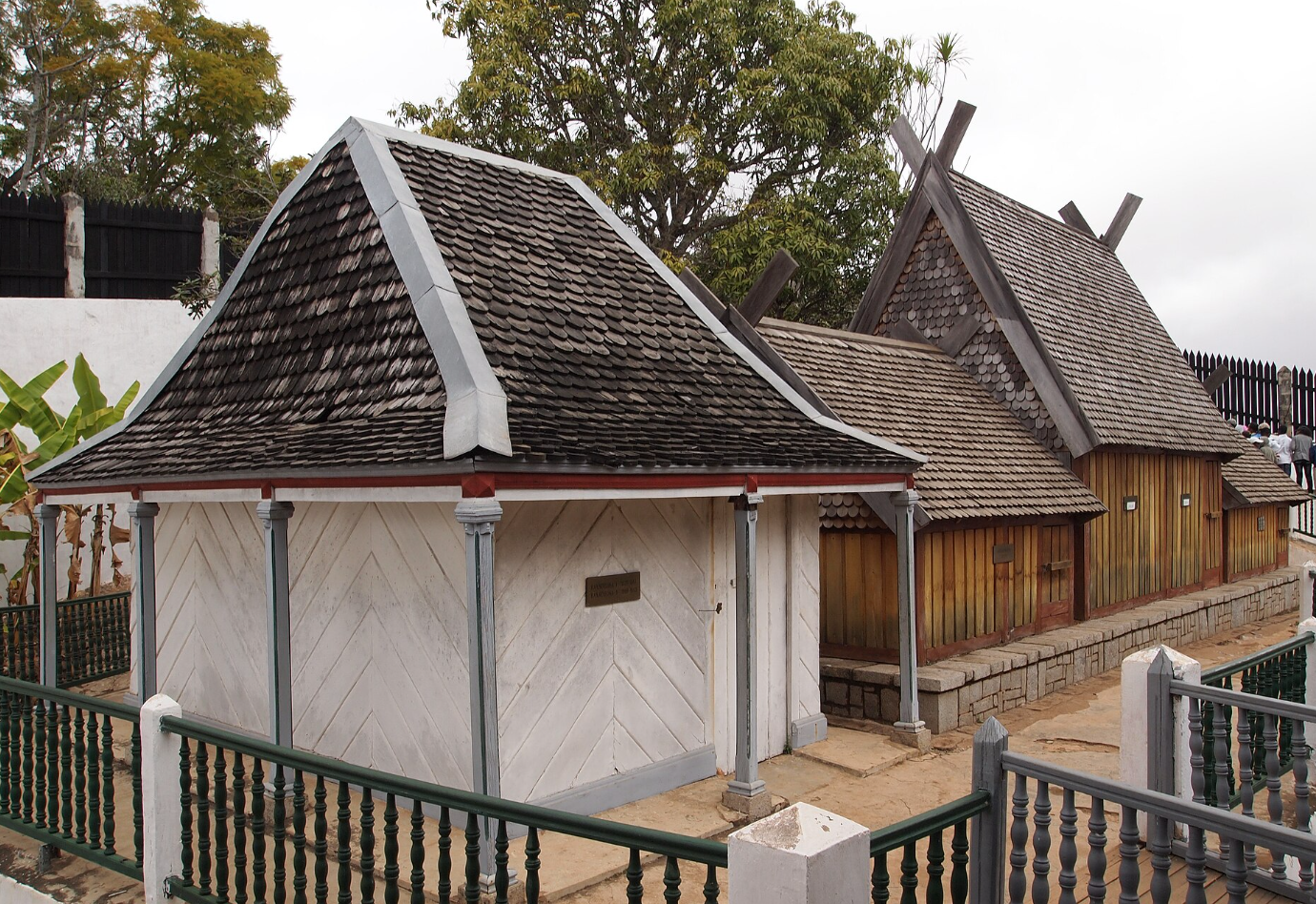
The palace of Andrianampoinimerina
Early in the 18th century the Merina king, Andriamasinavalona, divided the Kingdom of Imerina into four quadrants and assigned his son Andriantsimitoviaminiandriana to govern the northeastern quadrant from Ambohimanga. The division of the kingdom led to 77 years of civil war, ending when Andrianampoinimerina reunited it in 1793. Eventually, he moved the capital from the Ambohimanga to Antananarivo, but before he did that, he built a palace on the hill. That palace, Mahandrihono, is the oldest surviving building in the complex, dating from the 1790s. And not only does it still stand, but it is preserved in its original state, except for the thatched roof, which has been replaced with wood shingles.

The construction is of palisander, or Madagascar rosewood. Furnishings and artifacts inside (where posted signs prohibited photographs) are all original.
The palace today is a pilgrimage site, where Malagasy people come to connect with the spirits of Andrianampoinimerina and his ancestors. Our local guide told us we should enter right foot first and exit backwards, left foot first, in order to show respect for Andrianampoinimerina’s spirit.
Royal pavilions
Other structures on site include two royal pavilions dating from the mid- to late-19th century. These have an obvious European influence. The original furnishings, many of which were gifts from foreign nations to the queens who reigned in the late 19th century, have been preserved.


Royal tombs
Originally, twelve royal tombs were on site here. But French authorities destroyed many of them and moved the remains of the monarchs to Antananarivo. The Malagasy government restored the tombs and relocated the remains back to Ambohimanga.
I think there are too many long names of people I’ve never heard of. As I have been writing this, I’ve had to go back to find the names of Andriamasinavalona and Andrianampoinimerina. Unless I read closely and sound out their names one syllable at a time, I don’t even realize at first that these are two different people. As soon as I write all this, I’m probably going to forget it. And as soon as you read it (if you haven’t already lost interest and moved on to my photo album), so will you.
I don’t mean to make light of this important place. I know it’s very meaningful to the Malagasy people, who come here to engage with their spiritual ancestors.
Ritual basins
Ranavalona I built two basins for ritual purification. Today many Malagasy people come and bathe in the waters of these basins.


From Ambohimanga there are nice views back to Antananarivo.

I’m going to move on. Especially since it is now yet another day later, Sunday, and I’ve moved on both physically and emotionally to new and more memorable things.
Finishing up our tour
The rest of our visit to Antananarivo was nothing worth sharing too much about. We visited a very nice souvenir shop that had a lot of beautiful crafts in various media. I didn’t buy anything there, but adjacent was a gourmet food shop, and I bought some Madagascar chocolate because, well, chocolate.
I had mentioned to Hery that I wanted to get the best ice cream in the city, so we visited the Hotel Colbert. Their pastry shop had all kinds of visual delights, and the ice cream was excellent.


Farewell dinner
We had one last dinner at our hotel.

Jan actually got up to meet me for breakfast the next morning at 6:45, and Hery was there to see me off as well. It was a great tour, and I enjoyed both my travel mates and our fearless leader.
Hery was one of the best tour leaders I’ve had, leading with expertise, good humor, and patience. Mark had a sense of humor that didn’t always land with me, but he was always his authentic self, and he shared without a filter. (I know more details about his romantic life — and his sex life — than I needed to. And I’m pretty sure we all knew every time he took a shit and whether he suffered from constipation or diarrhea.) Jan, who himself runs tours for what seems to be a loyal and fearless Danish clientele, is planning on taking his group to Madagascar next year. He took superb photographs, some of which you can see if you’re on Facebook. We stayed up past my bedtime a few times chatting about travel and politics and life. I have just a few friends from trips I’ve taken in the past, and I now count Jan among them.
I still need to do some captions, but you can visit my photo album from Antananarivo if you want.
Lane, I admire your perseverance in getting that history down and presumably getting all the names right. And I laughed at your comment about us forgetting the details as soon as we finish reading. Thank you for sharing. I knew nothing about Madagascar before your trip and now know as much as I ever need or want to know. Continued happy travels.
Thank you Susan, I’m glad you enjoyed my post.