
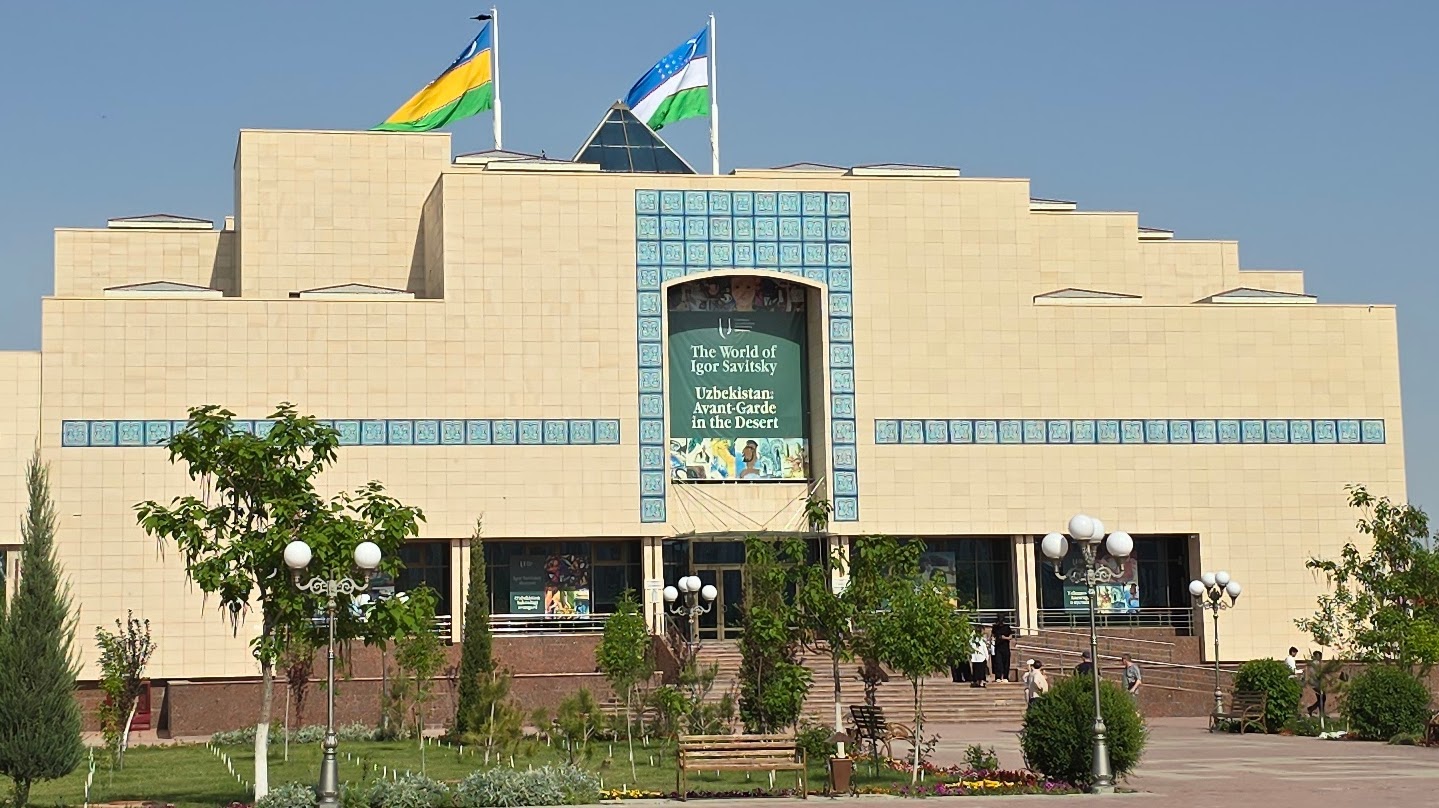
Visiting the State Museum of Arts of the Republic of Karakalpakstan named after I.V. Savitsky (aka the Nukus Museum of Art) was a highlight of my time in Uzbekistan. To my thinking, there’s really no other reason to go to Nukus. It’s a very ordinary, borderline-ugly city in the middle of the desert. It took more than three hours on poorly-maintained roads to get there from Khiva. But this museum is sufficient reason. For me, as a lover of avant-garde art from the early 20th century, the four hours I spent here were among the best museum experiences I’ve ever had.
A tiny bit about Karakalpakstan
I never heard of Karakalpakstan before taking this trip. It is an autonomous republic of Uzbekistan. It takes up about 40% of the land area of Uzbekistan, but has only about 3% of the population. It’s almost all desert. It has suffered greatly from the drying of the Aral Sea.
Karakalpakstan was ceded to the Russian Empire by the Khanate of Khiva in 1873. Under Soviet rule, it was an autonomous area within the Russian Soviet Federative Socialist Republic before becoming part of Uzbekistan in 1936. It made a brief attempt at independence after the breakup of the Soviet Union in 1991, but in 1993 it once again became part of Uzbekistan. Nukus is its capital.
The story of the museum
The story of how the Nukus museum came to be is almost as extraordinary as the art on display there. This documentary tells the story of Igor Savitsky’s mission to rescue art that was largely banned by the Soviet authorities as degenerate and anti-revolutionary.
The video is an hour long, so here’s a brief synopsis: Igor Savitsky (1915–1984) was a painter, archaeologist, and art collector. From what I saw of his paintings in the museum, he wasn’t a very good painter.
But Savitsky’s genius was in working within the Soviet system to accomplish something that should never have been allowed under the Soviet system. He first came to Karakalpakstan in 1950 to work on an archaeological expedition as its chief artist, drawing things that could not be properly photographed. From 1957 to 1966 he assembled an extensive collection of Karakalpak jewelry, carpets, coins, clothing, and other artifacts and convinced the authorities of the need for a museum. Following its establishment he became its curator in 1966.
He then began traveling around the Soviet Union, meeting artists whose work had been banned. He collected their works, many of which were in poor condition, requiring significant restoration. And he convinced Uzbek authorities to allow the museum to exhibit these paintings. Only in a remote place like Nukus, where leaders back in Moscow might not notice or bother to pay attention, could this happen.
All in all, before he died Savitsky collected 40,000 works of avant-garde art. Today just a few hundred are exhibited at the museum. The original building is currently closed and under renovation. A new building, opened in 2010, houses the exhibited works. And a third building stores the rest of the collection.
My favorite works at the museum
I took a lot of photos. I couldn’t help myself. After reviewing them, captioning them, and organizing them into albums, I am so glad I have them to remember them.
All my photos from Nukus are in one album. But I also created several albums devoted to my favorite artists, all of whom were new discoveries for me.
Aleksandr Volkov

Chaykhana is the local term for a teahouse, a place for social gathering. In this chaykhana, Lenin is watching and listening, and the men all have large ears but closed mouths and averted eyes.
The Nukus Museum has over paintings by Aleksandr Volkov (1886–1957), more than any other artist. Volkov came under fire from Stalin’s government in the 1930s.
Here’s my Volkov album of fifteen paintings.
Mikhail Kurzin

MIkhail Kurzin (1888–1957) was a Russian painter who lived in Uzbekistan. He was sent to Siberia twice for anti-Soviet agitation.
Here’s my album of twelve paintings by Kurzin.
Ilya Mazel

Ilya Mazel (1890–1967) was a Russian/Jewish painter. He was a classmate of Marc Chagall. While living in Turkmenistan in the early 1920s, he organized an art school, but in 1925 the Soviet government denounced the school and closed it.
Here is my album with nine paintings by Mazel.
Elena Korovay

Elena Korovay (1901–1974) was a Russian painter. For a time she lived in Samarkand and in Bukhara, where she captured life in the Jewish quarter. The photo above depicts three Bukhara Jews. It’s one of my absolute favorites.
(The term “Bukhara Jews” refers to a major diaspora community that settled a large area of Uzbekistan as early as the Babylonian exile in the 6th century BCE. They remained a significant presence in the area until after World War II, when most emigrated to Israel, the United States, Canada, Australia, and Europe.)
Here is my album with six paintings by Korovay.
Vasily Lysenko

Vasily Lysenko (1899–1974) was arrested in 1935 and sent to a mental hospital because his work was considered anti-Soviet. Few of his paintings survive, and those that do are mostly due to the work of Igor Savitsky.
The censors saw Bull as a parody of the mighty USSR advancing as a raging bull; its eyes symbolic of two gun barrels expressing Stalin’s methods of repression and blindness of state; the rising sun symbolic of the Soviet Union. The painting was also known by its alternate title: Fascism Advances. The inspectors assessed the painting for its anti-Soviet meaning. Lysenko was arrested and sent to a psychiatric asylum in 1935 because – a bull can’t be blue. Savitisky hid this painting during a gallery inspection and replaced it the next day.
Here is my album with four paintings by Lysenko.
Viktor Ufimcev

Viktor Ufimcev (1899–1964) was born in Russia and lived in Uzbekistan from the 1930s onward. I looked for more details about his life, but couldn’t find much. Toward the end of his life he taught in Tashkent. He didn’t seem to be seen as subversive or decadent by Soviet authorities, winning several awards from the Soviet Union.
Here is my album with sixteen paintings by Ufimcev.
Nadezhda Kashina

Nadezhda Kashina (1896–1977) was born in Russia but lived in Uzbekistan from 1930 onward. She was known for her works depicting the landscapes of Uzbekistan and the daily life of the hardworking Uzbek people in bright colors.
Here is my album with seven paintings by Kashina.
Aleksandr Nikolaev

Aleksandr Nikolaev (1897–1957) was a Russian painter who lived and worked in Uzbekistan from 1920 onward. In 1922 he converted to Islam and took the name Usto Mumin, which means “Faithful and Gentle Master.” In 1938 he was arrested for his homosexuality. He spent four years in prison. After his release, he returned to Tashkent but faced ongoing censorship; his works were banned for several years, and he self-censored homoerotic motifs in future output to avoid further prosecution under anti-homosexual statutes.
Here is my album with fourteen paintings by Nikolaev.
Aleksey Morgunov

Aleksey Morgunov (1884–1935) was older than many of the other painters represented in the museum. He studied in western Europe and was influenced by Cezanne and Manet. After the Russian Revolution he stopped painting for a time, but then embraced socialist realism and neoclassicism.
Here is my album with six paintings by Morgunov.
Nikolay Grigoriev

Nikolay Grigoriev (1880–1943) was a Russian painter. I couldn’t find out much about him.
Here is my album with four paintings by Grigoriev.
Ural Tansykbaev

Ural Tansykbaev (1904–1974) was born in Tashkent and died in Nukus, but I don’t know if he was living in Nukus at the time of his death. He seems to have thrived within the Soviet system.
Here is my album with seven paintings by Tansykbaev.
Oganes Tatevosyan

Oganes Tatevosyan (1889–1974) was an Armenian painter who lived in Uzbekistan from 1917 to 1966, and then in Moscow.
Here is my album with four paintings by Tatevosyan.
Although the art is beautifully displayed in the museum, with excellent lighting, there is no explanatory information about any of the paintings other than a few general descriptive banners about the works displayed in each gallery. Our group had a guide, but I decided to move around the museum at my own pace, and so I broke away from the group. Then, after a while, a young man approached me and identified himself as a museum volunteer. He asked if I’d like him to give me some information about the paintings. He spent about a half hour with me, and he was very knowledgeable and informative, but that still only gave me a small window of insight.
It was very difficult to find biographical information about many of the painters. Some were clearly seen as enemies of the Soviet state, and others not so much. But there are a lot of circumstances around that. Some subversion might have been subtle. I don’t know. The video gives some information about that, but there’s still so much to learn about the avant-garde art of the Soviet Union. I’m so glad I got this introduction.
What do you think? Do you like this art? Any favorites? Share your comments.
Ellen Schwartz
Thank you for doing so much research into the artists. Amazing how Savitsky was able to collect all of these.
Carroll
Such an interesting post; I learned so much. I can’t believe how many photos you took and how well you photograph paintings. It is not easy! Some of them I loved; others were not my taste. But I enjoyed seeing all of them. Thank you for sharing!
teo
Any idea when the renovations are complete? I was thinking of going this summer but i might just wait
Lane
Sorry, I have no idea.
Donna Seegar-Sedmak
Lane, I really appreciated this post and your organization of the background/work by each artist as it was too much to taken in at the time of our quick tour with the museum guide. Volkov is my favorite artist because of the intensity and use of color in his work but I agree if I could only choose one it would be Elena’s Bukhara (pink) Women. I agree that it would have been nice to have the artists’ interpretation of their work but I was okay just emotionally responding to their work.
Gail Duree
A “bull cannot be blue?” They should see the blue horse at Denver’s Airport!
Rebecca
What a fascinating contrast—an unassuming desert city holding such an extraordinary cultural treasure. It’s incredible how places like Nukus completely redefine the idea of “worth the journey.” The museum alone sounds like a powerful reason to make that long, difficult trip. Thanks for sharing this hidden gem!