
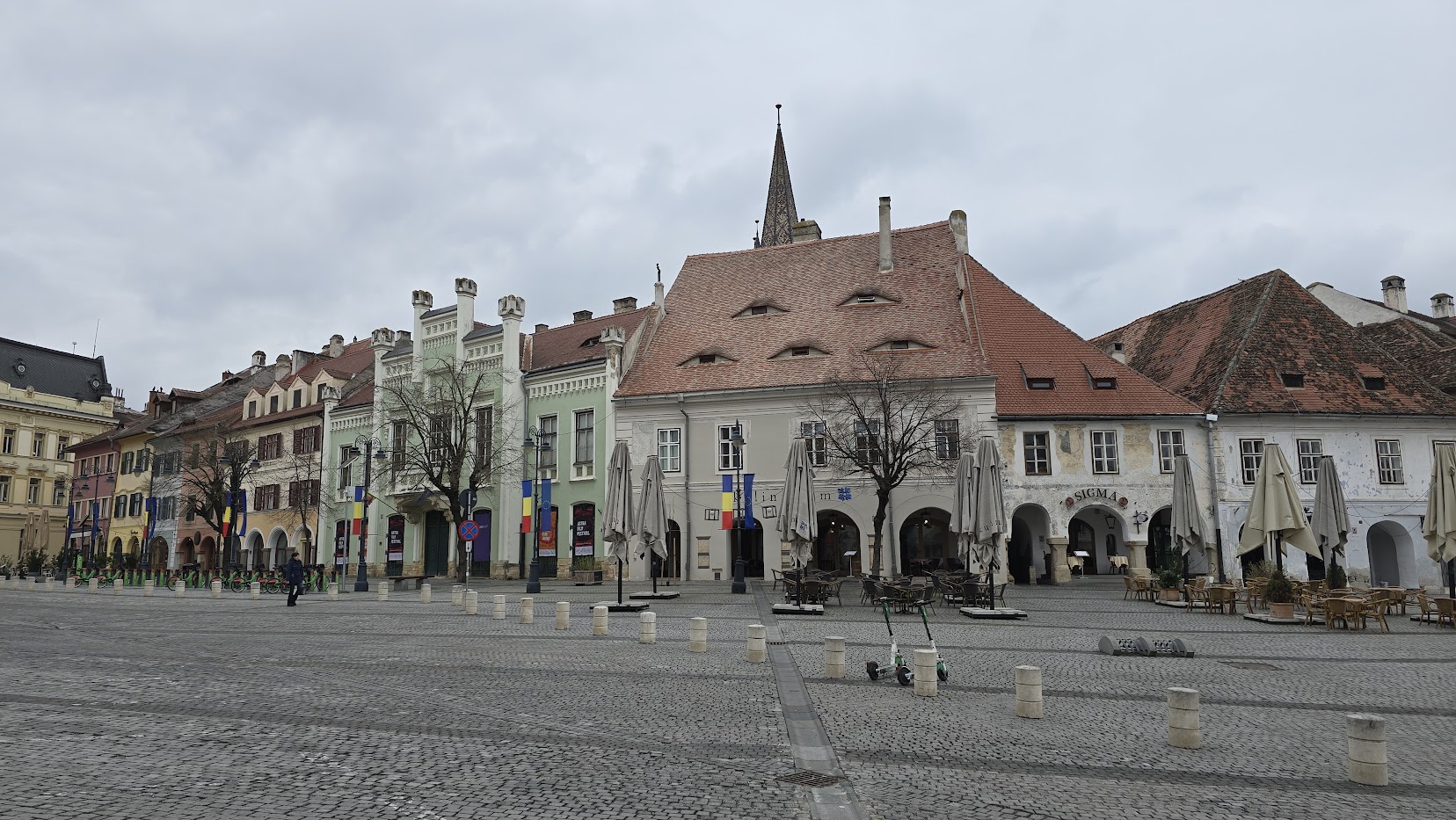
Romania, Part Two: Sibiu
We finally got a bit of a break from the rain! In fact we even got some sunshine yesterday afternoon. Sibiu definitely looked better under clear skies. But this morning, as we get ready to leave, the sky is grey and overcast, and the forecast for our next destination, Brașov, is rain, rain, and more rain.
But first, a little overview of Sibiu.
Where/What is Sibiu?
Sibiu is in central Romania, in the historical region of Transylvania. It’s about 275 km northwest of Bucharest. The city straddles the Cibin River, which gives it its name.
Originally established by Saxon settlers in the 12th century, the town or village got the name Hermannsdorf and later Hermannstadt. Supposedly, this name comes from Archbishop Hermann II of Cologne, or by a man named Hermann who is believed to have founded the city.
When the Principality of Transylvania was a realm of the Hapsburgs, Hermannstadt was its capital city. After World War I, when the Austro-Hungarian empire dissolved, Sibiu became part of the Kingdom of Romania. There were still many ethnic Germans and a large Hungarian community here. After World War II, most of the Germans emigrated to Austria and Germany. But I still saw a lot of German-language signage around the city.
Sights
Sibiu has an old town that exudes European old-world charm. Winding cobbled streets, large plazas, church steeples, and cute houses abound. It has the nickname “The Town with Eyes” because of the many eyebrow dormers that seemed to be looking down at us. (See the photo up top.) There are also the remains of Saxon fortifications: a wall and some towers still stand in a few places. And intermingled with the older charm are some grand Hapsburg-era palaces and some impressive churches.


This Romanian Orthodox cathedral is the seat of the Archbishop of Sibiu and Metropolitan of Transylvania. It was built between 1902 and 1906, inspired by the architecture of the Hagia Sophia in Constantinople.
This last church has a spectacular frescoed interior, one of the most beautiful I’ve seen on this trip.

Other stuff
On the way to Sibiu we stopped in a neighboring village, Cisnădie, where we visited a Montessori school.
We visited the ASTRA Village Museum, a village reproduction with some interesting structures from rural areas, mostly around Transylvania.

We had “A Day in the Life” in the nearby village of Sibiel, where we made donuts, painted on glass, met some school kids who were there for a field trip, visited a museum dedicated to icons painted on glass, and had a nice home-cooked lunch.

I spent about an hour in the National Art Gallery, which was not enough time. Just as I was getting to the good stuff when they closed. I added some photos to the album with the art I saw in Bucharest. I did manage to see more of my new favorite Romanian painters: Nicolae Grigorescu and Ştefan Luchian.

(from signage at the National Gallery in Bucharest)
Here are my photos of everything else in Sibiu and around the area.
I’m not familiar with Sibiu; it looks fabulous. As a history lover, I appreciate the historic background you provide. Also all the photos.
I hope the sun comes out soon!
BTW — What is Plan B for getting home? I worry as much as I read your posts.
No Plan B needed as far as I know. Please don’t worry about me, Gail. All is well!