
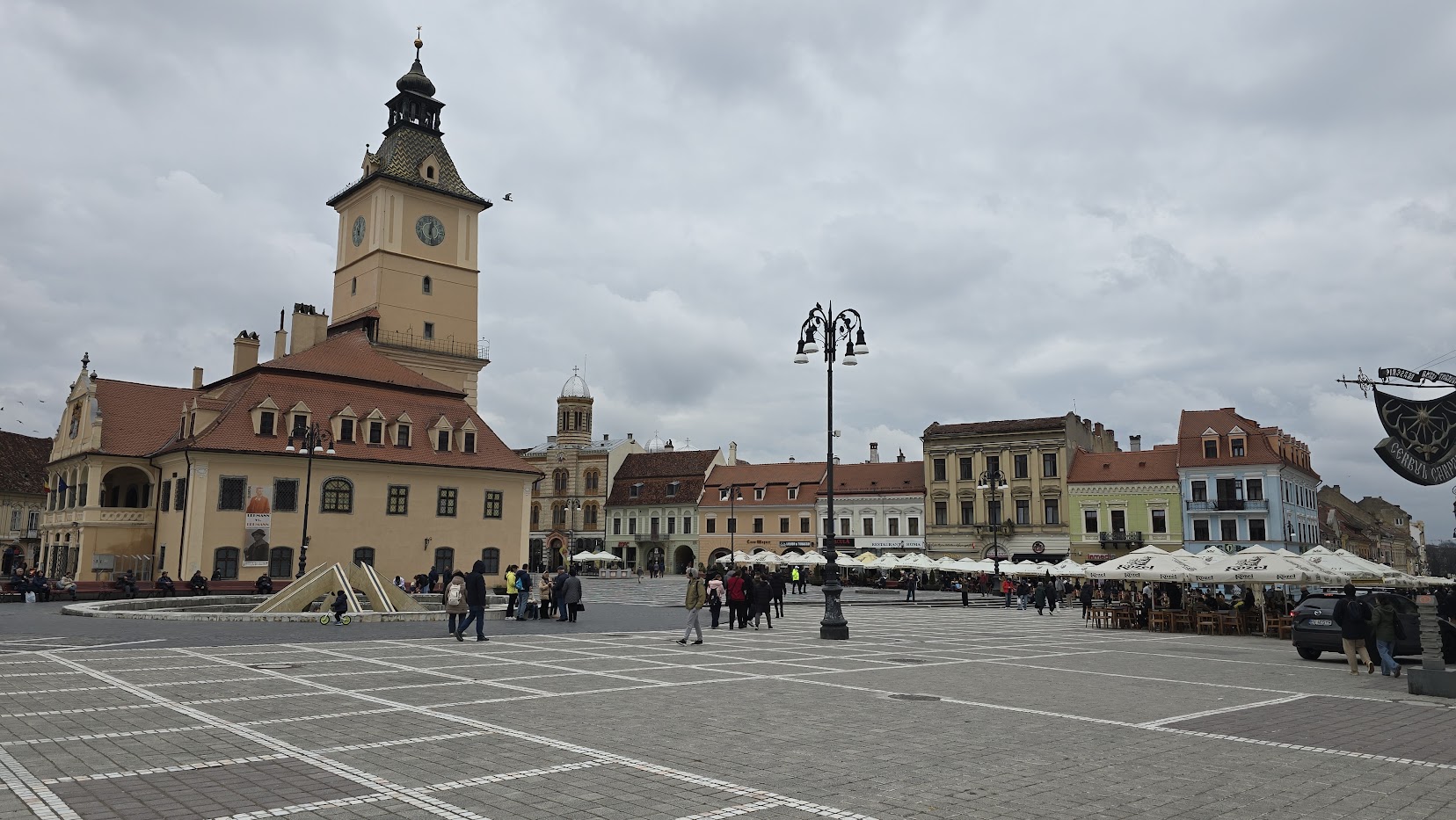
Romania, Part Three: Sighișoara, Brașov and some castles
My visit to Romania is about over. I’m writing this in the airport in Bucharest, waiting for my flight to Budapest. (It’s 5:30 am now, and my flight departs at 7:40.) Our group stayed the three nights in Brașov before heading back to Bucharest for a final (very short) night.
Here’s a rundown. Since I’ve fallen behind in my blogging, and my time is limited, it’s going to be a quick rundown. We stopped in Sighișoara on the way from Sibiu to Brașov, so I’ll throw in a little about that, too.
Sighișoara
UNESCO says, “Sighişoara is a fine example of a small, fortified medieval town.” It’s on their list of World Heritage Sites.
(If you want to say it aloud, it’s pronounced “siggy — shwara.”)
It’s also the birthplace of Vlad the Impaler, aka Dracula. More about him later.
We had a walk around the citadel, which lives up to UNESCO’s description.


While the group had some free time, Florin took a few of us to visit the synagogue, a short walk from the citadel. There are no longer any Jews living in Sighișoara, and the synagogue here hasn’t been active since 1987, but a lovely woman who lives nearby has taken the initiative of maintaining it with the financial support of an American lawyer, David Blum, who restored it.


Brașov
Brașov was also a medieval walled city, but UNESCO doesn’t list it. Nevertheless, it’s very pretty. The picture at the top of the page is the main square.
We had a walking tour in the morning of our first day here, and I happily found the art museum that afternoon. There I met up with my two favorite Romanian painters once again. They had several excellent works by Nicolae Girigorescu and Ștefan Luchian. I added lots more photos to my album of Romanian art museums.
Two of the highlights of Brașov were Beith Israel Synagogue and the Black Church.
Synagogue


Almost all were murdered.
240 Jews born in Brasov, including 38 children, perished in the Holocaust.”

Black Church


Vulcan
We also visited a nearby village, Vulcan, to see a fortified church. Many of these churches are scattered around Transylvania, and some are on the UNESCO list, but this one is not. The fortifications were built to allow villagers to gather in safety in the event of a siege. Apparently this was a common occurrence in medieval times. We heard a concert performed on a small organ in the church, along with the organist’s wife, a singer, and their son, a tenth-grader who is studying trumpet. It seems most of the group were impressed. I was not. Sometimes having a music background is a disadvantage.


Castles
The two castles we visited couldn’t be more different from one another. Together they are the two most visited sights in Romania.
Bran Castle
This imposing structure, built by Saxons in the 14th century, isn’t particularly interesting. There’s not much to see inside.

We had an entertaining guide inside the castle who explained to us that the castles that are famous in Europe are famous because they have a story. In the 1970s, Bran Castle acquired a story, as it is now and forever associated with Dracula.
The truth about Dracula
- Vlad the Impaler, who was also known as Vlad Dracula, never lived here, though he may have used the castle from time to time for defensive purposes, fighting against Ottoman invaders.
- Vlad’s father was Vlad Dracul. “Dracul” means “devil.” “Dracula” means “son of the devil.” Vlad the Impaler was also known as Vlad Dracula. He was a ruthless warrior who impaled his captured enemies in ways that are unpleasant to think about. So he was a sort of a devil. But also a hero to Romanians because of his strong defense against the Ottomans.
- Vlad the Impaler was not a vampire, nor was he in any way associated with vampire stuff. But there is a 15th-century manuscript stating that he once dipped his bread in the blood of his victims.
- Vlad the Impaler was a source of inspiration for Bram Stoker when he wrote Dracula in 1897.
- Bran Castle was probably unknown to Bram Stoker. The castle he describes in the book in no way resembles Bran Castle. Stoker never visited Transylvania.
- In order to boost tourism in the 1970s, the story of Bram Stoker’s Dracula was attached to Bran Castle.
- Many tourists (including me and my group of OAT travelers) visit Bran Castle.
The truth about the castle
Bran Castle served as fortification and protection of the Saxon settlers of Transylvania from the 14th century through the 18th. For a while it was a customs post on the mountain pass between Transylvania and Wallachia. It was not a residence until the 20th century.
In 1920 Hungary lost Transylvania, and the Saxons who owned the castle gifted it to the Romanian royal family. Queen Marie loved it and had it extensively renovated. Her daughter Princess Ileana inherited it. When the Communists took power in 1948, they expelled the royal family and seized the castle.
In 2009 the Romanian government transferred ownership to the children of Princess Ileana. The owner/administrator today is Dominic von Habsburg, one of her sons, a retired businessman living in New York. Based on the crowds we saw (and our own presence), it probably makes him a fair amount of pocket change.
I’m in Budapest now!
I ran out of time at Bucharest Airport. So now I’m in my hotel lobby in Budapest, charging my phone before I set out for some exploration. So I’m taking this opportunity to finish up.
Peleș Castle
Peleș Castle is just outside the town of Sinaia, about 30 miles south of Brașov. We stopped for lunch in Sinaia before visiting the castle on our way from Brașov to Bucharest.
Sinaia has a historic casino that we toured before lunch, and we dined in a historic hotel.
The castle dates from the late 19th and early 20th centuries. It was a project of the first king of Romania, Carol I. He visited the area in 1866 and fell in love with the magnificent mountain scenery. So he decided to build a hunting lodge. Construction began in 1873, and the inaugural ball took place in 1883. At that time Peleș Castle was the first building in Romania to have central heating, electric system, central vacuum cleaner, ducted air heating system and electric elevator. Construction continued until the king’s death in 1914.
Somewhere along the way this “hunting lodge” became a palace of epic proportions. It has 3,200 square meters (34,000 square feet) of floor space, more than 170 rooms, 30 bathrooms, and design elements pulled from the history of European art and architecture. To call it opulent is a gross understatement. The estimated construction cost in today’s US dollars is $120 million.


It’s no wonder Peleș Castle is typically ranked among the most beautiful palaces in Europe.
So that’s it from my OAT tour of Bulgaria and Romania, but my Bulmanipestan adventure is less than half over. So be sure to come back and read about the “-ipestan” portion of the trip.
Meanwhile, here are photo albums from the last few days of my “Bulman-” experience: