
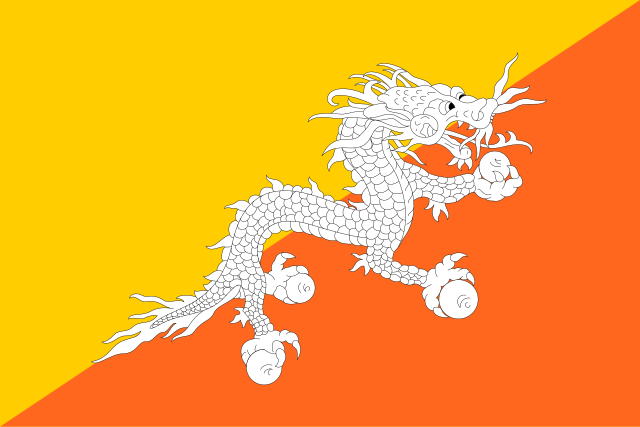
Welcome to Bhutan
Yesterday I flew from Delhi to Paro, Bhutan, and then traveled overland to Thimphu, the capital city. Here’s a look at what I’ve seen so far.
Flying in
We flew Drukair, the flag carrier of Bhutan. In Dzongkha, the official language of Bhutan, “Druk” means “thunder dragon.” And the name of the country is “Druk Yal” (Land of Druk). The flag of Bhutan (above) features Druk.
The service on the plane, which was probably only about one-third full, was great. They served a nice hot lunch. And there were frequent announcements pointing out the mountain peaks we were passing: Mount Everest and others (third highest, fifth highest). They were all on the left side of the plane. I was sitting on the right side.
But I did get a great view as we approached Paro.

Paro International Airport is Bhutan’s only international airport. It is considered one of the world’s most dangerous because is is located in a deep valley and requires complex navigation. Only a small number of commercial pilots are trained to land there. We banked steeply several times as we made what seemed like a 270-degree turn to approach the runway.


Drive to Thimphu
There are nine of us on this portion of the trip. Seven are a group: three married couples and one solo who all met on a previous OAT trip and have been traveling together ever since, and one other single plus me. We met our tour leader, Owl, and our driver, Norzeng, and boarded our van for the 35km drive to Thimphu. There are no highways here, just two-lane roads that are quite twisty as they wind along narrow river valleys. We followed Paro Chu (“chu” = “river”) downriver to the confluence with Thimphu Chu. They join to form Wang Chu. Then we continued upriver along Thimphu Chu until we arrived in the capital.
Along the way, we stopped a couple of times.


Thimphu
We arrived in Thimphu and checked into our lovely hotel, the City Hotel. There wasn’t much time to do anything last evening. We had dinner in the hotel. I did walk over to the nearby farmers market, which was huge.

Today we had a day to explore Thimphu. I think we covered all the highlights.
National Memorial Chorten
Built in 1974, the Memorial Chorten (or stupa) honors the memory of the third king of Bhutan, grandfather of the current king, who died in 1972 at the age of 44.

Also at the site are a set of large prayer wheels. In Vajrayana Buddhism, prayer wheels, which contain mantras or sacred prayers, are spun to spread spiritual blessings. The act of spinning a prayer wheel is believed to be as powerful as reciting the mantras it holds, and the rotation is thought to send the prayers and positive energy out into the world.


Buddha Dordenma
Here in Thimphu is the world’s tallest seated bronze Buddha. Construction began in 2006 and didn’t finish until 2015. The statue was built in China and brought here in pieces. The estimated cost of the entire project is 100 million US dollars.

The Buddha sits atop a temple that contains 100,000 8‑inch-tall and 25,000 12-inch-tall gilded bronze Buddhas. (Sorry, no photos inside the temple.) Inside we met a Buddhist monk, 31 years old, who answered our questions about his upbringing, training, and life as a monk. The thing that lingers most vividly about everything he said is this:
At first, he told us, all the rules felt oppressive. So many things were not allowed. You can’t do this; you can’t do that. But at some point, things shifted. When he did not concern himself with the things he couldn’t do, he learned to do things that set him free.
Lunch
Our next stop was lunch at a nearby restaurant. The food so far in Bhutan has been amazing!
Royal Textile Academy
Bhutan is famous for woven fabrics, and the Royal Textile Academy celebrates the art of weaving in a small museum.
Men and women each have a national dress: the men’s dress is the gho; the women’s is the kira. The museum had a video showing how to put them on. I don’t have that video to share, but I found these on YouTube:
Although the majority of people I’ve seen in Thimphu don’t wear these traditional outfits, many do. Our trip leader, Owl, and our driver, Norzeng, both wear ghos. And the flight attendants on Drukair wore kiras, as do the hotel staff.

The museum had many stunning fabrics on display.


Paper
Our next stop was a place where making paper is an art and a craft. They make just 400 sheets of paper a day, all by hand. And it starts from harvesting the bark from daphne to make pulp. It was fascinating to watch.
Takins
Owl told us that one of our options after the above activities was to visit the Royal Takin Park and see an animal with the head of a goat and the body of a cow.
I, for one, thought he was making this up.
He even told us a story about how these animals came to be:
Legend has it that during a gathering in Sha Samtengang, in Wangduephodrang Dzongkhag, Lama Drukpa Kuenlay (1455–1529), also known as the “Divine Madman,” was urged by his devotees to perform a miracle to prove his divine powers. In re-sponse, the Lama asked for a feast to be served to him. He specifically asked that the feast include a whole cow and a whole goat.
Lama Drukpa Kuenlay devoured both animals, leaving only their bones. With the bones, he fashioned a creature by attaching the goat’s skull to the cow’s skeletal remains. With his supernatural powers, the Lama brought the assembled bones to life and commanded the creature to roam the mountains and graze! The resulting creature was the Takin, a truly magical-looking animal that combines the features of both a goat and cow.
Anyway, I had to see for myself. And apparently, so did our entire group, because we all opted in for a visit to this sanctuary for takins.

There were also some other animals in the preserve. It was a fun way to wrap up the day.
My impressions so far
Bhutan may be the most beautiful country I’ve ever visited. Spectacular scenery aside, every bit of human construction in Paro and in Thimphu is beautiful. Inside and out, painting of buildings is decorative and impeccably maintained. The airport in Paro (photos above), the Memorial Chorten, the restaurant where we had lunch. There’s just so much care given to the aesthetics of this country, perfectly complementing its stunning natural beauty.


And this may also be the most civilized place I’ve ever been. Thimphu is the only capital city in the world that doesn’t have a single traffic light. Here’s how they manage the busiest intersection in the city:
You’ll find many more photos in my album. Enjoy!
Lane, thank you so much for posting this! You have a great talent and memory for writing about travel experiences.
I also appreciated your wonderful photos.
Adria
Adria, thank you so much for reading and for sharing this adventure with me!
Lane thanks so much for reminding me of how beautiful Bhutan really is! I may have mentioned to you just how striking the airport is. It really sets the tone for the rest of the country. Thanks for the photos. Have a wonderful time there!
Mary Strahota from your trip to India
Thank you Lane! Amazing recap!
Raeanne, I’m glad you enjoyed it. Looking forward to our ongoing shared adventures!
Lane, I’m following your trip closely to see if I should add Bhutan to my wish list. From what I’ve read so far, it’s a definite yes!
Yes, Sandi, a definite yes!
?please keep posting all of your experiences- even the negative ones! Am curious how this trip compares to the fabulous one we took to Southeast Asia last year?
After seeing your post I will put Bhutan on my list.
Thank you for sharing.
Thank you for reading! Bhutan belongs on everyone’s list!
Super Lane. Ask if this is true… Bhutan is the only country that doesn’t have a GNP but has a GNH. Gross National Happiness.
They definitely do have GNH here. The Constitution of Bhutan obligates the state to create conditions for the pursuit of Gross National Happiness. Government policies are required to ensure a high quality of life for citizens.
Thanks Lane for sharing
I had the good fortune to visit Bhutan in 2011
My highlight was the hike up to Tigers Nest where I flew my prayer flag.
Also the amazing Rhododendrons!
Interesting murals on the residences ?
Thanks for reading, Bernita. We have the Tiger’s Nest hike coming up.