
Tashkent: Monuments, Markets, Ballet, and Plov
As usual, I’m too busy doing stuff to write a lot about what I’m doing, but here’s a rundown of two days in Tashkent, the first stop in my tour of Uzbekistan.
Old and new
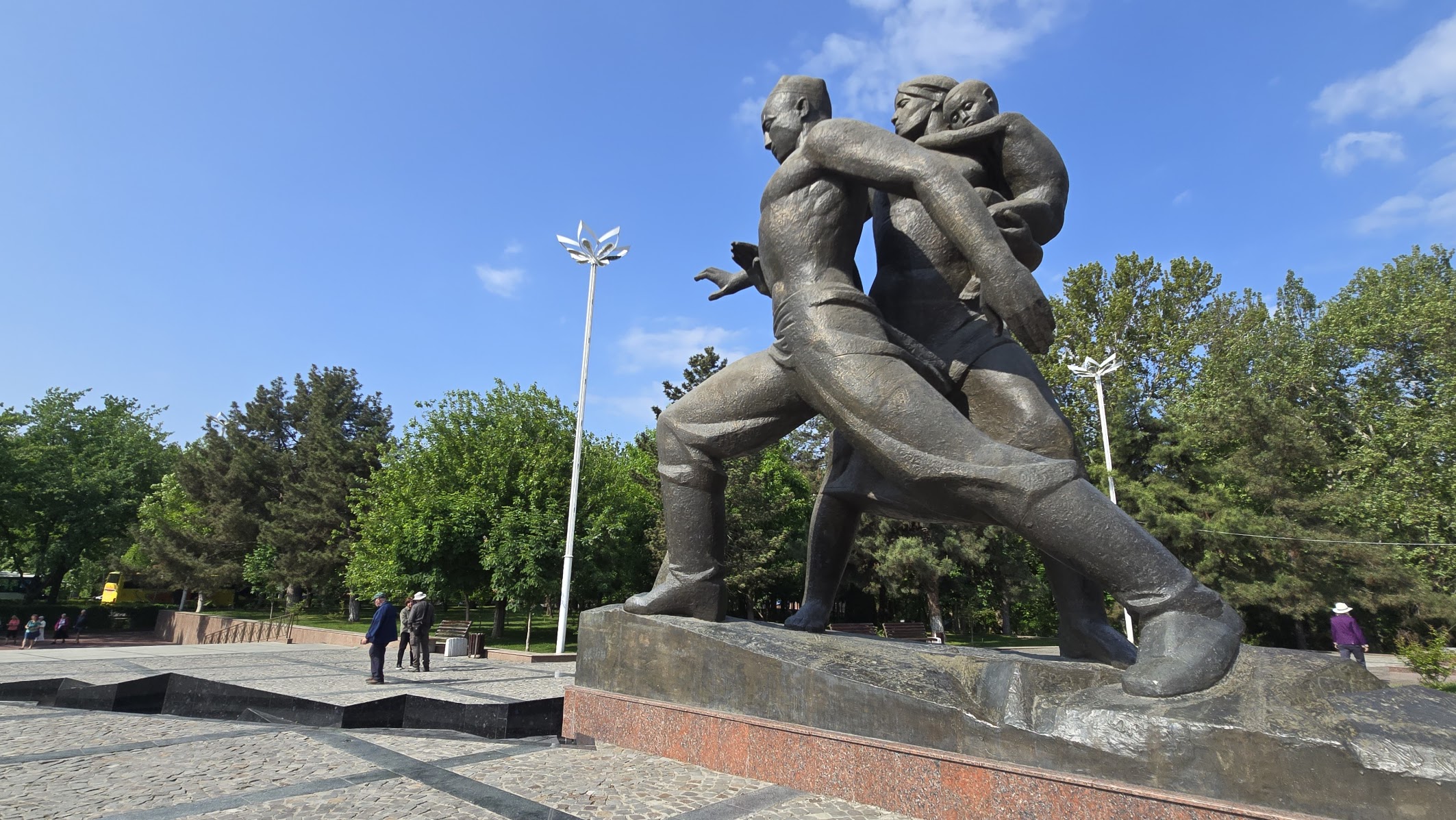
Compared to the cities I visited in Tajikistan, Tashkent feels far more cosmopolitan. It in many ways resembles big cities anywhere in the world, with modern office buildings and apartment buildings, and plenty of traffic. One thing that stands out in my mind is the large number of parks, as well as trees lining the wide avenues. And although the city has clearly cast off much of its Soviet past, there are still plenty of reminders.


The main element is the “Sorrowful Mother” sculpture, created by sculptor Ilkhom Jabbarov, embodying maternal grief. In front of the sculpture burns the Eternal Flame above the tomb of an unknown Uzbek soldier.

Islam in a secular country
As in Tajikistan, the population of Uzbekistan is predominantly Muslim, but there is no official religion, and some public expressions of religion are forbidden. Until 2021, women could not wear hijabs and men couldn’t grow long beards. They’ve lifted some of those restrictions, but niqabs and burqas are still banned, and hijabs are generally not allowed in schools.
But there are some signs of the Islamic faith. Last month the world’s largest museum dedicated to Islamic culture opened in Tashkent.

The museum sits adjacent to the Hazrati Imam complex, a large collection of Islamic monuments: mosque, madrasa, minarets, mausoleum, library, and the Imam al Bukhari Islamic Institute, where more than 650 students can study to become leaders of the Muslim faith.

Market
No OAT trip would be complete without a visit to a local market. The one here, Chorsu Bazaar, is the largest in central Asia, as well as one of the oldest, dating back to the Middle Ages, when it was an important waystation on the Silk Road.
After a while, many of these markets can seem more-or-less the same, but this one was clean, spacious, and pleasant. And in addition, there were a lot of fascinating items for sale, things I’ve never seen anywhere else.


Much Uzbek cooking, including plov, utilizes the aromatic fat from these sheep.
Plov
Also known as pilaf, or osh in Uzbek, plov is the national dish of Uzbekistan. Plov was recognized by UNESCO and inscribed on its Intangible Cultural Heritage of Humanity list in 2016.


A night at the ballet
Our hotel (which was very nice) was right across from the opera house (or more accurately, the Alisher Navoiy Theater. So several of us decided to get tickets. Unfortunately, opera tickets weren’t available on our only free night, but there was ballet. Not my favorite genre, but I went ahead and got a ticket. (The top ticket price was about $14 US, so even if it turned out to be bad, it wouldn’t be too great a loss.)
Chopiniana
The first half of the program was Chopiniana, also known as Les Sylphides. This was a set of eight piano pieces by Chopin arranged for orchestra by Russian composer Alexander Glazunov. This is said to be the first ballet that is simply about mood, with no plot. It consists of a bunch of women in white (the sylphs) moving around and striking poses, and one man described as a poet. What we saw may or may not have been based on the original choreography of the original 1909 production.
It was bad. The orchestral playing was rough and had serious tuning problems. The dance was boring and lacked charisma, athleticism, and precision. Jumps were not high. Unison was often not.

But the audience seemed pleased. One woman shouted “Brava!” more than once.
Carmen Suite
When I learned that the second ballet was “Carmen Suite,” I thought it would be a ballet danced to the music of Bizet. I wish I knew ahead of time what it actually was. When the orchestra first started playing, there was definitely Bizet’s Carmen there, sort of. But the orchestration was bizarre: strings and percussion. No winds or brass. And the percussion consisted largely of vibraphone, marimba, and xylophone, along with various drums and castanets and other idiophones and accessory instruments.
The dancing was a modern interpretative approach to the basic Carmen story. I can’t say it was a whole lot better than the first half of the evening, but it was at least inventive and imaginative, and it kept me awake.

Afterwards, I did some research, and discovered that “Carmen Suite” is an actual ballet from 1967. The music is by Russian composer Rodion Shchedrin, and is a loose reimagining of the music and story of the Bizet opera.
To be honest, I’m not sure knowing this would have made a difference for me. I just didn’t like hearing the music distorted as it was. It didn’t feel fresh and modern (perhaps because it’s sixty years old). But it didn’t feel like it respected the source material.
The dancing was a tad more solid than in the Chopiniana piece. But to be fair, ballet isn’t my thing, and I’m not qualified to judge.
If I were grading the evening, I’d give the first half a D and the second half a B-.
Our trip leader, Yura, has regaled us with some fascinating stories about his family during and since Soviet times. At some point I want to share some of those, but right now I want to get to bed. We’re in Samarkand now, and we have a long day tomorrow with a lot of activities scheduled, both daytime and evening.
My photo album from Taskent has lots more pictures of things I didn’t write about. Enjoy!
I agree that it may not have been the best dancers in the world but it was fun to get dressed up and enjoy a night performance at the Opera House.
I enjoyed that aspect as well.