
Kyoto: City of UNESCO
There are seventeen UNESCO World Heritage properties in Kyoto. Okay, so they are not listed individually. They are grouped together under a single listing: Historic Monuments of Ancient Kyoto. Sometimes it felt like the whole world was here to see them. I didn’t see them all. Not by a long shot. Our group visited just three of them, and all three were worth fighting the throngs of visitors.
The worst crowds we encountered were at a site that is not included in the list. Why we had to battle those crowds when there are fourteen other UNESCO properties we overlooked is a mystery to me. And OAT will hear about that from me in my post-trip survey.
Anyway, here are my photos from Kyoto. Feel free to check them out first, or read ahead now and look at the photos later. As always, I’ll include photo highlights here, but there’s always more in the album.
But first…
Before we got to Kyoto, we stopped in Nara, which has eight UNESCO properites, also grouped under a single listing: Historic Monuments of Ancient Nara. Here we saw just one, plus lots of deer.


There are about 1,700 deer living in Nara Park, the area around Tōdai-ji Temple. They are extremely aggressive. Street vendors sell deer crackers, and the deer will nip you to try to get some.

Tōdai-ji Temple is the UNESCO site we visited. Dating from the 8th century, the crowning feature is the Daibutsuden (Great Buddha Hall), which is the largest wooden building in the world. Of course, being made of wood, it has burned down twice and been rebuilt. The current building dates from 1709.

And inside this great big wooden building is a large seated Buddha. This dates from 752, and it is the original, though it has undergone restoration.

If you’d like to see more photos from Nara, here they are.
Kyoto
There was a lot to see in Kyoto. Here’s a quick rundown. Quick because I’m already in Hiroshima, and I’m really tired, so I just want to get this post finished.
Day One
Fushimi Inari Shrine
This was the site we visited that is not included by UNESCO. It’s mostly famous for the Senbon Torii (Thousand Torii Gates).
Fushimi is the most important Inari shrine in Japan. An Inari shrine is dedicated to Inari Okami, the Shinto deity of rice, agriculture, business prosperity, and general success. All shrines have torii gates, but at Inari shrines they are painted vermilion/orange. And at Fushimi, there are a thousand. No, check that. There are somewhere around 10,000 torii at Fushimi.
Because Inari is the goddess of business prosperity, Inari shrines attract business owners. At Fushimi, each torii was sponsored and paid for by a business.
At first it was cool. But the crowds were absolutely overwhelming, and I quickly tired of the parade through these gates. I ducked out and when back down to the entrance to wait for the rest of the group.


This went on and on and own. As I said, there are about 10,000 of these gates.
Foxes
Inari is also associated with foxes. Whereas typical Shinto shrines are guarded by komainu (lion-dogs), Inari shrines are guarded by fox statues (kimune) with symbolic items in their mouths.
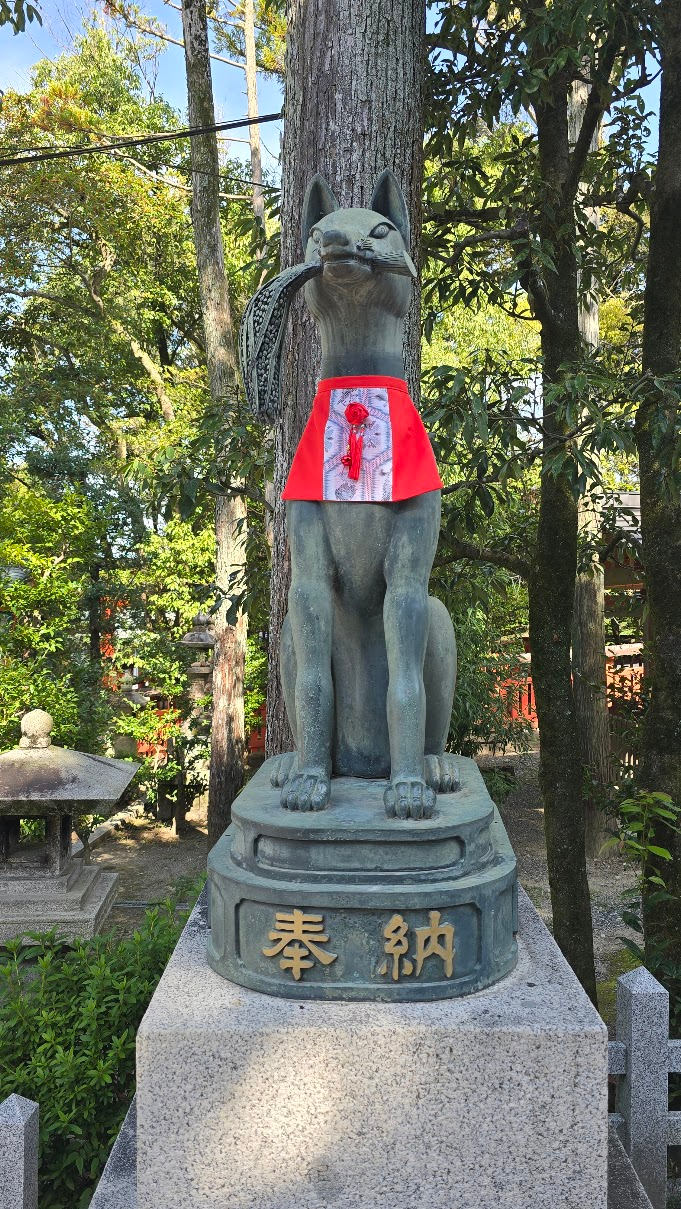
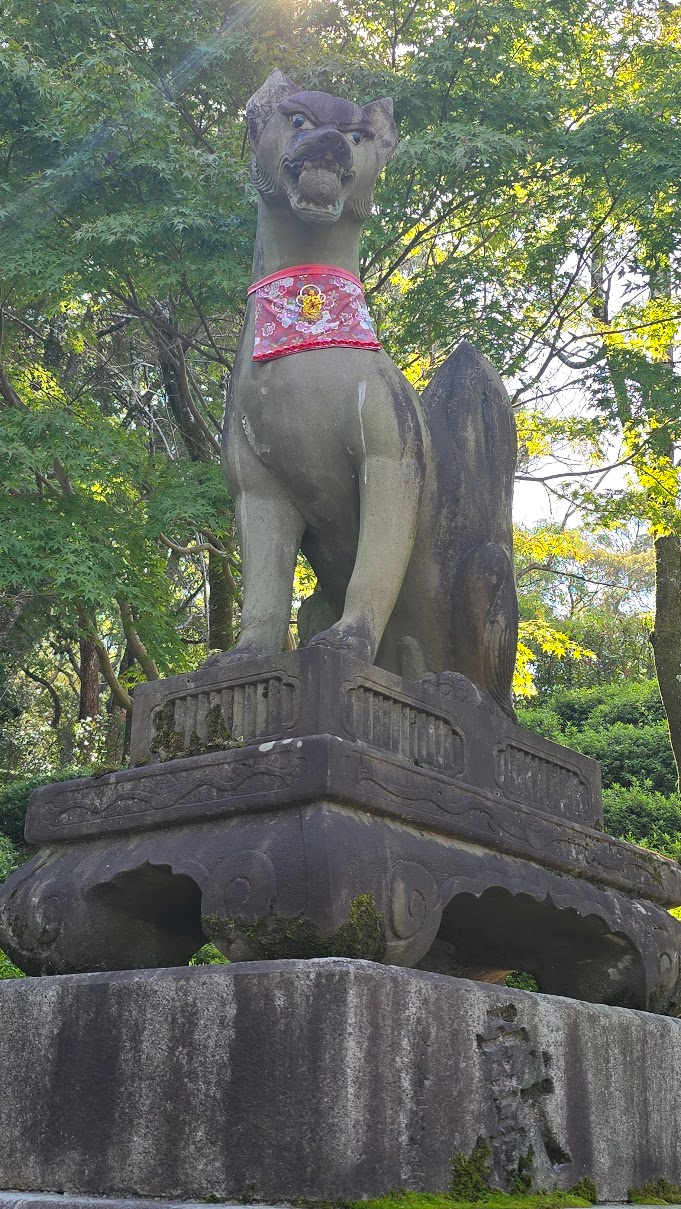
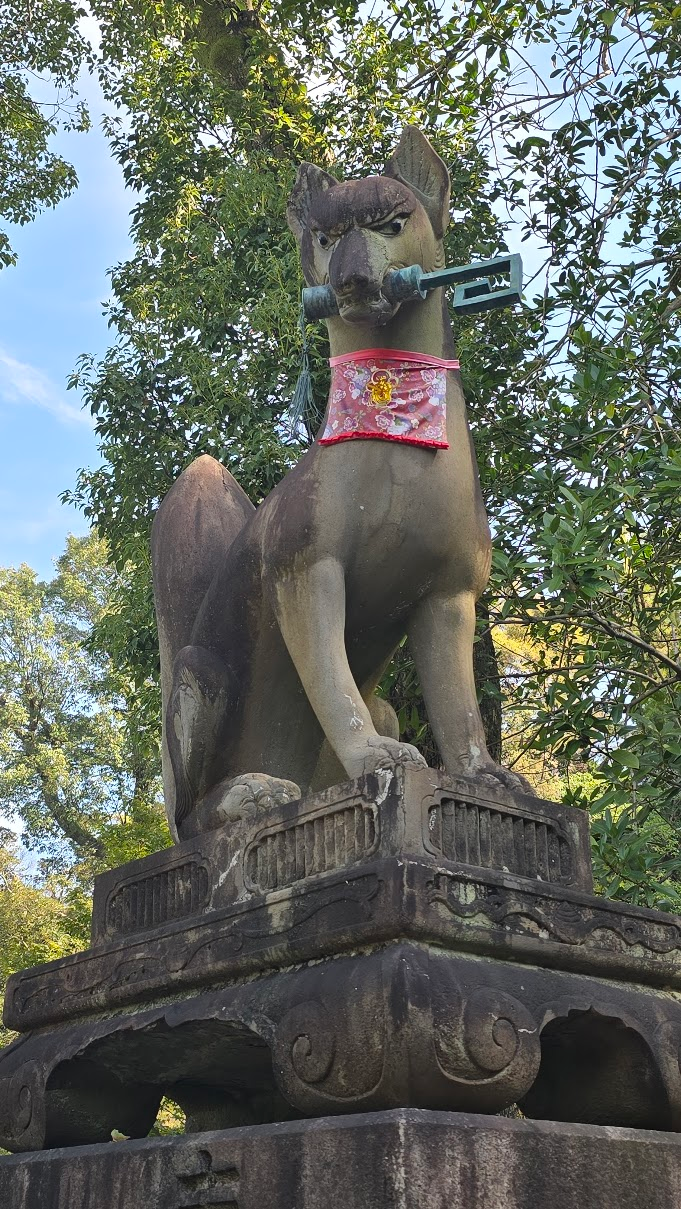
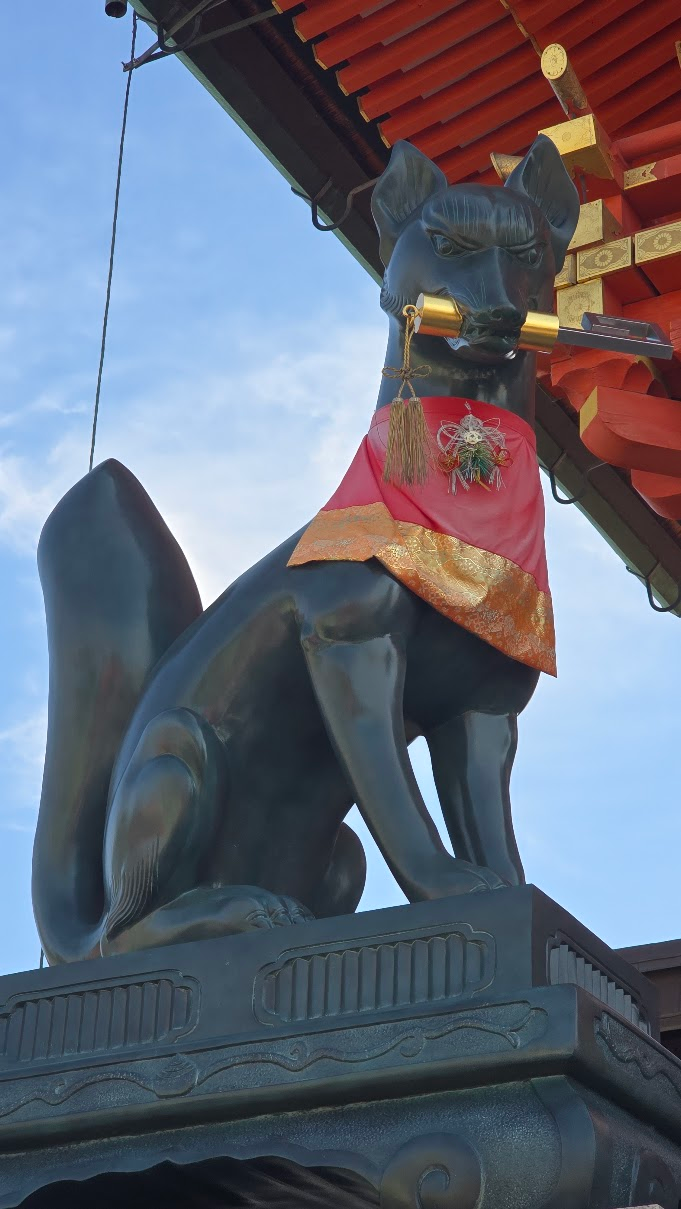
For me the kimune were more interesting than the torii. But the crowds really spoiled the whole thing.
Maiko and Geiko
A maiko is an apprentice geiko. A geiko is a geisha, except in Kyoto the preferred term in geiko.
We went to a restaurant for lunch where we had a chance to interact with a maiko and a geiko. The food at this restaurant was amazing. It was one of the best meals of the trip. And the maiko and the geiko made the experience interesting. They did a music and dance performance.
And we played a game called Konpira Fune Fune. The rules are very simple: An object like a cup is placed on the table between the two players. Players take turns tapping the table or the object to the rhythm of the folk song “Konpira Fune Fune.” If the object is present, you must tap it with an open palm. If the object has been removed by your opponent, you must make a closed fist.
Golden Pavilion
Next we went to see the Golden Pavilion (kinkakuji), one of Kyoto’s UNESCO properties.
Originally built in 1397, it was a retirement villa for the shogun become being converted to a Zen Buddhist temple.
In 1950, a 22-year-old novice Buddhist monk named Hayashi Yoken deliberately set fire to the structure. The event shocked post-war Japan, as the iconic 14th-century landmark was completely reduced to its wooden framework and ash. Following the arson, Hayashi fled to the Daimon-ji hill behind the temple and attempted suicide, but survived and was taken into police custody. He was diagnosed with severe schizophrenia and a persecution complex. He reportedly confessed that his actions were fueled by a deep-seated “hatred and jealousy of beauty,” resenting how flawless the temple was in comparison to his own personal anguish and physical stutter.

The crowds here weren’t quite as bad as at Fushimi. I didn’t find the Golden Pavilion to be super impressive, but it was worth a walk through the beautiful grounds.
Gion Corner
Gion Corner is a theatre that offers a tourist-centered arts experience. Per their website,
This show provides a great opportunity to enjoy seven traditional performing arts on one stage. The program is approximately one hour long and includes chanoyu (the art of preparing tea), koto music, ikebana flower arrangement, bugaku dance, kyogen comedy, Kyomai dance, [and] a noh play. The production is perfectly suited for travelers who are interested in the time-honored performing arts of Japan.
Most of our group went to see the show. It was something of mixed bag. Some of it was interesting and entertaining, and some of it was just weird. There are short video excerpts on their website if you’re interested.
Day Two
The second day in Kyoto really lifted it for me. It was one of my favorite days in Japan so far.
Sogenchi Garden
This beautiful garden at Tenryu-ji Temple, another UNESCO property, was just lovely.


Arashiyama Bamboo Forest
This bamboo forest is adjacent to Tenryu-ji Temple. Despite the crowds, it was one of the most special places in Kyoto. (I wish I’d had the opportunity to go see it very early in the morning, before the crowds show up, but it was beautiful nonetheless.


Nijō Castle
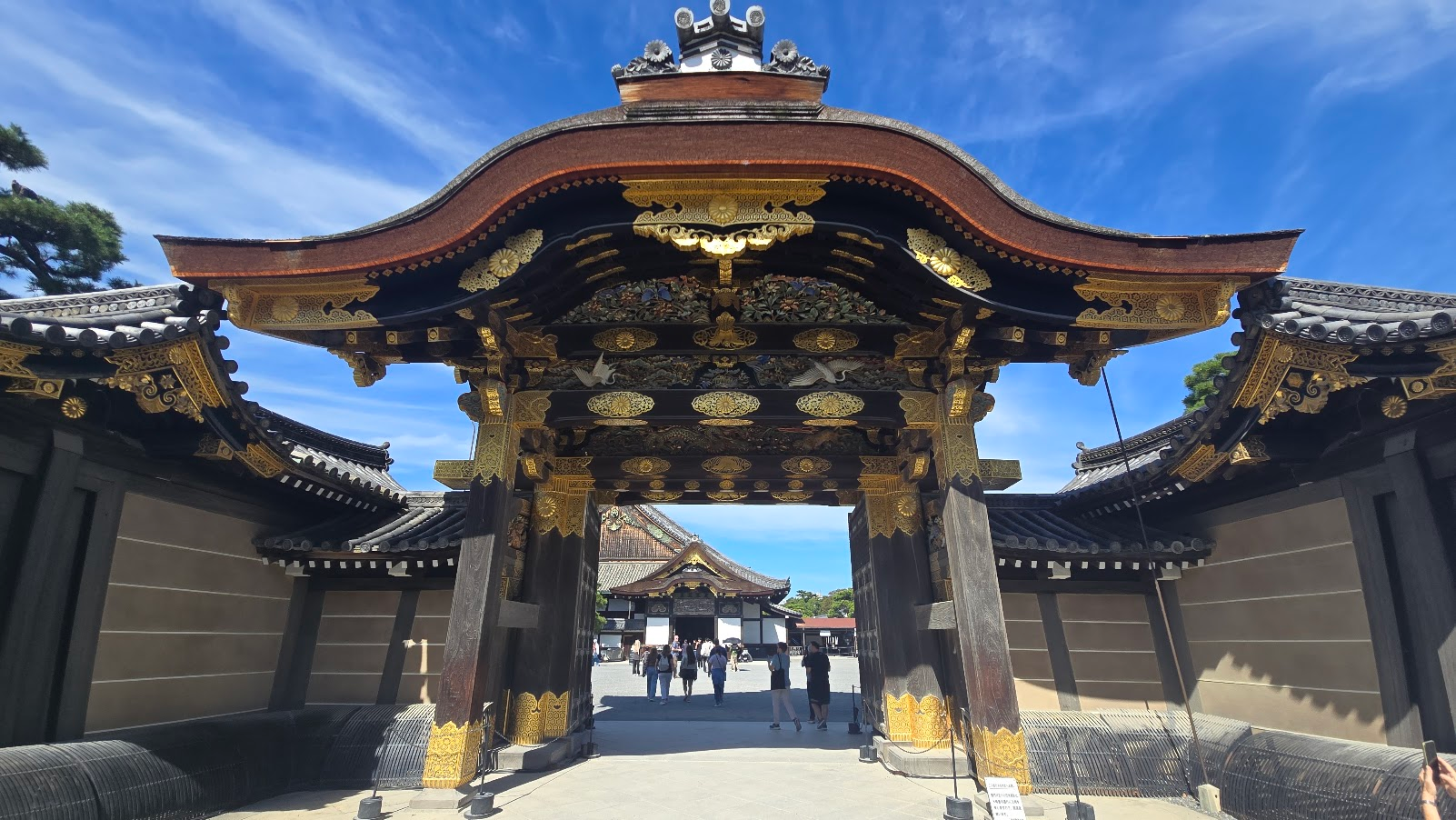
This UNESCO site was my favorite architectural location in Kyoto.
Nijō Castle dates from the early 17th century. Tokugawa Ieyasu, the founder of the Tokugawa shogunate, undertook its construction beginning in 1601, and it was completed in 1626 during the reign of his grandson, Tokugawa Iemitsu. Parts of it have burned down and been rebuilt in the intervening centuries.
In 1867 the shogun ceded power to the Imperial court. In 1939 it became the property of the city of Kyoto, and it opened to the public in 1940.
At the top of the page is Karamon Gate, which I think was the single most beautiful structure I’ve seen in Japan.
There are two palaces in the castle. Ninomaru Palace is 3,300 square meters (36,000 square feet) and consists of six connected main buildings made of Hinoki cypress and decorated with gold leaf and elaborate wood carvings. It was the public palace, designed to intimidate visitors by giving the impression of great power on the part of the shoguns.


The other palace is about half the size of Ninomaru and is newer and smaller; the original was replaced by the current version in the 1890s. I didn’t go inside.
The gardens are lovely.

So that covers the highlights of Kyoto. I’ll be back to write about Hiroshima next.
If you haven’t done so yet, here’s your last chance to check out my photo albums for Nara and Kyoto.