
Three days in the Gobi Desert
My visit to Mongolia (pre-trip extension for OAT’s South Korea and Japan tour) includes five nights in Ulaanbaatar and three nights in the Gobi Desert. Here’s a rundown of our Gobi adventures.
If you want to skip to the photos, here they are.
Arrival
We flew from Ulaanbaatar’s Chinggis Khan Airport on Chingis Airlines to Dalanzadgad, about a 90-minute flight in a 70-seat prop plane that was probably half empty.


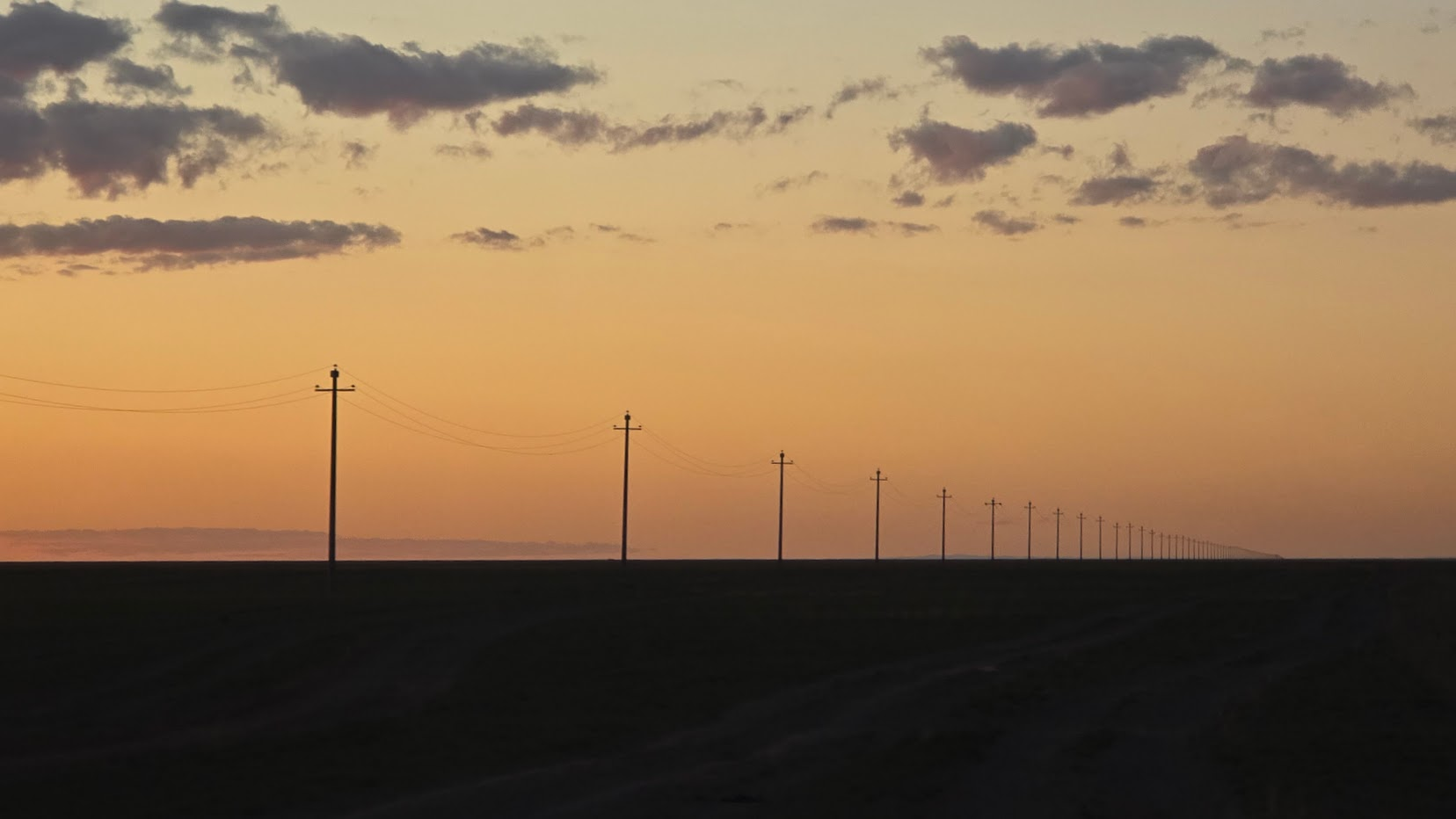
From the airport, we drove about an hour in two Lexus 4x4s, mostly on dirt roads, to our camp. Along the way, we stopped to enjoy the sunset and a herd of horses.


We are staying at Dream Gobi Lodge in gers (the Mongolian word for what we call yurts). However, to be fair, I think these are really only gers by outer appearance. On the inside they are hotel rooms with ensuite baths and electricity.

It is quite comfortable, and I can’t say staying here resembles the nomad lifestyle in any way.
Yol Valley
On our first full day in the Gobi Desert, we drove about an hour in our Lexus 4x4s to Gurvan Saikhan National Park, where we did a short hike through the Yol Valley. Technically, we didn’t hike “through” the valley; we hiked about a mile in and back out.
Gurvan Saikhan literally means “Three Beauties.” It refers to the Gurvan Saikhan mountains, which consist of three main subranges: Baruun Saikhan (The Western Beauty), Dund Saikhan (The Middle or Central Beauty), and Züün Saikhan (The Eastern Beauty). According to Mongolian folk tradition, the name comes from a story about a wealthy man who had three beautiful daughters. When he forbade them from marrying the poor herdsmen they loved, they fled into the desert in grief and turned into the three mountain ridges.
The Yol Valley is named for the yol, known as the bearded vulture or Lammergeier (Gypaetus barbatus).

We saw a number of other critters and some interesting landscapes along the way.


Weeping camel
In the afternoon, following our hike, we had the option to watch the movie The Story of the Weeping Camel.
This is a 2003 narrative documentary. The directors, Byambasuren Davaa and Luigi Falorni, lived with a multi-generational nomad family in the Gobi Desert, but they couldn’t have anticipated the actual drama that they captured on film. While some elements are scripted, the story — a mother Bactrian camel rejecting her rare white calf and the traditional hoos ritual using a morin khuur (horse-head fiddle) to make her weep and accept the baby — actually happened.
I loved this movie. It’s available on YouTube, or just watch it right here.
Nomads
We woke the next morning to a light dusting of wet snow, which was still falling as we went to breakfast. Eric had told us to expect temperatures of 50–55° F. But it was more like 30° in the morning and never got much above 40°. Fortunately, I was prepared for cold weather and wore the appropriate layers, hat and gloves.

Also fortunately, the snow didn’t last, and the sun prevailed, giving us a beautiful, if chilly, day for our activities.
We drove about a half hour to the encampment of a nomad family. On the way, we stopped at a well. Eric told us this would be shared by several families living in the area. While we were there, a nomad rode up on his motorcycle with two big jugs to get water to bring back home.

We also stopped to check out some camels.

These two-humped Bactrian camels are named for the ancient region of Bactria, spanning parts of modern-day Afghanistan, Tajikistan, and Uzbekistan.
We finally arrived at the nomad encampment, where we met a man and woman and visited them in their ger. They told us they have two grown children and one teenager who is in school. They shared some donuts, dried cheese curd, and fermented camel milk. The wife demonstrated how she makes felt from sheep’s wool, and we got to try on some of the beautiful embroidered outfits she makes by hand.


Finally, we went for a camel ride.


We stopped on the way back to our camp to admire the horses and the beautiful snow-covered mountains we’d hiked through the day before.

Farm
After a break for a few hours, we headed out again. Our first stop was surprising to me: a farm in the middle of the desert. This is in a low-lying area where what little rainwater there is manages to gather and can be used for irrigation.


Flaming Cliffs
In the 1920s, Roy Chapman Andrews, an American explorer, adventurer, and naturalist, led the first expedition in Mongolia ever conducted by motor vehicle. His goal was to seek proof that this region was the birthplace of the modern human.
His expedition followed the Great Tea Route, but along the way they got lost. While trying to get their bearings, he and his cameraman, John B. Shackelford, walked over to a nearby, striking red sandstone escarpment to look around. There, poking out of the rock, Shackelford spotted an array of ancient bones.
Over the course of 8 years, Andrews led several more expeditions to these cliffs, which he named the Flaming Cliffs. No longer looking for humanities origins, they made several significant discoveries:
- First Fossilized Dinosaur Eggs: Discovered in 1923 by team member George Olsen. Though originally attributed to Protoceratops, later science showed some nests belonged to Oviraptor.
- Oviraptor: Uncovered a theropod fossil right above a clutch of eggs; Andrews initially named it the “egg robber,” though scientists later realized it was brooding its own nest.
- Protoceratops andrewsi: Found numerous skeletal remains and skulls of this small, horned, plant-eating Cretaceous dinosaur, which was named in his honor.
- Andrewsarchus mongoliensis: Discovered the massive skull of an extinct, giant meat-walking mammal, considered one of the largest terrestrial carnivorous mammals ever known.
- Paraceratherium (formerly Baluchitherium): Uncovered remains of massive hornless rhinoceros relatives, ranking among the largest land mammals in Earth’s history.
The discovery of fossils has continued well into the 21st century. In fact, we visited a location where a fossilized dinosaur egg is still in situ. Eventually it will be removed and taken to a museum in Ulaanbaatar.

Fighting dinosaurs
The most famous fossil found in Mongolia was discovered in 1971, about 14 km west of the Flaming Cliffs. It is believed to be from the late Cretaceous period, about 75 to 71 million years ago.

On the left is Protoceratops andrewsi, a pig-like, 500-pound herbivore related to Triceratops. On the right is Velociraptor mongoliensis, a fast, feathered carnivore equipped with razor-sharp teeth and a signature 2.5‑inch curved sickle claw on its hind feet.
The pose of the skeletons gives us a precise story about what was going on in their final moments. The Velociraptor launched an attack, pinning the Protoceratops underneath it. It buried its massive sickle-foot claw directly into the Protoceratops’s neck, targeting the vital carotid artery or jugular vein. Reacting with crushing force, the Protoceratops bit down on the Velociraptor’s right forearm using its powerful beak, snapping the predator’s bone and trapping its arm within its jaws. The Velociraptor’s neck is preserved in a rigid S‑curve shape, indicating that it was buried alive and fighting to keep its head above shifting sediment, rather than dying before burial.
Paleontologists generally agree it is most likely that the combat occurred at the base of a massive, moisture-heavy sand dune. The weight and movement of their intense struggle triggered an instantaneous sand avalanche, suffocating and sealing both dinosaurs mid-fight.
The colors!
The Flaming Cliffs are a popular destination for the modern traveler because of the brilliant red sandstone formations. We (and a few dozen other tourists) were there late in the afternoon to see them in their most spectacular display.


Petroglyphs
On our last morning in the Gobi Desert we went to a different area of Gurvan Saikhan National Park. Here was a small mountain with petroglyphs at the top. It was a short but tricky hike up, with a lot of slippery sand and loose gravel on the trail (if you could call it that), but even our 83-year-old made it up and back down.


On the upper left are symbols that might be masks with antlers? Or wheeled carts? Or gers? Hard to know.

Building a ger
Before we left our camp in the Gobi Desert to head to the airport for our flight back to Ulaanbaatar (where I am now as I finish this post), we disassembled a ger.

After we finished taking it down, our two drivers, who are both nomads, reassembled it. It took them 21 minutes. Here’s a timelapse.
Here’s my album with all the photos and videos I took in the Gobi Desert. It was an interesting few days, with some fascinating and beautifully stark landscapes. But the real highlight for me was getting an understanding of what life is like for the people who live in this dry, cold, desolate environment.
Mongolia is the most sparsely populated country in the world. It is the 19th largest by area, but the 133rd by population (a little over 3.5 million), with about 2.2 people per square kilometer. Half the population live in Ulaanbaatar, which means the entire rest of the country has just 1.3 million inhabitants. Spending time in the Gobi Desert truly brought that into perspective.
Thank you! Loved the stories and photos…as usual.
I started to watch the film. Very interesting. I’ll finish it this evening. I noticed right away the Bactrian camel with the controversial nose peg.
Nice write-up. A small typo: you mean “meat-eating” mammal
Hi. Your pictures and descriptions are amazing. The way you describe makes me feel like I am there with you!! Safe travels. Cary and Sharon