
Madagascar Part One: Antananarivo to Andasibe
On Saturday I flew from Réunion to Madagascar, arriving in the afternoon at Ivato International Airport. After spending the night there, we got an early start for the drive to Andasibe. We had three separate visits to Analamazaotra National Park to get a look at lemurs and other endemic species, both plant and animal.
Here’s my look back at the last few days.
About this post
I started writing this post on Monday, June 22, but it’s now Wednesday, June 24, and I’m just finishing. So if I refer to “yesterday,” it means Sunday, June 21, and “today” means Monday.
Arriving in Madagascar
I’ve been to a lot of countries. Passport control is usually straightforward. Not so for Madagascar.
US passport holders need a visa to enter Madagascar. They say it is available on arrival, but they encourage you to get it online. So I did that. When I checked in for my flight in Réunion, they asked for my visa. Good thing I had it! They also asked for proof that I had a departing flight. And they gave me a form to fill out that I think was a sort of health check. There were questions about whether I’d had a fever, or was in contact with anyone who had a fever, in the last 72 hours. They asked whether I was vaccinated for Covid, and when was my last Covid vax. Also whether I was vaccinated for Yellow Fever. And they asked what countries I’d visited in the last two weeks.
When I arrived, I followed the line for non-residents. The first person I encountered briefly looked at the form and my passport and then sent me to another window. The next person did the same, asked if I had a visa, and when I showed it to her, she sent me to yet another window. This guy looked at my passport and my visa and put a sticker in my passport, and then he sent me to still another window to have the sticker stamped. At the next window, the woman pointed me to another woman sitting behind her, who stamped the sticker in my passport. Then they sent me on to baggage claim, but before I could go through, a guard checked my passport to make sure I had the sticker and the stamp.
Baggage claim
I was actually one of the first to get to baggage claim, and the carousel was already filled with baggage. It was so full, in fact, that no more baggage could fit. It had one of those electric eyes that only passes bags onto the carousel when there is empty space.
So I had to wait. And wait. And wait. Since few other passengers were through passport control, the bags were riding around and around, and no new bags were coming.
I think I waited nearly a half hour before my bag finally arrived. That’ll teach me to check a bag. (I normally don’t, and I had a carry-on bag, but sometimes I like not having to lug it around the airport while I’m waiting for my departing flight. And it’s nice not to stress about finding space in the overhead bin.)
Onward
I came out to the arrivals area to face sea of humanity holding up signs with people’s names. None of which was mine. After roaming back and forth, scanning all the signs, I finally found my driver and tour leader, holding an “Explore!” sign. (“Explore!” is the name of the tour company.)
We made our way to the car and then to the hotel, a short drive from the airport, on the outskirts of Antananarivo. It was about 4pm when I got to my room. We had an orientation meeting at 6pm, so I had some downtime, which was nice.
The Group
There are just three of us on the tour. Our tour leader is Hery. The other two travelers are Jan from Denmark and Mark from Connecticut. Both make me seem like a novice traveler. They’ve been places I’ve never even heard of. It’s been fun hearing their stories, but I’d still never want to travel to some of the places they’ve been (Yemen anyone? Afghanistan? DR Congo? Somalia? South Sudan? North Korea? No thanks…)
The drive to Andasibe
We had an early start yesterday for the drive to Andasibe. It was just 100 kilometers (62 miles), but because of horrendous road conditions, it took five hours. We traveled on the main highway (if you can call it that) heading east from the capital to the major port city on the coast. This two-lane road gets a lot of heavy truck traffic, and the asphalt is intermittently crumbling, requiring slow driving and swerving around ginormous potholes.
There was some interesting scenery, and also clear signs of poverty. Madagascar has the sixth lowest GDP per capita of all countries in the world, and evidence of that has been manifest, not just on this drive, but here in Andasibe as well.


Visiting the National Park
Of course the main reason we came to Madagascar is to see lemurs. We had three visits to Réserve spéciale d’Analamazaotra, the National Park adjacent to the village of Andasibe, which is home to a number of lemur species. (We’re staying in a lodge on the edge of the park, outside of the village. We each have our own bungalow. It’s very basic accommodation, pleasant but simple. No heat, which is challenging when it gets down into single digits Celsius, maybe mid-40s Farenheit. Fortunately they provide lots of heavy blankets, but you still have to get up in the morning.)


A little about lemurs
All I knew about lemurs before this trip is that they are endemic to Madagascar, and they leap sideways. So far, I’ve learned a lot more. And now, if you keep reading, you will too.
Lemurs got their name from Carl Linnaeus in the mid-18th century. Lemures is the Latin word for restless, malicious spirits. Linnaeus wrote, “I call them lemurs, because they go around mainly by night, in a certain way similar to humans, and roam with a slow pace.”
I always assumed lemurs evolved from primates that were already in Madagascar before it separated from Africa about 160 million years ago. But paleontologists believe that lemurs evolved from African ancestors about 65 million years ago, meaning they would have arrived on the island of Madagascar later. This means that rafting events, where small populations crossed the Mozambique Channel on tangled mats of vegetation, would have brought them here.
Because there were no competing species on Madagascar, lemurs did not have to develop the intelligence, deceptiveness, and aggression that other primates did. In mainland Africa, monkeys developed these traits in order to compete. Lemurs have smaller brains than other primates.
Extant lemurs belong to one of five families:
- Cheirogaleidae, comprising five genera of mouse and dwarf lemurs;
- Daubentoniidae, consisting of a single genus and a single species, the aye-aye;
- Indriidae, comprising three genera: indris, woolly lemurs, and sifakas;
- Lemuridae, comprising five genera: brown lemurs, bamboo lemurs, greater bamboo lemurs, ruffed lemurs, and ring-tailed lemurs;
- Lepilemuridae, with a single genus, the sportive lemurs.
Most lemur species are threatened, endangered, or critically endangered. Many are likely to become extinct in the next 20–50 years.
Lemurs in Analamazaotra
In our three visits to the park, we’ve seen six species of lemurs. Taking photos has been challenging. It’s winter here, and lemurs tend to be less active at this time of year. When they are active, they stay in the forest canopy to take advantage of whatever sunlight is available. So getting a good look at them means craning your neck and seeing them through a filter of leaves and branches. And while they aren’t constantly on the move, when they do move, they jump. And when they jump, they take huge leaps. So observing them is a constant scramble of moving through thick brush to find a spot with a clear view.
I also don’t have the best camera. Autofocus doesn’t know how to ignore the leaves and branches, so often the wrong thing is in focus.
I took hundreds of photos, and I’m still trying to sift through them to find the best of each species. My photo album right now has 180 photos, not all of which are lemurs. That’s just about half of what I took. And I’ll probably still delete half of those.
All this is to say I’m sorry for the poor quality of my photos. I’m going to find some really good photos of the lemur species I saw and include them in my album. But it’s going to take a while before the album is ready to share.
Here are some of my favorites:
Indri
The indri is the largest extant species of lemur, weighing up to 21 lbs. They are territorial, and in addition to using scent to mark their territory, we heard their very loud vocalizations. They don’t have a tail.

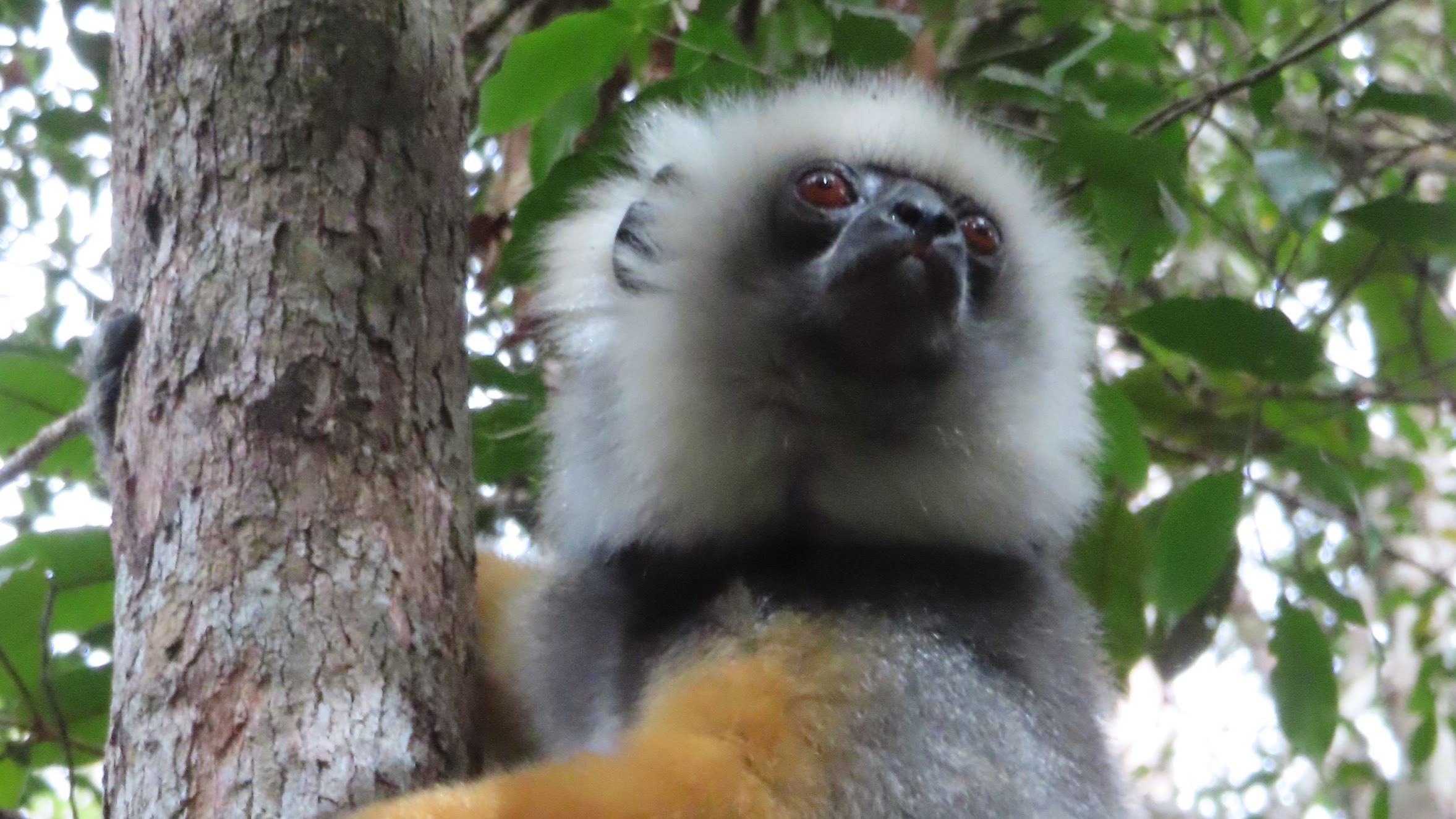
Diademed Sifaka
The one at the top of the page is a sifaka. As I mentioned above, these are in the indri family. They really stand out in the canopy because of their color, making it easier to get photos of them than any of the other lemurs.

Woolly lemur
Woolly lemurs are the smallest members of the indri family (I actually have no idea how or why the taxonomy of lemurs is divided into different families and genera). They weigh from 0.6 to 1.2 kilograms (less than 2.5 lbs). We only saw them at night, and I didn’t get any good photos, so here’s one I found online.

Bamboo lemur
As their name suggests, bamboo lemurs live around bamboo. They can weigh up to 2.5 kg (5.5 lbs).

Brown lemur
There are a few species of brown lemur, and I have no idea which we saw. They are one of the less endangered species, and I’m suspecting we saw the “common brown lemur,” since they are the most common. They weight between 2 and 3 kg (4.4 to 6.6 lbs).

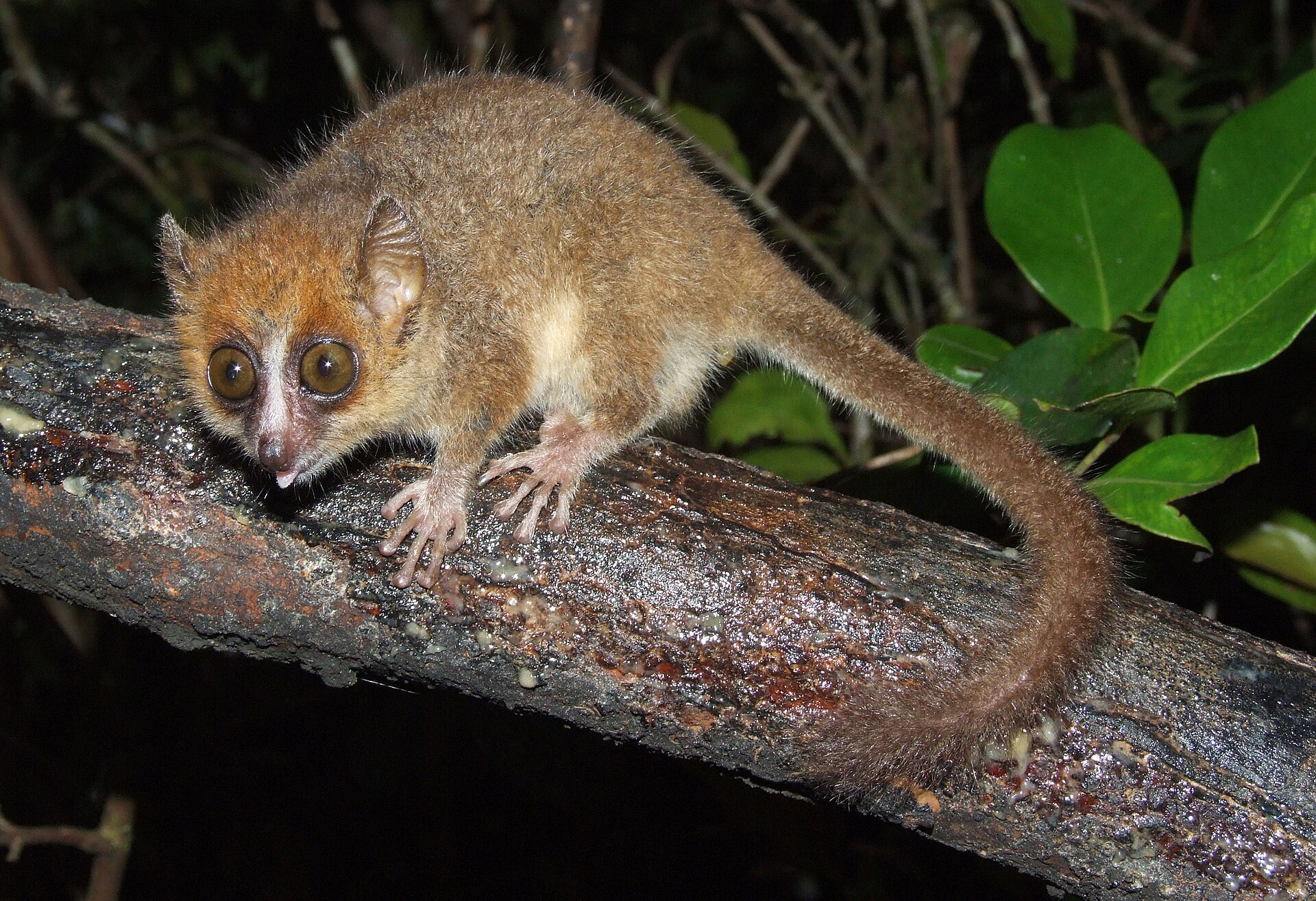
Mouse lemur
The smallest lemur is also the smallest of all primates, weighing 30–65 grams (less than 2.5 oz). I didn’t get any photos. The one I saw was scurring into its nest, so I got just a quick glimpse. Here’s a photo from the interwebs.
Other critters
Analamazaotra had plenty of other animals, few of which were photogenic. Here are a few I did manage to get photos of. Almost all are endemic to Madagascar, meaning they can be found nowhere else on earth.


Andasibe Village
After our morning walk in the National Park, we visited the village of Andasibe. With about 5,000 residents, this is not a tiny village. It made me a little uncomfortable walking through a village where people who are not tourist attractions were attracting the attention of tourists. I asked our local guide, and he said that the local people are accustomed to having visitors and don’t have a problem being in our photos.


Sleep
I’m happy to report that my sleep schedule has finally stabilized. I’m getting about six hours a night, and my Fitbit tells me my sleep quality has been in the “Good” range for the past three nights.
Photos
Here are all my photos from Andasibe and here are the ones from Analamazaotra National Park.