
Issyk Kul is the second largest high-altitude lake in the world (after Lake Titicaca). It is also the eighth-deepest lake in the world, the eleventh-largest lake by volume, and the second-largest saline lake. Since it’s at an altitude of just about one mile above sea level, it tends to be chilly here, though the lake rarely freezes due to its salinity. And “chilly” (with a lot of overcast and some sprinkles of rain) accurately describes the weather we’ve had here in the last two days.
We stayed two nights at a sort of resort. It’s probably a hopping place in the summertime, when local travelers come to escape the heat. But in early May, aside from our group, everyone here seemed to be Russian bicyclists in training. We did actually see some hardy souls in the lake, but for our part, a short boat ride, bundled up in blankets, was sufficient. (It was probably in the 50s, but the wind made it feel a lot colder.)
Here’s a video from the hotel website that shows what it might be like in peak season.
The mountains you could see across the lake in the video, we couldn’t see at all because of the grey skies. There was no outdoor dining, no dancing on the beach, no swimming, no tennis, no ice cream, no pizza fresh out of the oven (we did go out for pizza last night at a nearby restaurant, though). And no happy face.
Golden Eagles
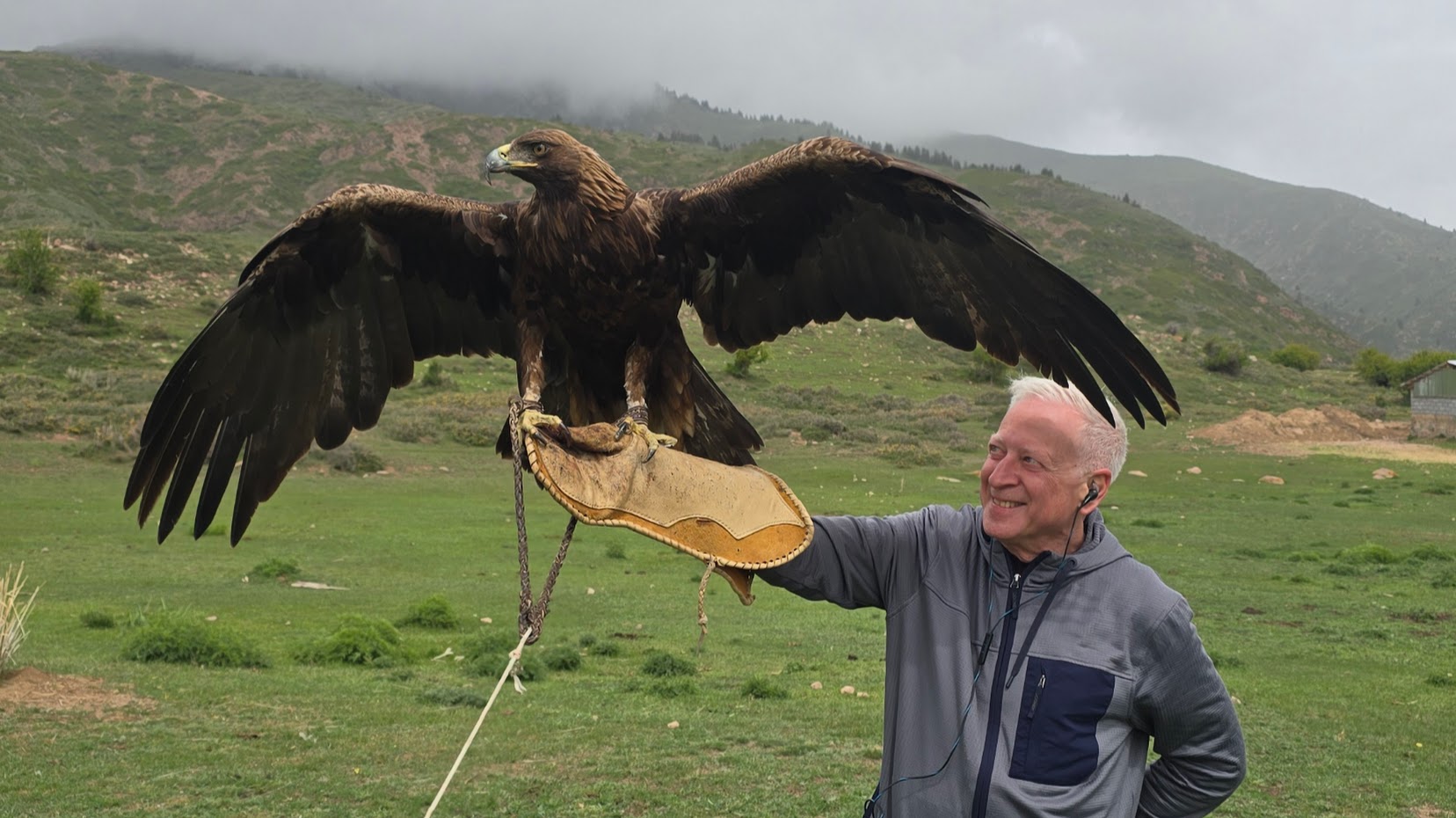
By far, the highlight of our visit here was an encounter with golden eagles. We met a man who works with these majestic birds to compete in an annual festival called Salbuurun. The events include lure hunting, where the eagles must fly to catch a fox lure dragged by a rider on horseback, and speed and accuracy tests, where judges evaluate how directly they fly from a distance to their target.
Our host, along with his ten-year-old son, demonstrated how the eagles perform.

It was a fascinating learning experience, though I would have liked to know more about how humane it is to take these creatures into captivity. They are released after fifteen years, and they can live upwards of fifty years. Our host seemed to have an excellent relationship with his birds, but I wonder how carefully (if at all) the treatment of birds kept by these hobbyists is monitored.
We learned that there is a problem with people from other countries bringing older birds into Kyrgyzstan and swapping them for younger birds. They track only the number of birds being brought in and out, and they don’t have any way to determine whether the birds being brought in and out are the same.
Other stuff in Issyk Kul
The only other things we did here were the aforementioned boat ride and a visit to an open-air museum of petroglyphs.


Mountain goats with very large horns. At the upper left is a much smaller man with a leash, and a snow leopard at the end of the leash. The men have bows and arrows. Three other snow leopards approach.
I don’t know who figures out what’s actually going on in these scenes, but it’s pretty cool.
Today we’re off to Bishkek, the capital of Kyrgyzstan. That will be our final stop on this tour and my final destination before heading home. It’s supposed to be a little warmer there, in the upper 80s Farenheit.
SueAnn Griffin
Oh it look so fun