
My delayed overview of Samarkand
We left Samarkand yesterday (now I’m in Bukhara). I started to think about writing this post two nights ago, but I couldn’t figure out what I wanted to say about Samarkand. I’m still not sure, but I can delay no longer.
Impressions of Samarkand
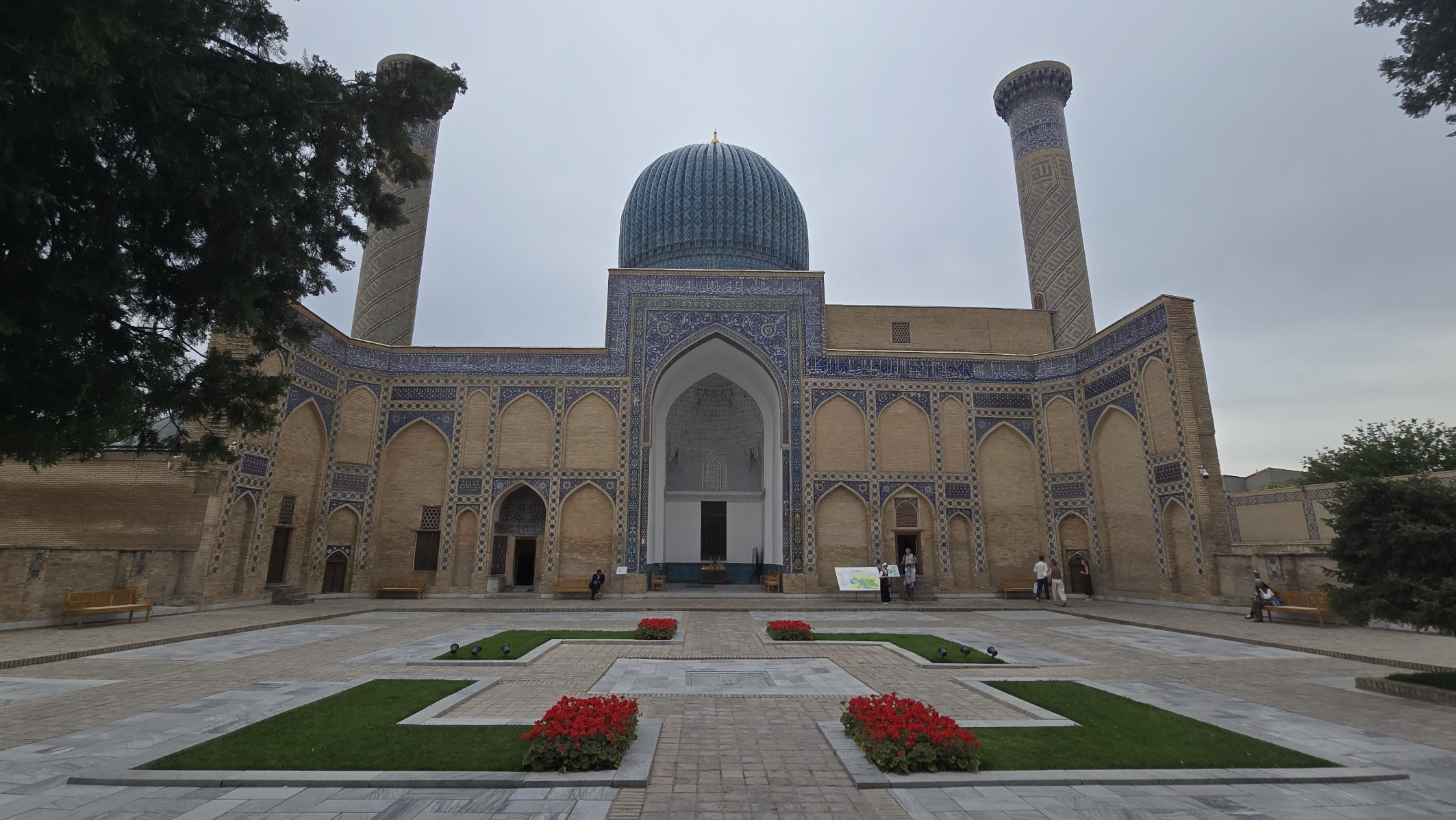
There’s no way to put into words how stunning the historical landmarks of Samarkand are. I can only show you.
At the top of the page is Guri Amir Mausoleum, where Timur (aka Tamerlane) is buried. Alongside him are his sons, Shah Rukh and Miran Shah, grandsons, Ulugh Beg and Muhammad Sultan, and his teacher, Sayyid Baraka.


Do you notice any similarities? In two hundred years, not much changed.


How can you see all this beauty and not be awestruck?
I was awestruck, but I was also disappointed somewhat.
These stunning sites are scattered around Samarkand. In between, the city is nondescript.
In addition, there is so much history attached to all of this monumental construction. And if you have been reading my blog from time to time you know I’m a big fan of history. But I just struggled to wrap my brain around it all. After a while, I just wanted to forget the history and appreciate the magnificence.
Part of the challenge of contextualizing all of this is that nothing is chronological. Things from different eras are juxtaposed. Over the course of 2 1/2 days in Samarkand, we repeatedly jumped back and forward in time. Alexander the Great, Genghis Khan, Tamerlane, Mohammed, and lots and lots of other names, some I’ve heard of and some I haven’t. Trying to place these figures into a historical chronology is really hard!
Our trip leader, Yura, is such a font of information, and we would often stand in one place for a while listening to him telling us about the history of what we were seeing. Eventually my mind wandered and I lost track of the narrative.
Looking back at my photos, I am wowed all over again. Maybe even more than when I was there. Maybe the secret is to just appreciate it all aesthetically and not worry about the names and dates.
Archaeology
We visited an archaeology museum, the Museum of the History of Samarkand and the City of Afrosiab. These kinds of museums are generally not my bag. I don’t get much value from looking at shards of pottery and the like. Plus, as I said, there was too much history just exploring the city.
But there was one exhibit there that impressed me a lot.

Afrasiab (or Afrosiab) is the ancient, foundational site of Samarkand, located north of the modern city center. Occupied from roughly 500 BC until its destruction by Genghis Khan in 1220 AD, the 220-hectare site contains massive archeological ruins, including 7th-century Sogdian murals, and is a major center of Central Asian history.
Among the artifacts found in the ongoing excavations of Afrasiab are wall paintings that decorated a room in a house or palace. They believe it was the residence of the ruler Varkhuman, who governed this region in the later half of the 7th century. And these murals probably decorated the hall in which foreign ambassadors were received. The four walls tell four different stories: reception of foreign envoys by the governor of Samarkand, paying reverence to the grave of the father of Varkhuman, hunting on leopards and such different events.
Here’s a video (which we watched at the museum) that tells about it. It’s about nine-and-a-half minutes, but it’s fascinating.
Interactions
We had some opportunities to interact with locals and travelers from other places, and that was an interesting and enjoyable break from the sightseeing.
OAT always has a home-hosted dinner, where we visit a local family and eat with them while sharing stories and learning about each other.


Half of our group visited this very nice family. Mom and dad didn’t speak any English. The older daughter, Anora, who is 20, was very fluent; her younger sister, 15, less so. They they also had an 11-year-old brother who had gone to bed before we got the family photo.
There was lots of conversation about a lot of topics. In particular, Anora told us about her parents’ arranged marriage and about how she is ready for marriage and is narrowing down the prospects. Her father, as translated by her, said that the clock is ticking and he is eager for her to get married and start making babies.

OAT has what they call “controversial topics.” Apparently there is controversy in Uzbekistan about arranged marriage vs. love marriage, but none of that controversy was present here. Both of these women had an open mind about the topic. To be honest, I would have preferred to learn about the school and the study of languages.
That’s it on Samarkand. No history lesson!
Fabulous as always. I am struck by the lack of hordes of people in your pictures of the buildings..
Gail, the lack of hordes is a combination of factors. Patience (waiting for hordes to dissipate) helps. Time of day (early morning is always a good time). And Google’s Magic Eraser! It also helps get rid of things like garbage cans, street signs, and other out-of-place items.
Beautiful photos!
Thanks Liz!
Thanks for the photos and stories. I have great memories of the Stans and, yes, it’s easy to forget the history, even in the moment. It is so complex. That said, it’s an interesting fact that matched marriages have a much better chance at surviving (4–6% divorce rate) than the Western “love” marriages (40–50% divorce rate). I’m starting to believe that a matchmaker would work much better for me than an app!
Keep enjoying your trip!
I think arranged marriages have a better success rate for a variety of reasons. The more I learn about it, the more sense it makes. But good luck finding someone in Mexico to do that for you!