
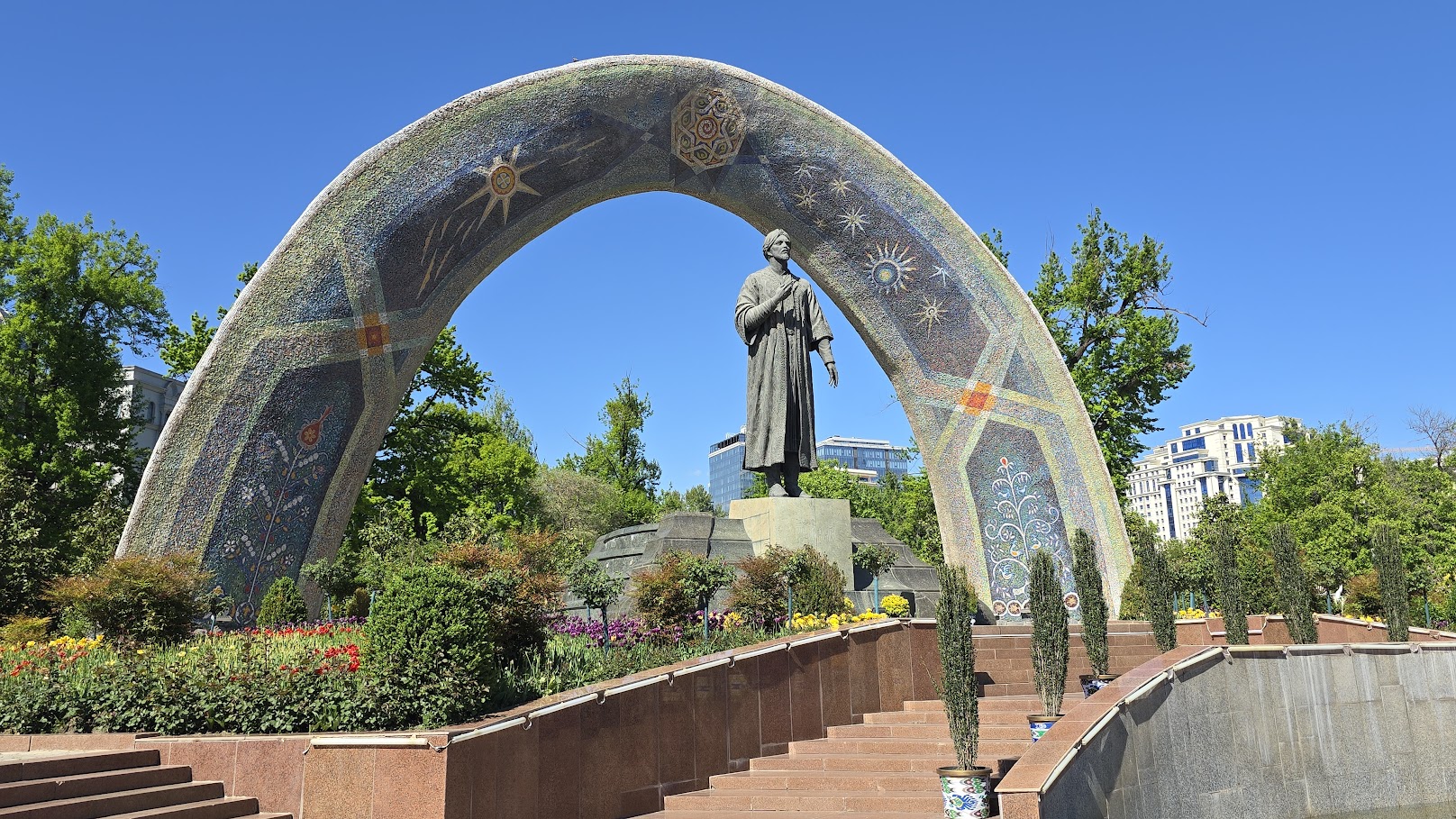
Sometimes it’s easy to select a representative photo of the place I’m visiting to put at the top of my blog posts. This time, not so much. Dushanbe has many fascinating things, but no one of them captures the feel of the city.
Perhaps that’s because this city is really just 102 years old. When it became the capital of Tajikistan in 1924, it was a village with a population of about 1,000. Today there are a little over 1.2 million residents.
So there’s nothing old in Dushanbe. And in fact the city seems to be getting newer by the day. I don’t think I’ve ever been in a city with as much ongoing construction. In some sections of the city, cranes fill the sky, and they all seem to be erecting residential highrise buildings.


Apparently these are all replacing Soviet-era apartment blocks. Many houses, some that seem to predate the 1924 founding of the capital, remain, as you can see in this view from my hotel room window.

But for my “cover photo” I wanted to select something meaningful that bows to Tajikistan’s past while also recognizing Dushanbe’s modernity. So the picture up top is a monument to the Persian poet Rudaki (858–941) in the park named for him. Rudaki is considered the father of Tajik literature.
Flowers
Another candidate for a cover photo would have been any of the beds of tulips and pansies that decorate the city. Dushanbe is a city that goes to great lengths to be colorful.


Monuments
As the capital city, Dushanbe is rife with monuments and with government buildings that are monumental. I am not sure how to describe the architectural style.

Ismail Samani (849–907) was founder of the Samanid dynasty and is considered the father of the Tajik nation.
The monument was placed in 1999 to commemorate the 1100th anniversary of the Samanid state.


They seem to love columns in Dushanbe!
And not just government buildings adhere to this standard.


Perhaps the most monumental of all the buildings I saw was Navruz Palace. This started out as an effort by a private consortium to build the largest teahouse in central Asia. It turned into something more.

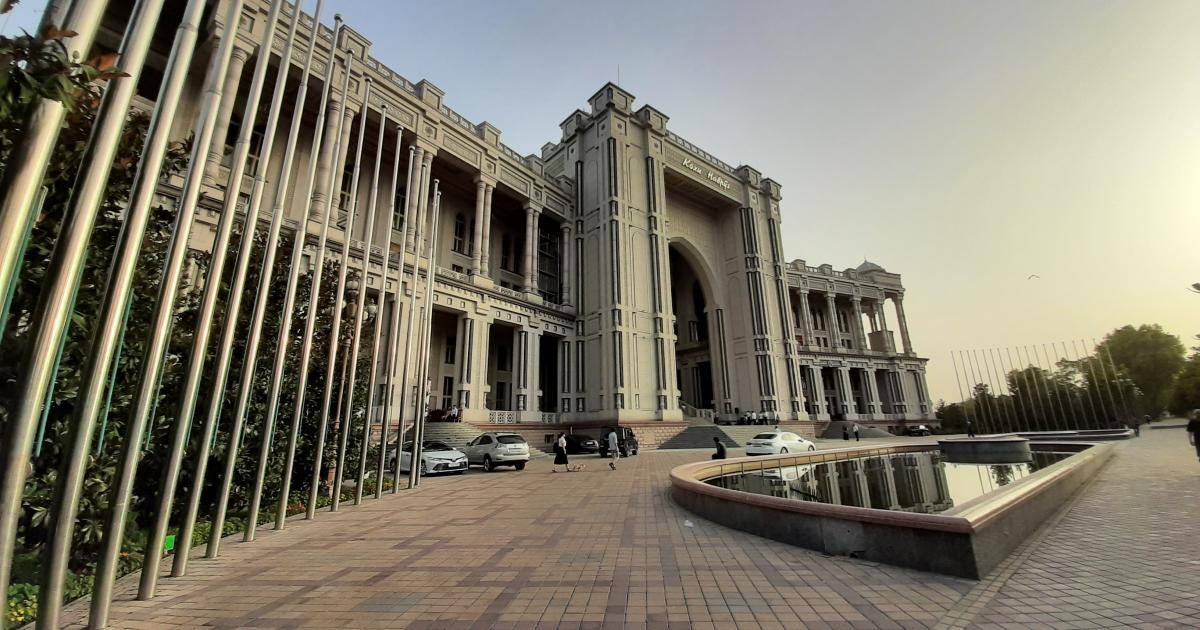
The real jaw-dropping extravagance of this building is the interior rooms.


Tajikistan 101
I was going to do a history lesson, but my photos distracted me. So let me rush through the history.
I already mentioned Ismail Samani, the father of the Tajik nation. But in fact, there was no real nation of Tajikistan until the 20th century. Samani established an independent empire in central Asia, including what is now Tajikistan as well as parts of Uzbekistan. But a succession of conquerors took control over the next several centuries. The last of those was Imperial Russia in the 19th century.
After the Russian Revolution in 1917, rebel groups called basmachi fought against the Bolshevik armies. After four years the Bolsheviks prevailed.
The Tajik Autonomous Soviet Socialist Republic was established in 1924 as an autonomous republic within the Uzbek Soviet Socialist Republic. In 1929 they became the Tajik Soviet Socialist Republic, separate from the Uzbeks. The Soviets government required a particular dialect of Persian, which they named “Tajiki,” to become the national language of Tajikistan. At first Tajiki used the Latin alphabet, but in 1940 it switched to Cyrillic. These changes had the effect of cutting the Tajiki people off from the world of great Persian literature.
In the 1980s, Tajikistan was pretty much the poorest of all the Soviet republics. They also had lowest rate of university graduates. Tajik nationalists began calling for increased rights, but only in 1990, as the downfall of the Soviet Union was imminent, did serious uprisings begin.
Tajikistan today
Tajikistan declared independence on September 9, 1991, and almost immediately fell into a civil war that lasted until 1997. Emomali Rahmon, who became president in 1992, is still president today, and there are concerns about unfair elections and lack of basic freedoms. I have noticed that while I can access the New York Times website while using the hotel Wifi, it seems to be blocked if I’m using a local data plan.
Tajikistan is a secular state, though somewhere between 95% and 99% of the population is Muslim. While not strictly regulated by law, bushy, uncontrolled beards are discouraged and may be forcibly shaved by authorities. Women are not allowed to wear hijabs in public, and revealing clothing is also prohibited. Clothes that don’t match the traditional Tajik national dress (often colorful dresses with trousers) are discouraged.

Music and Art
I’m about out of time, but I want to quickly mention two of the most interesting things we did in Dushanbe.
We visited a local ensemble of some renown, and they played some traditional music on traditional instruments.

And we visited the studio of one of the world’s foremost Florentine mosaic artists.

Read all about it and see all the photos (and some video) in my album.
Donna Seegar-Sedmak
As a fellow member of your tour group, I just wanted to add a comment about the women’s clothing. Although they wore “modest” clothing, the women of this country had so much glamour because of the glitter and sparkly embellishments on their clothes and scarves. They and their apparel were beautiful.