
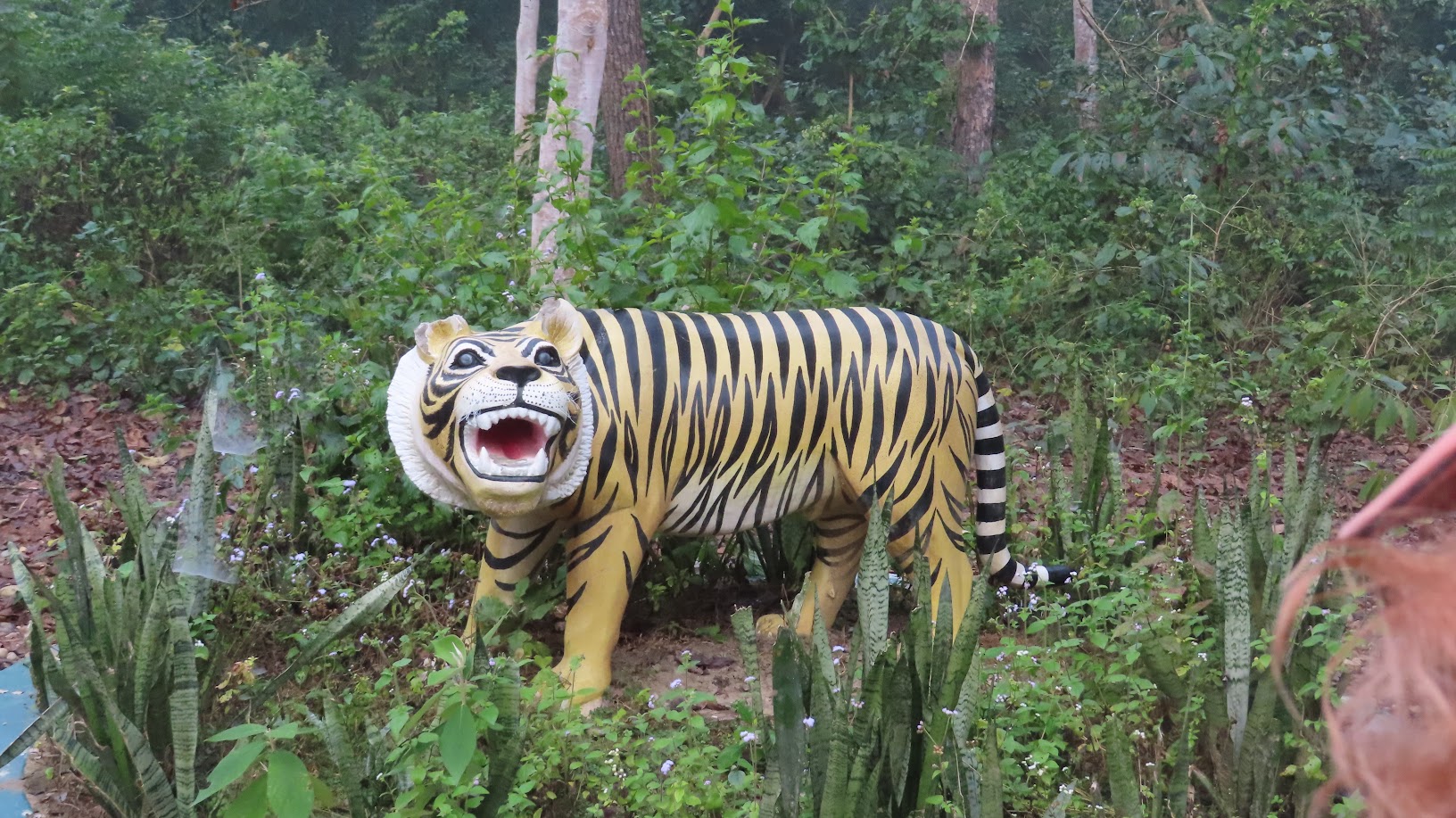
I was hoping to see a tiger (or two) in Chitwan National Park, but it was not to be. I guess I will have to settle for the two tigers I saw in Ranthambore, India.
There were a whole lot of Indian rhinoceroses and gharials, two animals I’ve never seen before, and a number of other critters, so it was a worthwhile end to my time in Nepal.
Now I’m back in Kathmandu, where we visited an important Hindu temple, and this evening we’ll have a farewell dinner and I’ll bid farewell to most of my fellow travelers. Then, tomorrow morning, I’ll travel back to India for some new experiences there. There’s just one other traveler from the tour going on the post-trip: it’ll be the Artie-and-Lane show!
Anyway, here’s a quick rundown of our stay in Chitwan.
Our hotel and some culture
We stayed at the Kasara Resort, which was super lovely. The rooms are huge, which an entry way that was like a living room, bedroom to one side and bathroom to the other. Except that the bathroom sink had a leak (which they fixed) and the hot water ran out quickly if you like a long shower (which I do), it was very luxurious.
We had a naturalist from the hotel assigned to our group. On our first afternoon we visited a Tharu village. He explained that the Tharu migrated from Rajasthan, in northern India, around the 16th century, when the Mughals defeated the Hindu Rajput kingdoms in the area. They settled in this region, which was considered uninhabitable and inhospitable because of malaria. But the Tharu have a genetic resistance to malaria, and they thrived here.

The Tharu people are also known for their art and folk dance. Later that evening, by our hotel pool, we were treated to a dance performance called Lathi Nach, which is performed by groups of women rhythmically striking sticks with each other.
Animals
We started our animal encounters on a bridge over the East Rapti River. Have you ever heard of the gharial? I hadn’t. It’s a species of crocodile (Gavialis gangeticus) that is critically endangered. In the 1940s there were an estimated five to ten thousand gharials in Nepal and India. Today there are just about 650 left in the wild, about 265 of which are in Nepal. Conservation efforts are succeeding. We also visited a gharial breeding center, which was established in 1978. They are breeding, hatching and raising gharials until they reach the age of six years, and then they release them. But there is a long way to go to bring them to a sustainable population. Gharials eat fish, and overfishing has limited their habitat.


We did a jeep safari yesterday. Sadly, the only tiger we saw was the one at the top of the page.
But the rhinos were very interesting, and so different from the ones I saw in Africa last year.


(I took some photos with my camera and some with my phone. They render color quite differently!)
Here are some of the other wildlife encounters we had:


Back in Kathmandu: Pashupatinath Temple
We flew back to Kathmandu this morning and visited Pashupatinath Temple, one of the holiest places for Hindus in Nepal. Here we witnessed cremation ceremonies along the banks of the Bagmati River.
According to the Nepalese Hindu tradition, the dead body must be dipped three times into the Bagmati before cremation, so that the reincarnation cycle may be ended. The chief mourner (usually the first son) who lights the funeral pyre must take a holy river-water bath immediately after cremation. Many relatives who join the funeral procession also take a bath in the river or sprinkle holy water on their bodies at the end of the cremation. It is believed that the Bagmati River purifies people spiritually.
Wikipedia


Final impressions of Nepal
To be honest, Kathmandu is kind of a pit. Lots of traffic, and not lots of beauty. A few interesting sights, to be sure, but Nepal makes its best impressions away from here.
The mountains of Nepal are breathtakingly beautiful. For me that was the highlight of being in this country. And not just the highest peaks of the Himalayas, but the experience of the foothills and the river rafting down the the flatlands of the south, all of it was thrilling.
This was my twelfth OAT tour, and by far it put the Adventure in Overseas Adventure Travel more than any of the other eleven.
See in back in India!
Don’t forget to check out the rest of my photos from Chitwan.
adria Sherman
So nice traveling with you lane. I really appreciated not only your companionship but your blog and photos also.
Adria