
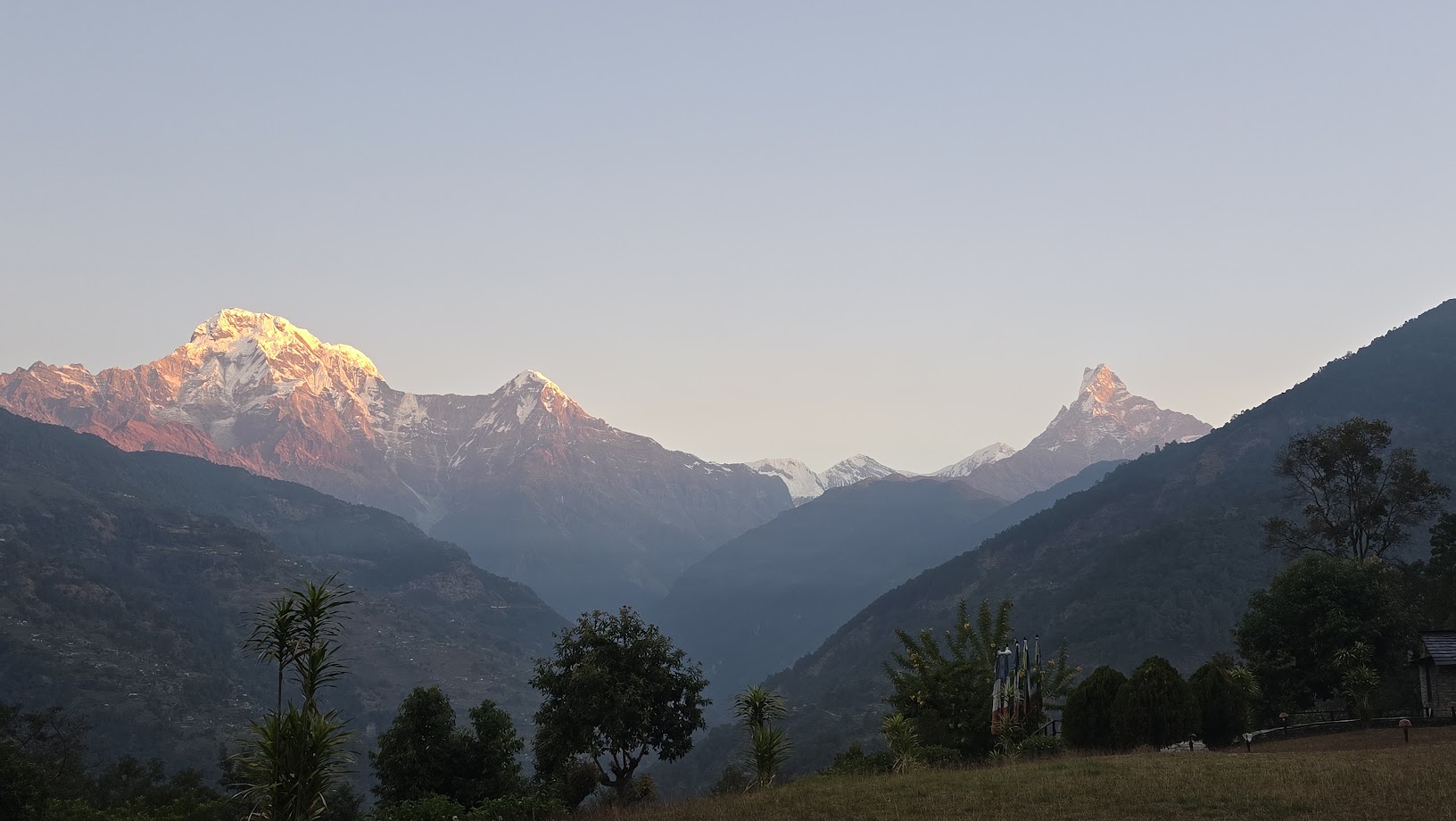
We spent three nights at a mountain lodge in the Annapurna Valley. This is possibly the closest I’ve ever been to heaven. A good portion of the experience was trying to photograph the view (up top) in different light at different times of day and from different angles. And a better portion was spent just gawking at it.
There were some activities along the way: hikes and visits to villages, a school, and a health clinic. We met some of the lovely people who live in isolated places the the Annapurna Valley, and we learned about the many who have left for life in the city, or for work abroad.
Getting to the Annapurna Valley
Flying to Pokhara
It was no simple matter getting to Pokhara or to our mountain lodge. We had a flight scheduled to depart Kathmandu at 7:00 am, which obviously meant a very early departure from our hotel. Well, actually, not that early, because flights rarely operate on time from Kathmandu to Pokhara due to fog at the airport. We didn’t even leave our hotel until 6:45. Still an early start, but nothing like getting there two hours early!
Our flight eventually departed a little before noon. The flight was just about 25 minutes, still enough time to serve a bag of nuts and a cup of water. Talk about service! Yeti Airlines is the best!
Next we got on a small bus (or large van) and rode to a local restaurant for lunch before continuing toward our mountain lodge.
Driving then trekking
Because of our late start, we rushed through lunch and back to the van/bus. We drove about an hour to a drop-off point on the “highway” (using the term loosely) near the village of Lumle. There we met our porters: seven women from nearby villages who carried our luggage in baskets in a way I’ve never seen before.

Raz, our trip leader, told us that it would be possible (and cheaper) to hire a jeep to carry our luggage to the lodge, but these women need the work.
It was about a two-hour trek, first through the village of Lumle, and then along a road that was occasionally paved, but mostly either dirt or gravel or rocks. We started at 3:30pm, and we wanted to be sure to arrive before dark.


Somehow, maybe because it was cloudy and maybe because we were too busy looking at where we were walking, none of us ever saw the stunning mountain view. Raz told us we’d be getting a 6:30 wakeup call the next morning for a mysterious reason. And at 6:30 the next morning I walked out of my cabin and saw that amazing view.
And an hour later, the full moon began to set.

Patlekhet
After breakfast we went on a hike (or trek; I’m not sure I know the difference) to the village of Patlekhet.


Then we went back to the village and met a migrant worker who shared his story with us.

Many Nepalese men are forced to go abroad to work because there is not much work in these small villages. This man went to Saudi Arabia, where he was told he could become a supermarket manager. Instead, when he arrived, he was put to work in the fields, working in the hot sun from dawn to dusk. They took away his passport and withheld his wages. He got sick with what turned out to be an ulcer, but he was told if he didn’t work he wouldn’t get paid. He finally got his salary, which was less than promised, and he returned home.
But he still was without work, so he left again, this time to Qatar. Things were better there, but still he had to stay there, if I remember correctly, for six years.
No he is back in his village, where he is a social worker. His story was heartbreaking. At one point he broke down talking to us.
Later, back at our lodge, there was time to enjoy the view some more.


Majhgaun
The next day (yesterday) we trekked again, this time to the village of Majhgaun. This is a village that has benefitted from support by Grand Circle Foundation, the charitable arm of Overseas Adventure Travel.

School
Our first stop was Shree Tanchok Majhgaun Basic School. This school has also received funding from GCT, enabling the construction of toilet facilities and the purchase of laptops. Since GCT began supporting the school and community here, enrollment has doubled from 13 to 26. We watched as the children arrived. Some walk an hour from other villages to attend school here. School is not mandatory in Nepal, so getting parents to send their children a long way to attend is a significant achievement. They all have clean uniforms and look to be well groomed.

Later we broke into groups and visited the children in their classrooms. I interacted with the first graders, five six-year-olds.

I tried to teach them “Head, Shoulders, Knees, and Toes,” but they already knew it. And they sang the alphabet song for us as well.
Health Clinic
Our next stop was the local health clinic. Here we met with a young man who is an EMT, and he told us about the challenges of providing vaccinations, medications, family planning, and childbirth support. GCT bought them an incubator for premature babies.
He also talked about how USAID has supported them in the past by providing medications, and how that has dried up in the past year. We’ve all heard about how the current administration in Washington, DC, gutted USAID. But it’s one thing to read about it in the newspaper; it’s another thing entirely to see first-hand how it’s affecting real people.
Villagers
Next we walked through the village. This was enjoyable, but kind of weird. It reminded me of Colonial Williamsburg or Sturbridge Village. All the people were out doing their handiwork: milling grain; blacksmithing, carpentry, weaving, making things out of corn husks, feeding goats. Everyone was dressed in traditional outfits. I honestly wondered (and wonder) whether everything was staged for our benefit.


Eventually, we came upon a group of women who were preparing lunch for us. Some of us got to help. I chopped up some Swiss chard.
After a delicious lunch, some of the women danced for us and pulled us out of our chairs and got us to dance too.
This is what OAT calls “A Day in the Life.” I’ll give them the benefit of the doubt and accept that what we experienced was an authentic slice of life in a mountain village in the Annapurna Valley.
Departure
This morning we hiked back to Lumle to get the bus back to Pokhara.

I’ll pick up the story of my Nepalese adventures from there. I just have to say how hard it was to leave this beautiful place. But I suspect there will be more encounters with paradise before this trip is over.
I have lots more photos and a number of excellent videos in my photo album. Please click the link to see them all.
Joy Sherman
Dear Lane,
What spectacular treks and village visits!
The pics are wonderful. I was deeply touched by the man who was treated with such dishonesty and cruelty when he travelled abroad for work. His story is heartbreaking, but I’m so happy he was able to come home.
Thinking about you and immensely enjoy your blog!
Tim
Lane,
This trip is particularly amazing. Thank you for sharing your stories and photographs.
Tim
(Mary) Sheila Bartle
Your appreciation and enjoyment of other cultures is so rich, Lane — thank you.