
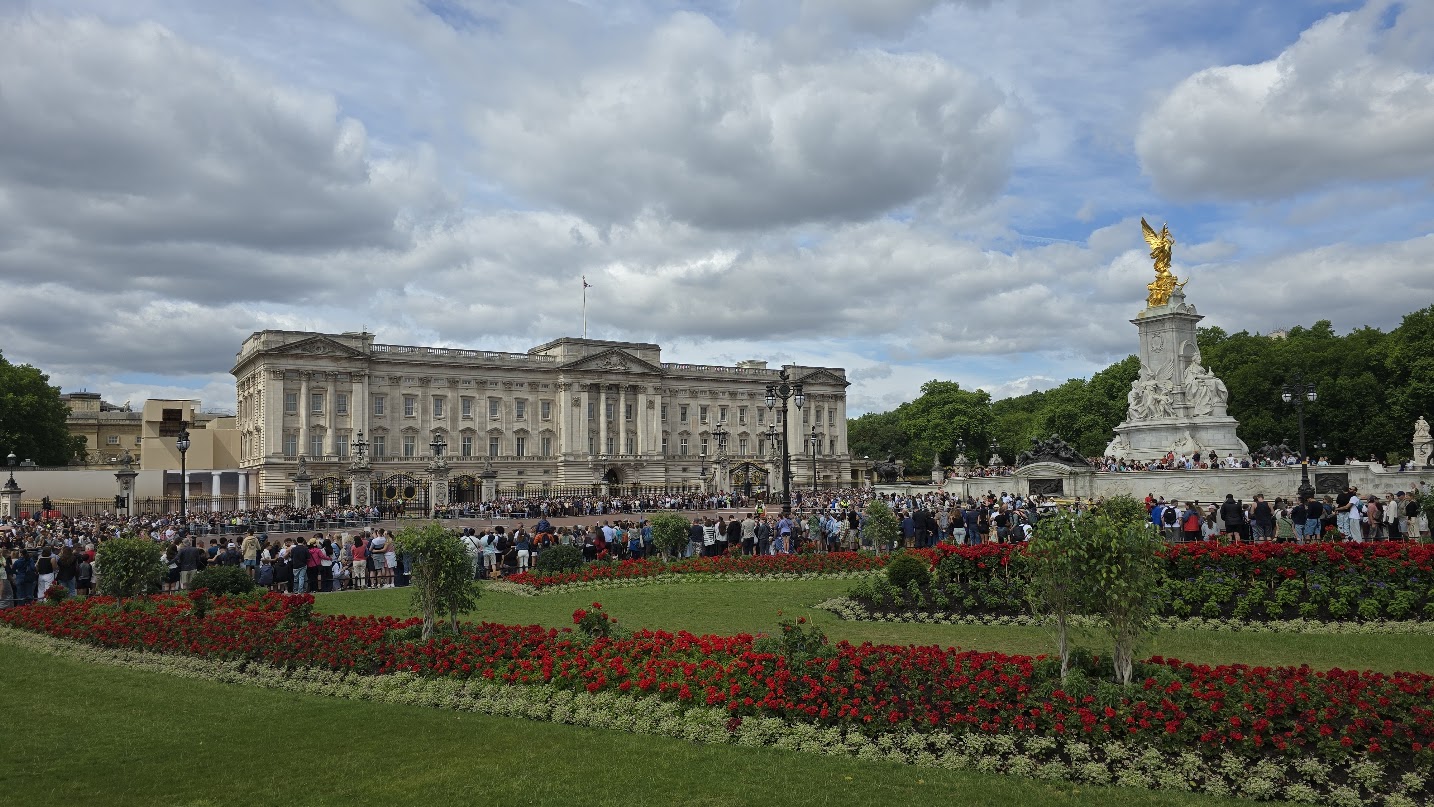
I spent my first morning in London doing a Changing of the Guard tour. And I spent the afternoon at the National Gallery. Here’s a bit of detail about the day.
Premier Inn
I started the day with breakfast at my hotel, the Premier Inn London County Hall. I won’t be doing that again. It was a huge buffet, expensive, and not very good.
I kind of regret having chosen to stay here. Though the location is good and my room is fine, but it just feels impersonal and utterly devoid of character. Plus you have to request housekeeping each day. And you have to enter a new WiFi password every day. I’m nitpicking, I know, but still, London has so many interesting and historic hotels. Why didn’t I choose to stay in one of them?
Changing of the Guard Tour
I booked this tour based on recommendations from the Rick Steves Travel Forum. It did not disappoint. In fact, the tour was better than the actual pomp and ceremony.
There were probably about twelve of us on the tour. Our guide, Rick Jones, was a hoot. He was also super knowledgeable. He talked a lot of Joseph Haydn, the Austrian composer who came to London in the 1790s. And he gave us a great deal of background on what the Changing of the Guard is all about.
History
It started with Charles II, who was living in exile in Paris after his father, Charles I, was beheaded in 1649, and Oliver Cromwell became Lord Protector. Even though the people didn’t like the monarchy (Charles I tried to raise taxes), it seems they liked Cromwell even less, because he dissolved Parliament and attempted to establish a strict morality. Life was more fun under the monarchy, so when Cromwell died in 1658, Charles II returned and London celebrated.
Seeing a need to protect the monarchy, Charles established the King’s Guards. There were two regiments. The Grenadier Guards, established in 1656, are ranked first in order of precedence; the Coldstream Guards are ranked second, even though they are older (1650).
Today’s fun
The Changing of the Guard takes place four times a week, replacing one of the regiments with the other. Today the Coldstream Guards (with red plumes in their bearskin helmets) arrived and took over from the Grenadier Guards (with white plumes).
We started in Piccadilly Circus and walked to The Mall. The ceremony began with the marching of the Gurkhas, Nepalese soldiers who previously served in the British Indian Army.
Next a cavalry troop came back up The Mall from Buckingham Palace.

After that, we walked to Buckingham Palace and watched the entrance of the Coldstream Guard.
The crowd was huge, and that’s really all there was to see. Next we walked through St. James’s Park to the Horse Parade grounds. (Rick told us that this area, the largest public square in London, was the location of the beach volleyball competition in the 2012 Olympic Games.

To be honest, I have no idea what all these different pieces of activity had to do with the Changing of the Guard. But it was fun to watch it all. And Rick made it very enjoyable.
National Gallery
I had prebooked a 1pm entry time to the National Gallery, but that turned out to be unnecessary. I stopped for an ice latte at a local coffee shop. Have I mentioned that London is very expensive? My small beverage cost six US dollars.
I got to the National Gallery at 12:30. It’s free to enter (I guess that makes up for how expensive everything else is), but I read somewhere that it’s good to prebook so you don’t have to stand in line to get in. But there was no line at all. I walked right in. No one checked my ticket.
Even though there was no line outside, the Gallery was very crowded.
José María Velasco
I was excited to see they are running a temporary exhibit of paintings by José María Velasco, a Mexican landscape painter who lived from 1840 to 1912. I was not familiar with Velasco, but I was eager to see the exhibit, so I got a ticket. (It was not free.)
This is the UK’s first in-depth exploration of Velasco’s work and the first ever dedicated to a historical Latin American artist at the National Gallery.
His work is stunning.

This monumental vista unites the Valley of Mexico’s natural grandeur with several places of great historical significance. The small rise at the centre of the painting is the hill of Tepeyac, a sacred Mesoamerican site. The colonial-era Basilica of Our Lady of Guadalupe nestles at its base, while modern Mexico City, built on the remains of Tenochtitlan, the capital of the Mexica (sometimes called Aztecs), appears in the background.

In this iconic painting, Velasco depicts a majestic giant cardón cactus that he saw near the hamlet of Tecomavaca. The precision with which he renders the sunlit upper arms contrasts with the loose brushwork used for the dark tones of the lower reaches and trunk. The disparity in size between the human figure and the immense cactus makes this painting, ostensibly a botanical study, into a meditation on the natural splendour of Mexico.
The collection
There are so many brilliant painters from all over Europe represented in the National Gallery’s immense collection. I spent I think close to four hours and had to hurry past a lot of paintings.
I have a photo album with my highlights. The National Gallery website also has a page dedicated to its “must-sees.” So I won’t post any pictures here.
I’ve added to my London photo album, including some more pictures from the Changing of the Guard tour.
Tomorrow I will be visiting St. Paul’s Cathedral in the morning, doing a bit of self-guided wandering, and attending a performance of Romeo and Juliet at Shakespeare’s Globe Theatre in the evening.
Tim
Enjoy London! SO much to do and see and a lot of walking. Thanks for the Velasco photos. I don’t know much about him either, but guess what rabbit hole I’m in right now!