
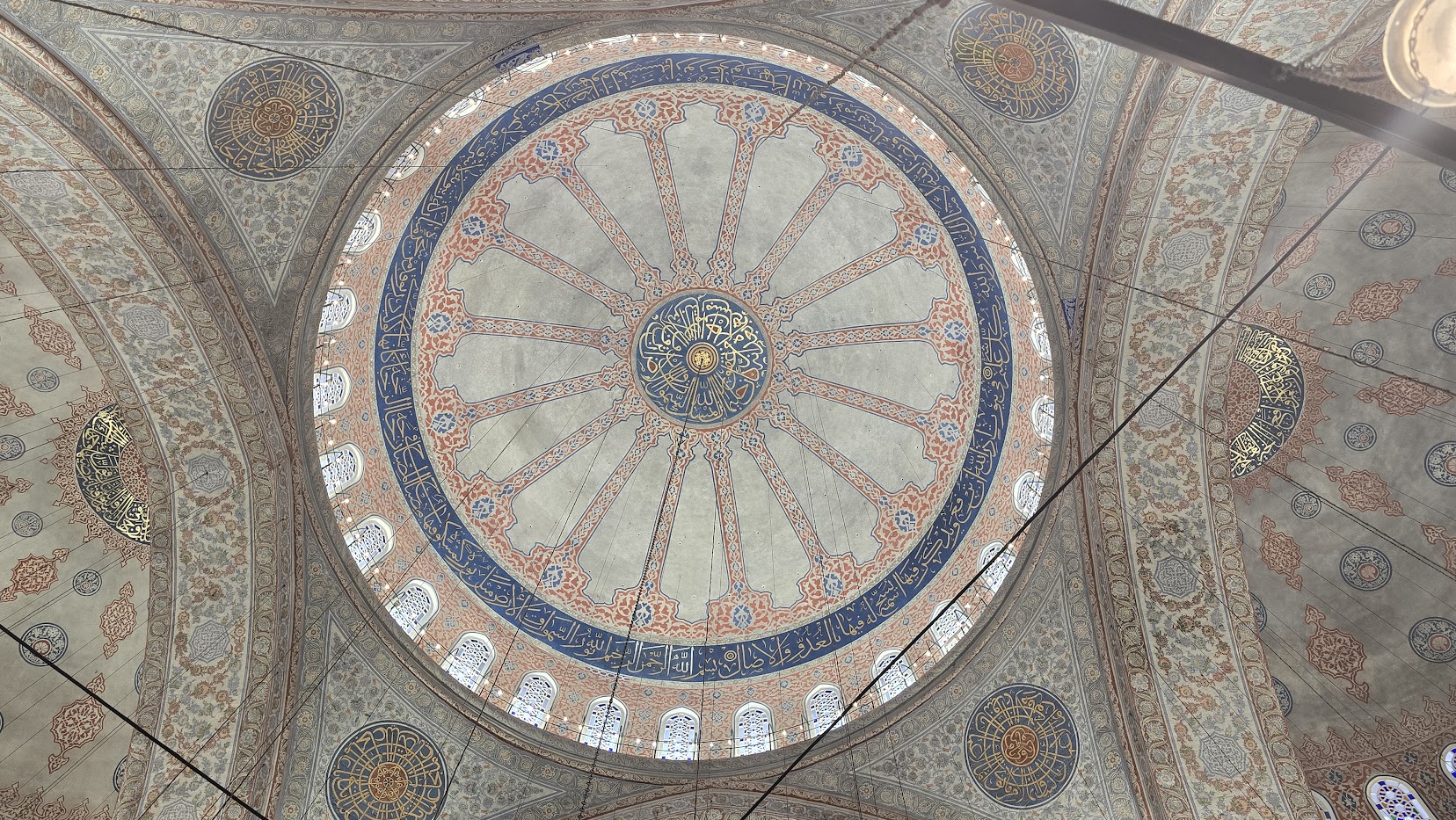
Last time I was in Istanbul, in 2022, the Blue Mosque was under renovation. I learned it was filled with scaffolding, so I opted out of visiting.
This time, it was my top priority for my Istanbul stopover.
Visiting the Blue Mosque
It certainly didn’t disappoint. It’s really beautiful inside. Though it was very crowded, everything worth seeing is up on the walls and overhead, so the crowds did not really detract from the experience.
At the top of the page is a photo I took of the main dome. The design, typical of Ottoman-era mosques, is a large dome surrounded by four semi-domes. To maintain stability, the domes are held together with curved triangular sections. Four huge arches are supported by four massive columns known as elephant’ feet.
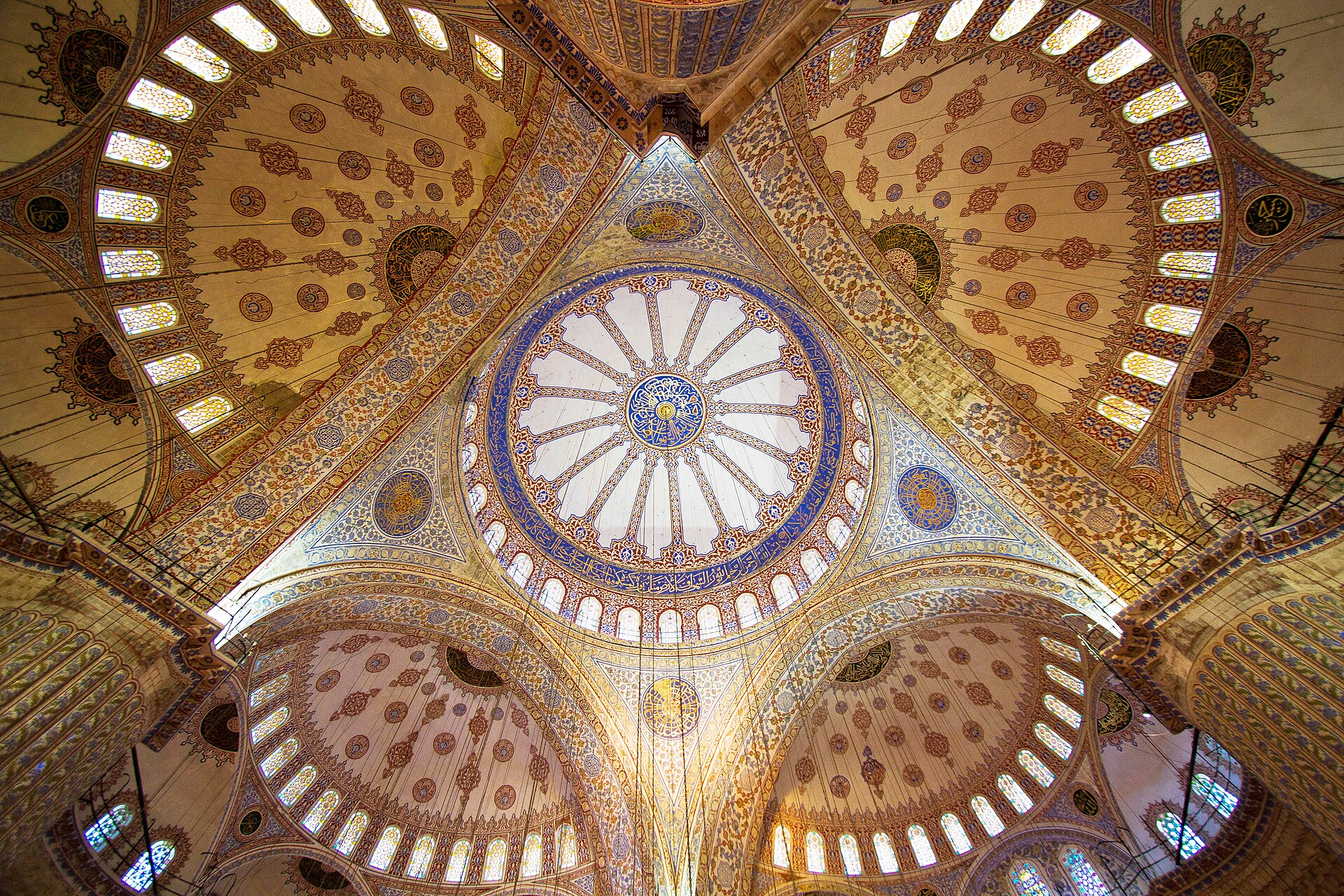
By Christian Perez — Own work, CC BY-SA 3.0, https://commons.wikimedia.org/w/index.php?curid=25931849
A little history
The Blue Mosque, officially the Sultan Ahmed Mosque, dates from the early 17th century. Ahmed I ruled from 1603, when he was just 13 years old, to 1617, when he died of typhus and gastric bleeding at the age of 27. The early years of his reign were marked by a series of wars and conflicts that did not go well for the Ottomans. For that reason, he decided to build a great mosque in order to gain the favor of Allah. But, alas, it was scarcely completed before he died. In fact, some historians believe he died before construction finished.
I enjoyed learning some of this history from a crusty guide named Hal, though I’m not sure the guided tour was necessary. Entrance is free, and there’s an audio guide.
Tiles
In any case, I was there to see the beautiful blue Iznik tiles that give the mosque its popular name. (Iznik is the town in Anatolia where the tiles were made. The ceramic craft of Iznik flourished between the 15th and 17th centuries, but lower-priced imports from China led to a decline in quality. The local craftsmen still couldn’t compete, and the last pottery from Iznik dates from 1678. Tiles in the Blue Mosque that have been damaged cannot be replaced. But there are just a few areas where tiles are missing.)
More than 20,000 Iznik tiles decorate the walls of the mosque.

Three years ago, when the Blue Mosque was under renovation, I visited the Rustem Pasha Mosque, which dates from about 50 years before the Blue Mosque. It also features Iznik tiles. Compare:

Honestly, I think I liked Rustem Pasha more.
I’m still working on my photo album, but you can find more pics of the Blue Mosque here.
Museum of Turkish and Islamic Arts
I never made it to this museum on my last visit to Istanbul. I’m glad I made it this time. I love history, but I’m not interested in museums that merely present historical artifacts and required a lot of reading. But when these artifacts are presented as works of art, as is the case at the Museum of Turkish and Islamic Arts, count me in!
From ceramics to metalware to calligraphy to carpets, this museum was awesome. I think my favorite pieces were the exquisite Qurans.


Lots more photos from the museum are in my album.
Sleep
After a quick lunch, I came back to my hotel for a nap. I did this stopover in Istanbul in part to have a few days to adjust my sleep schedule before I join my first OAT tour on Saturday. Unfortunately, it’s not going well. I got a good nap and then stayed up until about 11pm. But I woke at 2:30 this morning and couldn’t get back to sleep, so I’m decided to do this blog post. (It’s now 5am.) I hope I’ll be able to stay awake today and shift my sleep schedule so I can sleep through the night.
Today I have a Culinary Backstreets food tour in the Bazaar Quarter. I did a different Culinary Backstreets tour in Istanbul three years ago, and definitely looking forward to this one. It runs from 9:30 until 3pm, and then I have a ticket to visit Kariye Mosque (formerly Chora Church), which is a long way away. It’ll probably be close to 6pm before I get back to my hotel, and if I crash then, I’ll never get my sleep schedule adjusted.
I may be a zombie by the time I reach my next destination.
Leave a Reply