
This is going to be my feeble attempt to encapsulate all I’ve seen and done in the last day and a half. We flew from Delhi to Amritsar, arriving late yesterday morning, and I have had a whirlwind introduction to Punjab, a part of India so different from Delhi or Rajasthan or Uttar Pradesh, the other states I visited. In fact, it is hard to believe I’ve been here for such a short time, and even harder to accept that we are leaving tomorrow.
I’m going to try my best to share the some of the stories, the history, the drama, the fun, and the sadness that I’ve encountered here. I don’t expect to be able to convey the complete scope of it all.
I have a lot of photos and videos, but I’m going to suggest you start by reading and look at my album afterwards.
Partition Museum
Since we got here fairly early (for once there was no flight delay; we took off on schedule and landed right around 10am), we had time to visit the Partition Museum before our hotel rooms were ready. I had only vague knowledge about the partition of India before visiting this museum. I’m not a big fan of history museums, and there was a lot more to read than there was anything of interest to see. But I’m glad I started my time in Punjab with a visit to this museum, because it provided so much context for the other things I’ve seen here.
A short history lesson
In my previous post I wrote a little about Muslim rule in India starting in the 13th century. This came to an end gradually, starting with the arrival of the British East India Company in the 17th century. Their first ships arrived in 1608, and they established trading posts starting in 1613 with the permission of Mughal Emperor Jahangir’s permission. Over the next 150 years, they expanded their presence, culminating with the Battle of Plassey in 1757. In that battle the East India Company defeated the last independent Nawab (hereditary ruler) of Bengal, who was allied with the French. They then installed their own puppet Nawab, Mir Jafar. Jafar’s successor, Mir Qasim, attempted to throw off British control, but he failed, and by 1773 the British were in complete control of Bengal and established their capital in Calcutta.
By the mid-19th century, the East India Company had expanded their control over most of India. In 1857 they squelched an Indian rebellion, and the government took control the following year, establishing the British Raj.
The Raj lasted 100 years, ending with the partitioning of British India into the Union of India (later the Republic of India) and Pakistan. Both nations became independent at midnight, August 14–15, 1947.
The partitioning of India and Pakistan involved the division of two provinces, Bengal and the Punjab, based on district-wise non-Muslim (mostly Hindu and Sikh) or Muslim majorities. It also involved the division of the British Indian Army, the Royal Indian Navy, the Indian Civil Service, the railways, and the central treasury, between the two new nations. (In 1971, the Bengal portion of Pakistan, known as East Pakistan, seceded following a nine-month civil war and formed the People’s Republic of Bangladesh.)
Why partition?
British rule over India was brutal in many respects. Not the least of these was how they fomented and exploited discord between Muslim and non-Muslim populations in order to weaken opposition to their iron-fisted rule. As the push for independence grew, Muslim leaders, in particular Muhammad Ali Jinnah, pressed for a separate Muslim state. Jinnah was initially a member of the Indian National Congress, advocating Hindu-Muslim unity, but he resigned from Congress in 1920 and joined the Muslim League. As independence neared, the Congress and the Muslim League were at an impasse. Ultimately all parties (Hindu, Muslim, Sikh, and British, but not Mahatma Gandhi, who was opposed to partition) agreed to the independence of a Hindu-majority India, and for a predominantly Muslim state of Pakistan.
Another part of the story, as Dil, our trip leader, told me, was that the United States of America wanted a buffer zone between India and the Soviet Union. An independent Pakistan served that purpose.
How partition?
A landslide victory in Britain by the Labour Party in 1945 led to the ouster of Winston Churchill as Prime Minister and a new government headed by Clement Attlee. Attlee had a long history of championing the decolonization of India, and by the end of the year the government decided to end the British Raj. In early 1947 they scheduled the transfer of power no later than June 1948. On February 21, 1947, Attlee appointed Lord Mountbatten as the last Viceroy of India. Lord Mountbatten’s mission was to oversee India’s independence by June 30, 1948, with the instruction to avoid partition and preserve a united India. But increasing tensions led Mountbatten to move forward more quickly. On June 3, 1947, he announced the date of independence: August 15. And the plan included partition.
The task of determining the boundary between India and Pakistan fell to a Boundary Commission led by Sir Cyril Radcliffe and consisting of two Muslim and two non-Muslim judges. On every decision, the Commission deadlocked 2–2, and Radcliffe was left to draw the border himself in just a matter of weeks.
The aftermath
So as not to cause chaos, the final border was not announced until two days after independence. This had the opposite effect. People in villages near the border had no idea what country they lived in. Somehow, the architects of the plan thought there would be no need for migration across the border. But what actually happened was the displacement of millions.
An estimated 18 million people, primarily Hindus and Sikhs moving to India and Muslims moving to Pakistan, took part in a chaotic, often violent, religious-based exodus — the largest mass migration in human history. About one million, or maybe as many as two million people died. Massacres, arson, and sexual violence took place on both sides of the hastily drawn border.
The museum
Most of the above was covered by the museum’s displays (though I did plenty of separate research to fill in the gaps in my memory). As I said, for the most part the museum was a place to read about the partition of India. So whether I got the information there or elsewhere, it’s the same information.
The one thing I found most interesting in the museum was this poem by WH Auden:

A story
After we checked into the hotel, we went to lunch, and while there, Dil told us a story. I’m going to get some of the details wrong, but here is the gyst:
Dil’s parents were both Sikh. But her father had a cousin who was Hindu. She grew up in a part of India that became Pakistan after the partition. Her family fled, and she eventually moved to the United States.
Once, on a visit to family in India, her Muslim cousins urged her to visit her hometown in Pakistan. Why should she go? she wondered. They told her she should go on their behalf, as they could not enter Pakistan with Indian passports. So she went. And she found the house where she had grown up.
A Muslim family was living there now, and they invited her in. Their visit was very cordial. They told her they had something of hers they wanted to return to her. She said no, whatever they found in the house belonged to them now. But they insisted.
They had a cupboard built into a recess in the wall. They pulled it out. Inside was the family shrine, intact, with all the Hindu idols, figurines of Hindu gods. As Muslims, they were not allowed to have these in their home, but they had not wanted to destroy them, so they hid them away so many years earlier. And so she took them with her and they returned with her to India.
Afternoon outing
Our plan was to visit the India-Pakistan border for the nightly border ceremony. I had read a bit about this, so I knew what to expect. But there were some surprises.
Sarovar
“Sarovar” is a Sanskrit word used in Hindi, Punjabi, and Nepali to refer to a large pool or pond used for spiritual cleansing. When we pulled off the main highway to the border and drove up a long pothole-filled road for some twenty minutes, I had no idea what we were going to discover.

This sarovar is called Pul Kanjri. All I know about it is what the informational sign said.
Located midway between Lahore and Amritsar, Pul Kanjri is said to be associated with the life and times of Maharaja Ranjit Singh, around which are sewn many tales and legends. The Maharaja is believed to have often camped here, for rest and leisure, while passing by along with his royal troops and retinues. Legend says that he was often entertained here by Moran, his favorite dancer (Kanjri). It is said that once, as she was coming to perform for the Maharaja, she lost one of her silver sandals while crossing a nearby canal built by the Mughal Emperor Shah Jehan to carry water to the Shalimar Gardens in Lahore. Disappointed as she was over her loss, she refused to perform before the Maharaja. The Maharaja immediately ordered a bridge (Pul) to be built over the canal, and the place thence came to be known as Pul Kanjri.
Maharaja Ranjit Singh was the founder of the Sikh Empire, which consisted of most of the Punjab. He ruled from 1801 to 1839 and established friendly relations with the British. But after his death the Sikh Empire fell into disorder, and the British went to war with them twice in the 1840s. In 1849 the Sikhs were finally defeated, and the Punjab became part of British India. (Sorry for the more history, but since I was sharing about Ranjit Singh, I thought I should offer some more background.)
While we were at Pul Kanjri, we enjoyed seeing a group of dancers in traditional costumes filming a dance.
Attari-Wagah Border Ceremony
Daily since 1959, the Indian BSF (Border Security Force) and the Pakistani Rangers have conducted a flag-lowering ceremony at the Attari-Wagah border crossing just before sunset. I knew it attracted a lot of tourists, and I knew it was filled with pomp and bravado, but I was unprepared for just how raucous and high-flung it would be.


As we arrived, the cacophony was nearly deafening, as music and crowd noise from each side of the border tried to drown out the noise from the other side. But that was nothing as the activities got underway.
I have a lot of photos and videos in my album, but here’s just one video you can enjoy before you head over there.
The ceremony has been canceled on several occasions when tensions between the two nations flared up. You may remember the crisis that started in April when 26 tourists were killed in Kashmir. On May 7 India launched missile strikes in Pakistan, which responded with a ground attack in the disputed region of Jammu. The crisis ended with a cease-fire on May 10. Prior to that, the ceremony at Attari-Wagah ended by raising the gate and border guards shaking hands. Dil said they stopped doing that after the May crisis.
So yes, as I said, pomp and bravado. It was a spectacle like none I’ve ever seen before.
And…
… it was also deeply moving. Here are two countries that have had continual challenges since they both became independent at the same moment. All the flexing of muscle, all the chanting and cheering, egged on by BSF agents (and all mirrored on the other side) had an element of good-natured camaraderie between people. It was the friendliest imaginable competition. It had clearly been rehearsed across the border, as much of the activity was perfectly synchronized.
Watching this, and getting drawn into it along with the crowd around me, I felt sad that these kinds of small-scale moments that transcend national boundaries can’t be reproduced on a larger scale.
Golden Temple
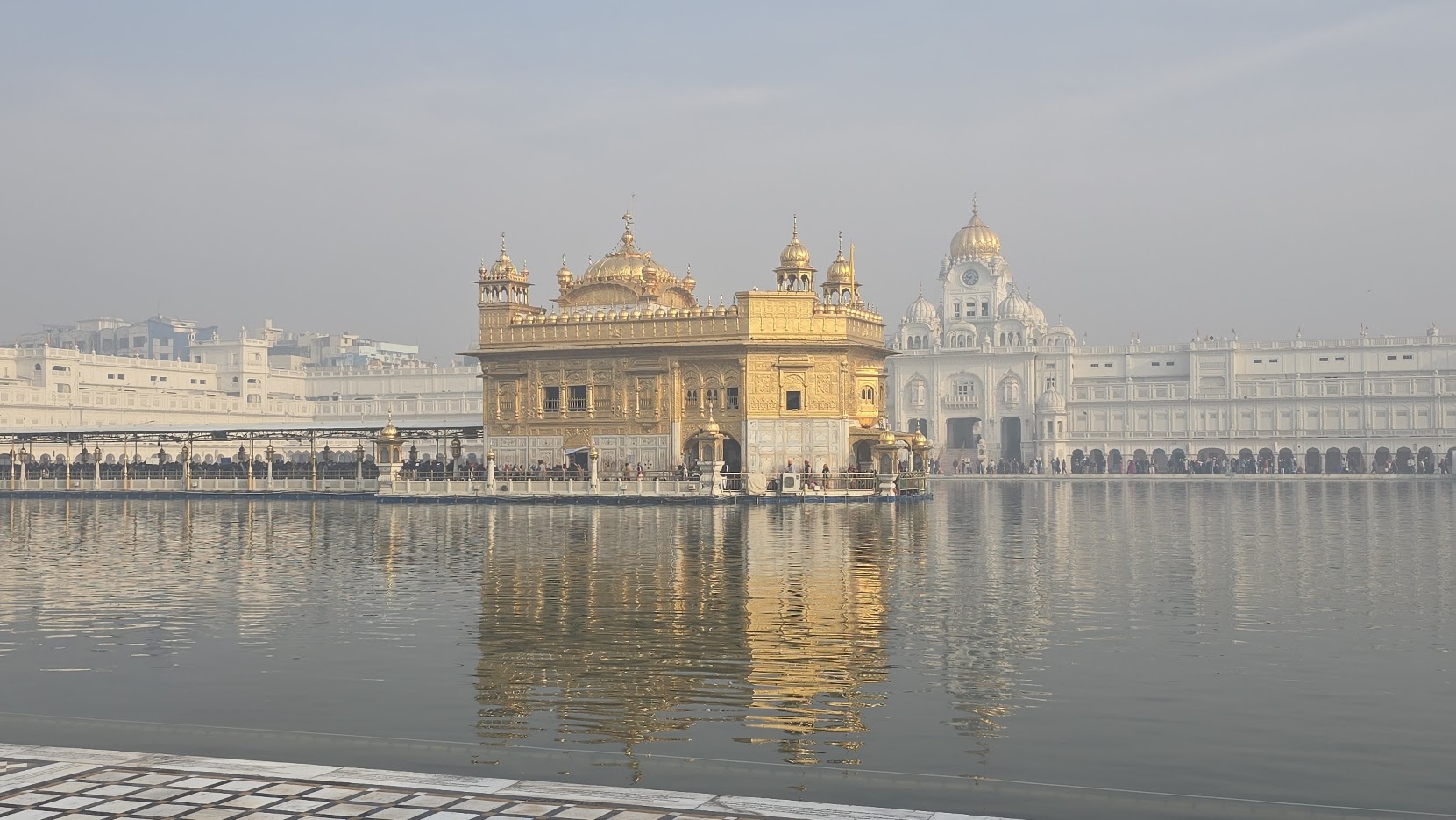
The highlight of any visit to Amritsar is the Golden Temple. Actually, the Golden Temple itself (the Sanctum-Sanctorum) is just a small part of the massive complex in which it sits. It is surrounded by a sarovar which is surrounded by an array of other structures.
I previously wrote about my visit to the Sikh temple in Delhi. This wasn’t too different, except the Golden Temple complex is on a vastly larger scale. Think a small chapel compared to Saint Peter’s Basilica, or think a rural landing strip compared to O’Hare Airport and you’ll get the idea.
The Langar (community kitchen) at Gurdwara Bangla Sahib in Delhi feeds 35,000 people every day. It seemed like an extraordinary effort when I visited. At the Golden Temple, the Langar feeds over 100,000 people, 24 hours a day, 365 days a year.


Eating here is a way to shed ego. I’ll repeat what I wrote after visiting the langar in Delhi:
This is not a soup kitchen. The goal is not to feed the poor, although the poor are certainly welcome to come and eat. This is about community. Wealthy and poor sit together and eat together. The wealthy and privileged classes are humbled, and the needy are uplifted. It’s a beautiful thing. And it’s unlike anything I’ve ever experienced.
The Golden Temple is the pre-eminent spiritual site of Sikhism. Pilgrims come to Amritsar from all over. While I was walking around, I met this family and offered to take their picture. They were originally from Punjab, but they now live in Australia. Then I asked if I could take a picture of them with my phone.

We went back in the evening to see the Golden Temple lit up.

A Massacre
I have to give you some more history.
On March 18, 1919, the British Colonial Government in Delhi passed a law known as the Rowlatt Act. This law gave the police the authority to arrest any Indian on mere suspicion of nationalist activity, and to detain them for up to two years without trial. Mahatma Gandhi called on the people to perform acts of non-violent resistance to this law.
On April 13, which was a holiday in Punjab, a large crowd gathered at Jallianwala Bagh in Amritsar to protest against the Rowlatt Act. Jallianwala Bagh is a garden near the Golden Temple, founded in 1812. It has just one narrow entrance and is surrounded by apartment buildings.
On hearing of this gathering, Brigadier-General Reginald Dyer of the British Indian Army sent his forces into the garden and ordered them to shoot at the crowd. An estimated 1,500 people were massacred; an additional 1,200 suffered injuries.
The British government has never apologized for the Jallianwala Bagh Massacre. In 2019, Prime Minsiter Teresa May described it as a “shameful scar” on British history in India and expressed “regret,” but went no further.
Jallianwala Bagh
Visiting Jallianwala Bagh was a sobering experience. A memorial to the victims stands in the garden. Bullet holes pierce the surrounding buildings. A well from which 120 bodies were recovered is surrounded by a glass partition.


I asked Dil why India is a member of the British Commonwealth. Given the horrific treatment of the people of India by the British authorities during the Raj, it’s hard for me to understand why India wouldn’t want to throw off any connection the Britain forever. But there are many practical reasons for India to maintain its ties to Britain. The 1949 London Declaration allowed India to become an independent republic while remaining in the Commonwealth. This was really a transformation of the British Empire into something completely different. And it provided India with a level of political and diplomatic influence, economic and trade benefits, and an international platform among democratic nations that it could not have achieved otherwise.
I have learned so damn much on this trip!
Now you can check out all my photos from Amritsar and Punjab.
Sandi Shevin
And your followers are learning SO MUCH through your experiences! Thanks so much for your fascinating posts, Lane. After all this rigorous travel, aren’t you ready to go back home? It seems like you’ve been a really long time on this amazing adventure!
Lane
Oh Sandi, it’s almost time to go home, and I’m wishing I had more time to see more of these beautiful countries!
Mary
Hi Lane! You might enjoy the movie Viceroys House. It tells about the separation of India and is directed by Gurinder Chadha who also directed Bend It Like Beckham.
Lane
Mary, thanks for the recommendation. I’ll have to look for that movie. She also has a new movie out called “Christmas Karma.” I’m going to look for that one as well.
Cheers!
Lane
Artie Davidson
Lane — Was glad I had the chance to travel with you and our guide Dil for the OAT post trip to northern India. Same goes for the previous part of this great OAT portion to Bhutan and Nepal. Your pics and blog help me clarify details and recall all we saw and experienced!
Lane
Thanks Artie. It was good getting to know you, especially on the last days when we spent a lot of time together. We both have so many great memories of this trip.