
I’m now back in Delhi, in a hotel near the airport, and tomorrow I begin my journey home. The last stop on this wonderful adventure was Dharamshala, in the state of Himachal Pradesh. This is the home of the Tibetan government in exile, and it is the home of the 14th Dalai Lama.
Visiting Dharamshala and the surrounding area was not entirely about Tibet, but Tibet was a recurring theme in this beautiful place, which is also a paradise for lovers of the great, mountainous outdoors. After encountering the Himalayas in Bhutan and Nepal, it was a perfect finale to the last seven weeks of travel.
If you want to skip the narrative and just look at pictures, you’ll find them here.
About where I was
For simplicity’s sake, I’m calling the places we visited “Dharamshala.” But technically, we spent more of our time in McLeod Ganj, and many of the places we visited, including the hotel where we stayed, the Dalai Lama’s house, and the Tibetan Museum, are in McLeod Ganj.
McLeod Ganj was named after Sir Donald Friell McLeod, a Lieutenant Governor of Ajmer during the Raj. The suffix ganj is a common word used for “neighborhood.“
Also, Dharamshala is also correctly spelled Dharamsala. You’ll see it both ways.
Norbulingka

Norbulingka is, per their website, “a cradle for the preservation of Tibetan art, and provide a haven for artists to practice their crafts.” It opened in 1995. It is named after Norbulingka, the palace in Lhasa, Tibet, which was the summer home of the Dalai Lamas starting in the late 18th century, until the current (14th) Dalai Lama’s exile in 1959. In Tibetan, “Norbulingka” means “Jeweled Garden.”
We visited several workshops at Norbulingka and had a chance to see some of the artists at work. Many of the techniques that the artists practice are unique to Tibetan culture. Without Norbulingka, this wonderful cultural heritage could die.


Thangka painting
I learned about thangka for the first time at Norbulingka, but this art form has been around since the 7th century. Unlike western art, where the work is a manifestation of the artist’s vision, thangka, and all Tibetan religious art, “is regarded as a way to communicate transcendental qualities to practitioners, the painter being the vessel.”
In many Tibetan thangkas, the painter depicts a historical or religious figure in the center surrounded by related events or other figures. Mandalas (sacred, circular geometric designs used as a tool for meditation, focus, and spiritual guidance) are also a common theme.
Here’s how the Norbulingka website describes the technique of creating a thangka:
The first step in the making of a thangka is stitching canvas onto a wooden frame and preparing the surface with a mixture of chalk, gesso, and base pigment, which is rubbed in until the texture of the cloth is no longer apparent. The outline of the deity is then sketched in pencil using the iconographic grid pertaining to the deity being depicted, then outlined in black ink. Powders of crushed mineral and vegetable pigments are mixed with water and adhesive to create paint. Landscape elements are blocked in and shading is applied using both wet and dry brush techniques. Finally, 24 kt gold paint is added in certain areas for highlights, and the piece is framed in a precious brocade border. A standard thangka in our collection, which is about 18 x 12 in., takes an artist about six weeks to complete.
https://india.norbulingka.org/pages/thangka-painting-traditional-buddhist-art


Thangka appliqué
Appliqué is another method of producing thangka art that is practiced at Norbulingka.
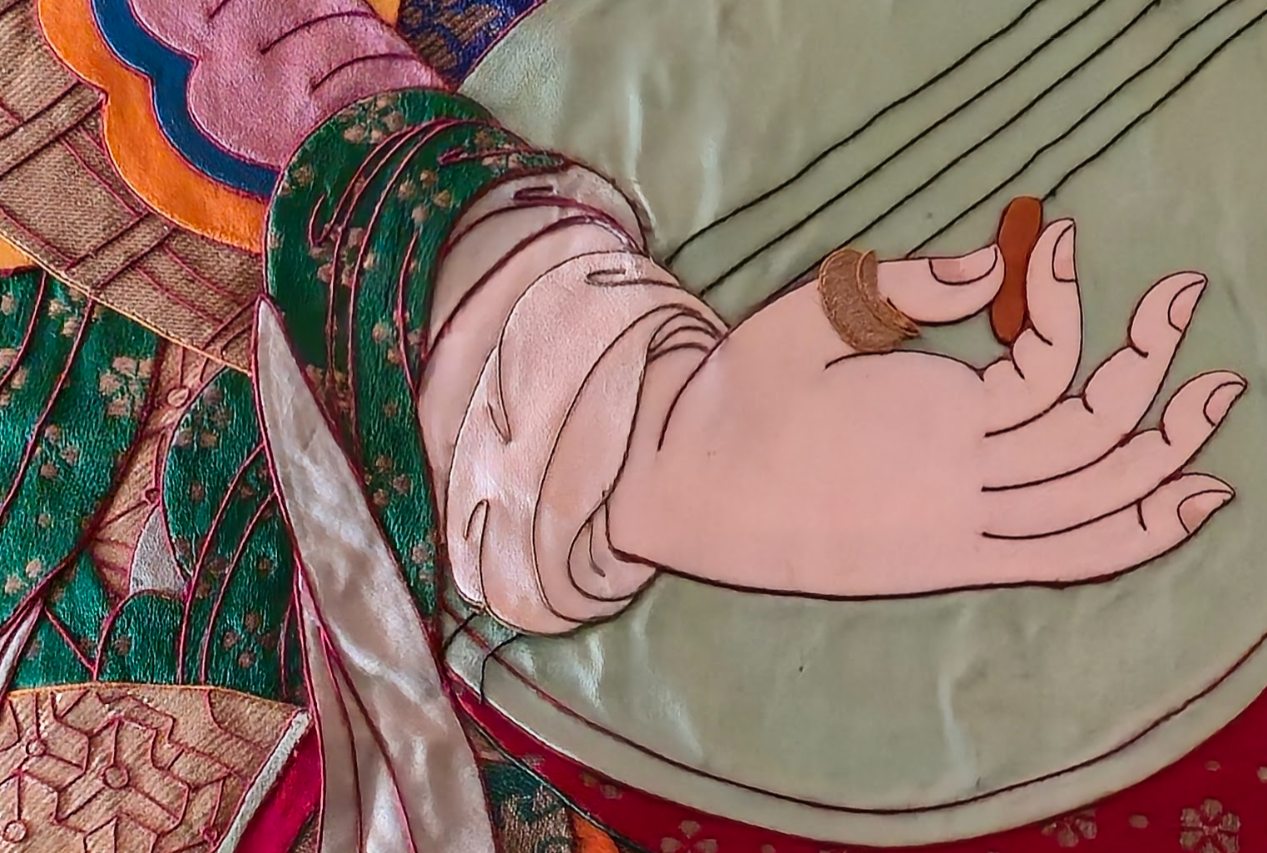
A completed thangka comprises hundreds, if not thousands, of individually embroidered pieces, each outlined by a border of horsehair wrapped in silk thread. This type of embroidery, called couching, is different from other methods in that the design is not embroidered directly onto the fabric, but rather, the cord of horsehair and silk is “couched” over the fabric to create the design. Once finished, the pieces are assembled and hand-sewn onto a base to form the design. This layering technique creates an extremely durable piece, while the horsehair gives the thangka strength and allows it to adjust to different environments without losing shape. A completed thangka is the product of many months of work and the care of many artists.
https://india.norbulingka.org/pages/thangka-applique-religious-buddhist-art


Kora
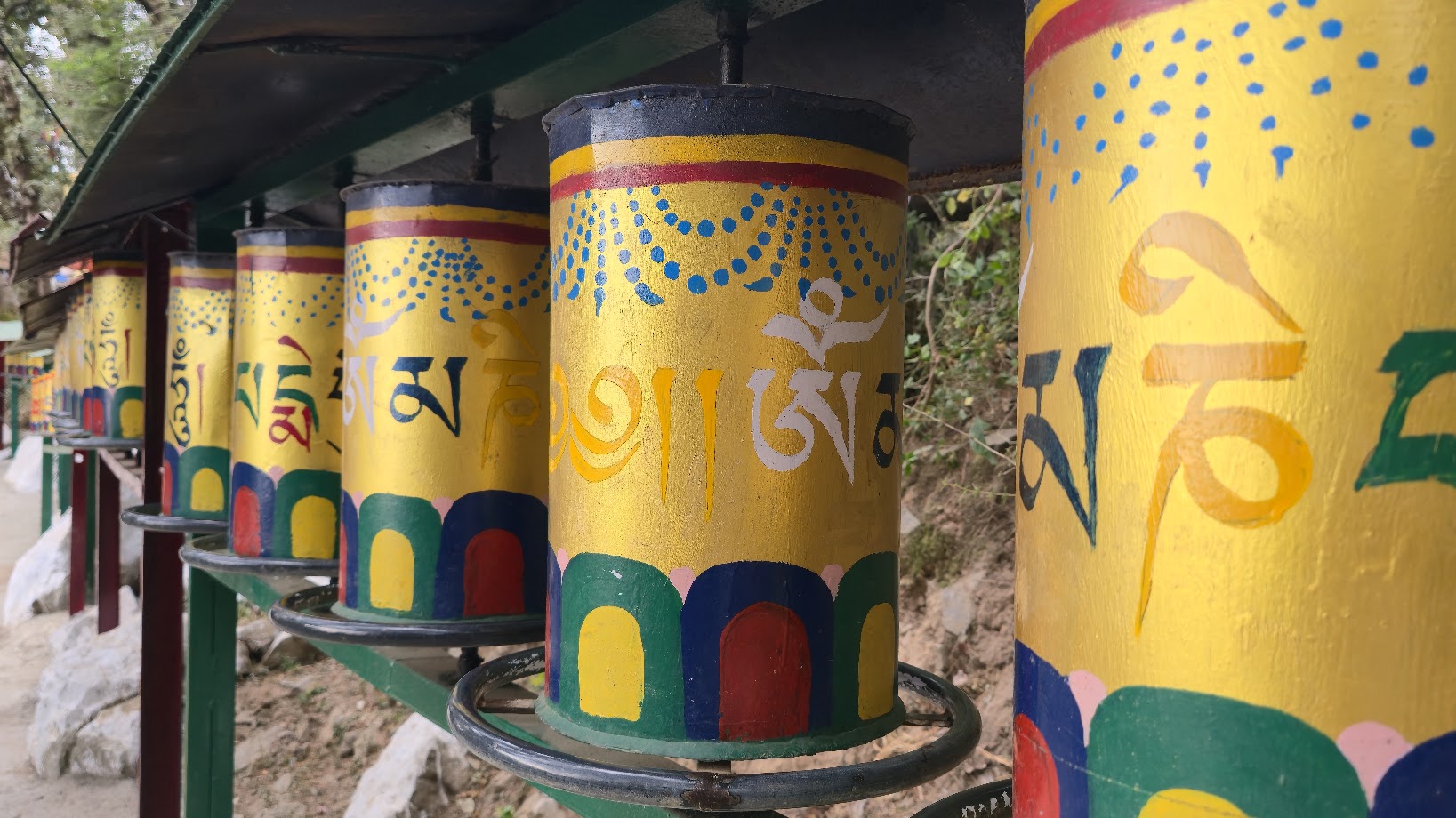
In Tibetan Buddhism, Kora means circumambulation, a spiritual practice and pilgrimage where devotees walk clockwise around sacred sites, natural or otherwise. Kora symbolizes the universe revolving around a central point, generating merit, and deepening meditative focus. Some Buddhists chant mantras while performing Kora. At many sites, prayer wheels (hollow, cylindrical wheels — see the photo up top — containing mantras) line the route. Spinning these prayer wheels has the same meritorious effect as reciting the mantra thousands of times. Kora is a profound form of walking meditation, transforming a physical journey into a spiritual path towards enlightenment.
We performed Kora in Bhutan around the National Memorial Chorten in Thimphu. The one we performed in Dharamshala was much longer. We circumambulated the residence and temple of the Dalai Lama on a hill overlooking the city.
I wish I could say this had the spiritual or meritorious or meditative effect for me that it was meant to. I saw many others along the way for whom it seemed important and meaningful, including people who were doing it despite physical disabilities. But for me it did not rise above the level of a pleasant walk.


More Buddhism


Next we had a chance to talke with a young Buddhist monk.

His name is Tenzin. He is 25 years old. His family chose him to be a monk at the age of 4, and when he was 5, his uncle brought him to India. He described that as a joyous experience, but he didn’t describe any details about the journey. He was raised in a monastery, but is now a student at university, working on a Masters degree in Buddhist philosophy. Even though he hasn’t had contact with his parents for twenty years, he seems immensely happy with his life. He clearly has a deep, and completely willing, commitment to his faith even though he was so young when it was chosen for him.
Naddi
Up in the mountains a few miles away is the village of Naddi. It was once a quiet, traditional village where people grew the crops they needed to live. But tourism has found Naddi, and there are now a lot of vacation rentals. Still, we could see the mix of old and new here, and it’s in a beautiful setting. It has also been the starting point for trekking in the foothills of the Himalayas.


Critters
We also saw some interesting critters in Naddi.


The Tibet Museum

The Tibet Museum opened in 2022. It tells the story of Tibet’s history, focusing especially on the Chinese occupation of Tibet.
I could write an entire book about Tibet. But I won’t. I will share some of what I learned at this museum:
- Tibet was once an empire. It reached its peak in the 9th century, when it covered about 4.6 million square kilometers, more than half the size of modern China.
- Roughly one-fourth of China is what can be considered culturally Tibet. About half of that makes up the Tibet Autonomous Region (TAR). That makes it the largest province of the People’s Republic of China.
- China invaded Tibet in 1950. The “official” reason was that Tibet was a backward, theocratic state ripe for modernization and “liberation” from its traditional system. They also claimed that Tibet was historically a part of China. But the underlying reasons were strategic and economic: securing their border with India, acquiring abundant mineral resources, and controlling water supplies, because…
- Six of Asia’s major rivers have their sources in Tibet: the Yangtze, Yellow, Mekong, Brahmaputra, Indus, and Salween.
- In 1951 China forced Tibet to agree to a Seventeen Point Agreement establishing Chinese sovereignty while promising internal autonomy. But China has not abided by the Agreement. They have attempted to erase Tibetan culture through military action, surveillance, and forced re-education.
- The Dalai Lama escaped to India in 1959. About 30,000 Tibetans live in the area around Dharamshala, with close to 100,000 throughout India. The numbers are decreasing, as more and more Tibetans are moving to western countries. It’s now estimated that 150,000 to 200,000 Tibetans live outside Tibet.
Sobering
If I say visiting the Tibet Museum was a sobering experience, that’s a bit of an understatement. It’s pretty shocking how little interest there seems to be in the “Free Tibet” movement compared with other parts of the world where whole ethnicities are oppressed and nations have lost (or are at risk of losing) their sovereignty.
There were several opportunities around the museum to reflect on what the visitor has done or will do to commit to supporting the Tibetan people in their quest to return to their homeland and reestablish their independence. It’s been on my mind since visiting the museum.
I could probably write a lot more about my time in Dharamshala, but I’m tired, and I have a 4am pickup to go to the airport tomorrow morning. I still have to finish repacking for the long journey ahead.
Elizabeth Gregory
You’ll be home soon Lane to a Merry Christmas and a deserved rest from the travelling life. I’ve enjoyed reading about your adventures after we parted paths in Nepal. Liz
Susan Bennett
Have a safe trip home Lane and, I agree with Liz, it’s been a treat to read about the rest of your adventures after we left you in India. All the best of the season to you. I look forward to a reading about your adventures in 2026!
sharon
Thank you for your amazing pictures and narratives of your travels. You make it all look so interesting, easy and like we are there with you!! Merry Christmas and safe travels back home! Take care. Sharon and Cary
(Mary) Sheila Bartle
I wonder what that Dharamshala community will do when the Dali Lama dies (or “transitions” is perhaps more appropriate). I’m glad you’re seeing the world, away from the USA. I still hope to visit you!
Sheila