
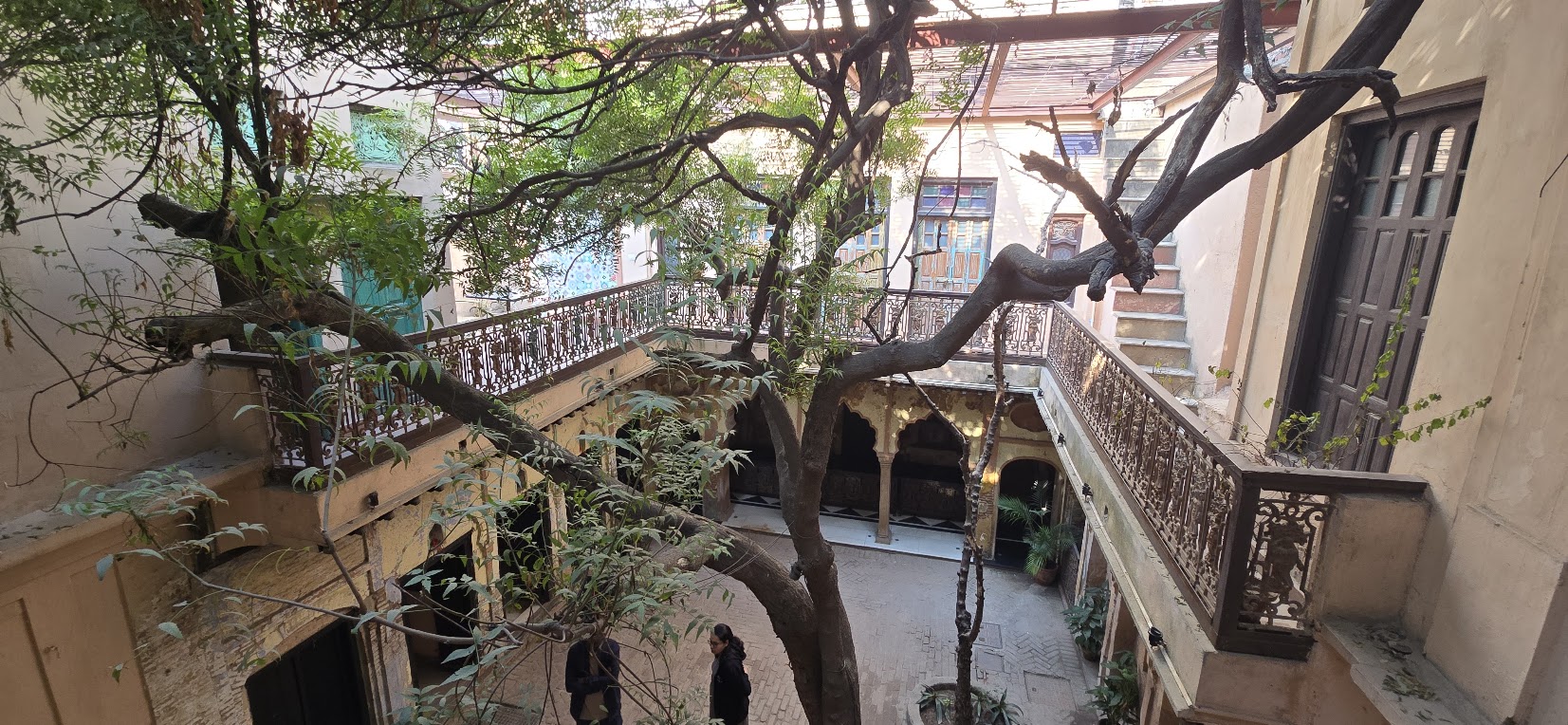
When I booked this tour with GetYourGuide months ago, I had no idea what to expect. The name of the tour is “Art Tour with Indian Classical Music & Dance.” The description says, “A cultural extravaganza in Old Delhi, savour classical music, dances and treasures of Arts. Along with our guide, explore deep cultural belly of Delhi’s Old Town while walking. Tour duration 03 hours.” Perhaps if I’d read more carefully, I would have gotten to the detailed description where it mentions the beautiful havelis where the entire experience took place. But I don’t think I could have gotten a full appreciation for this magnificent experience ahead of time.
Getting there
My guide, Jai, and a driver picked me up at my hotel. I assumed we would be meeting other participants, but it turned out to be just me. We drove to the edge of Old Delhi, but this was an area I hadn’t visited before.
From there, Jai and I walked through some narrow streets to get to the venue. He told me that while many visitors see this neighborhood and think it is a slum, the people who live here are not poor, and they have a comfortable lifestyle in a very good location.

Kathika Cultural Centre & Museum
After a few minutes’ walking, we came to Kathika. Jai and I were the only visitors. And here I learned about havelis.
Havelis
I suspect at some point on the tour I was on, Ashish told us about havelis. Surely it would have come up when we did our pedicab ride through Old Delhi, but I don’t remember. So this was completely new to me.
A haveli is a traditional, large Indian mansion or palace, typically built from the 17th to the 19th century, often with an open courtyard in the center. The name comes from the Arabic word for a private space, and these buildings were historically owned by wealthy merchants, nobles, or royal families.
As of 2014 there were almost 554 havelis in Old Delhi. Most are privately owned, and their owners can’t afford maintenance. When repairs have been made, original architectural features have often been ignored, and much of the heritage of these old houses has been irretrievably lost.
In 2015 one of those 554 havelis collapsed. Atul Khanna read about this in the newspaper and decided to commit himself to restoring some of the lost heritage of Old Delhi’s havelis. He bought the ruined one and one across the street. Along with a team of architects, he spent over 8 years preserving and reviving these two 19th century havelis.
Kathika, across the street from the ruined one, became a delightful museum and cultural center. The ruined haveli is now a B&B.
Music and dance
To start with, I got to enjoy music and dance performances. I’ve already shared about Kathak dance that we saw in Lucknow, and we got a wonderful opportunity to listen to a performance on sitar and tabla in Varanasi.
This was quite special because it was a private performance, just for me! The sitar and tabla players were wonderful, as were the ones we saw in Varanasi.
The Kathak dancer here was a revelation. The dancers we saw in Lucknow were students, some very advanced and some more novice. This performer was in a class by herself. (I acknowledge that some of my fellow travelers from the tour might disagree, but to me there was a significant difference between her level of dance and the students we saw.)
Either way, I am so hooked on this stunning dance form. I could watch it for hours!
Museum
After the performances I got a tour of the museum. It is chock full of various pieces of art, handicrafts, and memorabilia from Mr. Khanna’s family and from Old Delhi.


She has four arms, holding a book (Vedas) and a rosary, and playing a veena, a stringed musical instrument.
The goddess is traditionally shown wearing white and sitting on a lotus or riding a swan, which represents purity and knowledge. But here she is wearing garments that predate fabric, and she is sitting on a peacock.
Calligraphy
Following the tour, I met a gentleman who gave me a demonstration and a lesson of calligraphy in Urdu and Hindi. He told me I was a good student, but I was mostly a failure. (I did one letter that he said was excellent.)

Lunch
Next we went across the street to Neem Ki Haveli. The renovation of this haveli carefully preserves the authentic nature of the original structure on the ground floor. Upstairs the B&B rooms are luxurious, with modern amenities, but still maintaining the 19th-century character. The photo at the top of the page shows the courtyard as seen from the balcony.

Lunch consisted of a selection of pakoras and chaats and breads. Jai joined me, and I had a chance to tell him how thrilled I was by the experience of visiting these beautiful havelis. He told me that this tour is not very popular, and I suggested that he emphasize the cultural heritage and the experience of visiting the havelis in his GetYourGuide listing. To me, while the performances were superb and the lunch was excellent, it was the overall feeling I got from understanding how these one-time elegant homes are still there, hiding behind businesses and throngs of people.
I’ve added my photos from today to my Delhi photo album.
Tomorrow I leave Delhi for the next part of my adventure. Keep reading to find out where I’m going next!
Susan Bennett
That sounds like a great adventure Lane. I love those kind of surprise experiences when traveling, and this traveller would agree with you that that Kathak performance is much superior to what we saw.
Liz and I leave for Bhutan Thursday. Maybe we’ll see you there! Su