
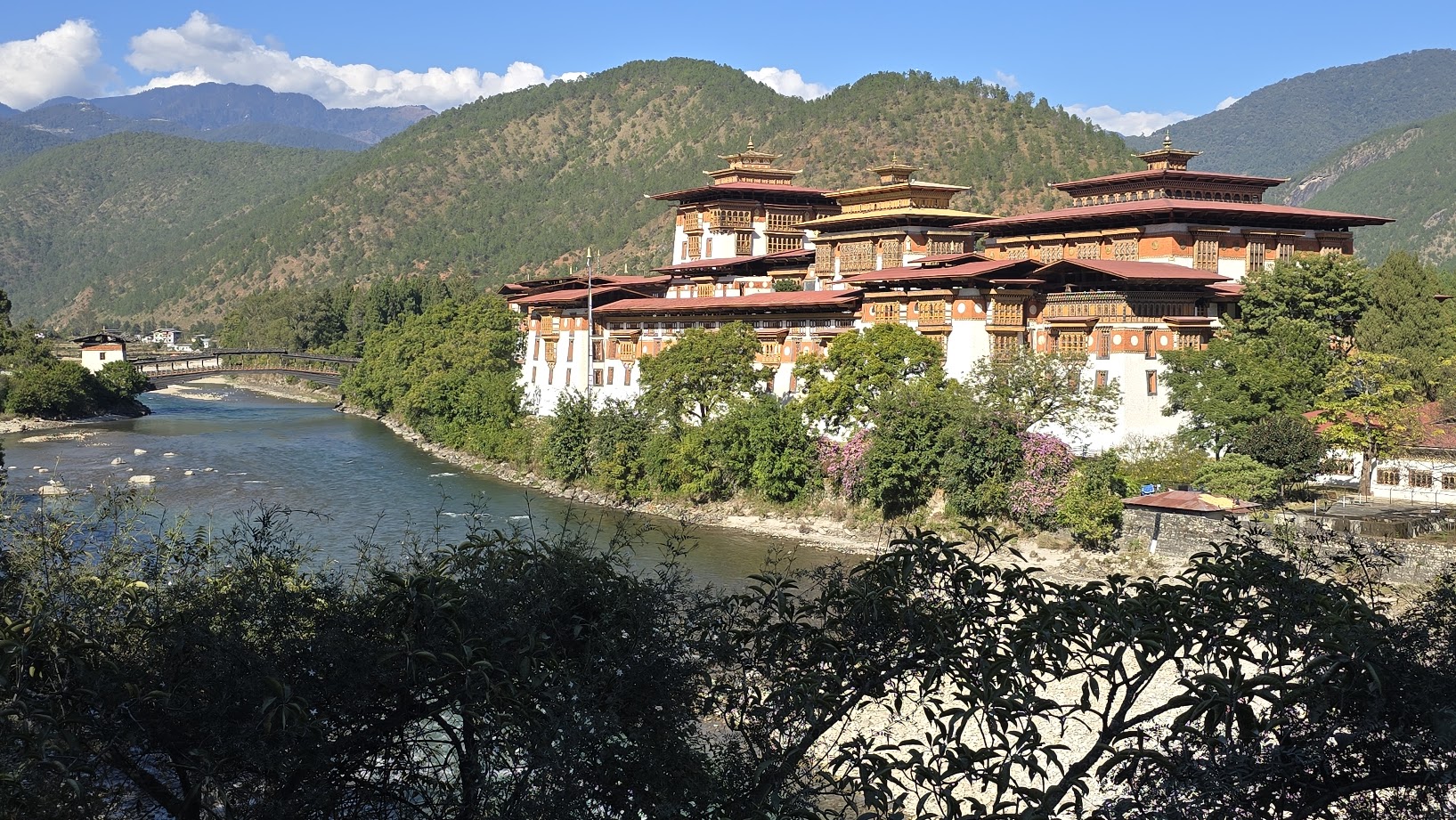
Yesterday we drove from Thimphu to Punakha. This was a drive of just about 75 km, but the road was twisty almost the entire way, and we made a few stops, so it took more than four hours. Here’s a quick overview (quick because I’m tired and I want to get this done so I can go to sleep) of the drive and the time we spent here.
Dochula Pass
We got to Dochula Pass in about 45 minutes, climbing from 2,334 meters in Thimphu to 3,100 meters at the pass. This was the highest elevation of the trip. The views were spectacular, with a ridge of Himalayan mountains spread across the horizon to the north, on the border with Tibet.


Prayer Flags
Prayer flags are ubiquitous in Bhutan. The people believe they carry prayers and blessings on the wind and symbolize peace, wisdom, and prosperity. The flags are in five colors representing the five basic elements—blue (air), white (sky), red (fire), green (water), and yellow (earth)—and have inscriptions with mantras, symbols, and deities. Bhutanese people hang these flags in windy places, believing the wind transmits blessings to all sentient beings.
We stopped along the road to Punakha to hang our own prayer flags. Owl, our tour leader, has been bringing groups to this spot for several years, and our flags joined others already flying. He had us write our names on one flag each. Then we strung all the flags together and tied them to trees.


Punakha Dzong
A dzong is a Bhutanese fortress. There are 25 dzongs in the country, at least one in each of the 20 districts. They mostly date from the 17th century, when they were an important part of the defense against Tibetan invasions. Their construction includes no iron nails and traditionally used no architectural plans. Construction proceeded under the direction of a high lama who established each dimension by means of spiritual inspiration. The interior courtyards and temples have richly decorated woodwork depicting traditional Bhutanese themes.
The dzongs’ original purpose was defensive, as well as stocking grains in times of emergencies. Today they serve religious and administrative purposes.
The fortress’s construction dates from the 1630s, making it the second oldest dzong in Bhutan. It is also the second largest, and it is generally considered the most beautiful. The photo at the top of the page shows Punakha Dzong from across the river.


The Main Temple


The decor inside the temple was exquisite, and I wish I could share it with you. Along the side and back walls were stunning murals telling Gautama Buddha’s life story. Owl walked us through the entire narrative.
Here are the twelve episodes:
1. Descent from Tushita Heaven
Before his final birth, the future Buddha resided in the Tushita heaven as a Bodhisattva and resolved to be born on Earth to guide sentient beings.
2. Entering the Mother’s Womb
He entered the womb of his mother, Queen Maya, who had a prophetic dream of a white elephant entering her side.
3. Birth
Siddhartha Gautama was born in the Lumbini Grove, said to have emerged from his mother’s side while she held onto a tree branch.
4. Skill in Arts and Sports
As a prince, he demonstrated mastery in various traditional arts, sciences, and athletic competitions.
5. Life in the Palace with Consorts
He lived a sheltered life of luxury and pleasure within the royal palace, shielded from suffering and surrounded by royal consorts.
6. Renunciation and the Great Departure
After encountering the “Four Sights” (an old man, a sick person, a corpse, and a wandering ascetic), he developed a profound sense of renunciation and secretly left the palace to seek the truth of suffering.
7. Undertaking Ascetic Practices
He engaged in severe ascetic practices and self-mortification for six years, nearly starving himself, before realizing the “Middle Way” was a better path.
8. Proceeding to the Bodhi Tree
Abandoning extreme asceticism, he sat under the Bodhi tree in Bodhgaya, determined not to rise until he achieved enlightenment.
9. Defeat of Mara’s Demons
While meditating under the tree, he triumphed over Mara, the demon of temptation and death, and his demonic forces.
10. Attaining Full Enlightenment
He became fully enlightened, realizing the nature of suffering, its cause, its cessation, and the path to liberation (the Four Noble Truths).
11. Turning the Wheel of Dharma
He gave his first sermon in the Deer Park in Sarnath, sharing his insights and setting the “wheel of Dharma” (his teachings) in motion.
12. Passing into Parinirvana
At the age of 80, he passed away and achieved parinirvana (final nirvana) in Kushinagar, an event that marks the end of his physical existence and the release from the cycle of rebirth.
You’ll have to trust me when I tell you the murals depicting all of this were absolutely magnificent. As was the entire interior of the temple.
The Fire Ritual Ceremony
In a room in the first courtyard, a group of monks were gathered, chanting, beating drums, blowing conch shells, and placing offerings in a firepit in the courtyard. This was truly mesmerizing to watch.

Sangchhen Dorji Lhuendrup Lhakhang Nunnery
This morning we started the day with a visit to a nunnery.
Following a brief game of badminton with one of the nuns, another nun brought us into the garden where we had a chance to ask her questions and learn about life in the nunnery. Her commitment to peace and to karma and to respect for all sentient beings was powerful.


Chimi Lhakhang
We already met Lam Drukpa Kuenley when we visited the Royal Takin Park in Thimphu and saw the bizarre half-cow-half-goat creatures he supposedly created. Known as the Divine Madman, Drukpa Kuenley subdued a demoness who took the form of a dog and fled down to the valley. He uttered “chi mi,” or “no dog,” and buried the demoness under a mound of earth, building a chorten (stupa) on the spot. Drukpa Kuenley’s cousin built the temple here in 1499.
The reason Drukpa Kuenley was known as the “Divine Madman” is that he had unorthodox ways of teaching Buddhism. He deliberately portrayed the image of a vagabond and wandered around the countryside, indulging in song and dance, alcohol and women, hunting and feasting. In reality, what it meant was that he was beyond the norms and conventions established by human society.
The phallus
The Divine Madman advocated the use of phallus symbols as paintings on walls and as flying carved wooden phalluses on house tops at four corners of the eaves. He called the phallus the Flaming Thunderbolt of Wisdom.
In the temple is the original wooden phallus that Drukpa Kuenley brought from Tibet. This wooden phallus is decorated with a silver handle and is used to bless people who visit the monastery on pilgrimage, particularly women seeking blessings to beget children. They are supposed to carry the phallus, which probably weighs close to 30 lbs., three times around the temple.
Pilgrims can receive a blessing from the caretaker monk at the the temple. The tradition is for him to strike pilgrims on the head with a smaller (10-inch) wooden phallus. Symbols of an erect penis decorated the path up to the temple, and all kinds of sizes of phallic souvenirs are available in gift shops.


At the temple

Rinchen Gang
After the fertility temple and lunch, we visited a small village that has been designated a “heritage vilage” by the Bhutan government.
Rinchen Gang is very different from anywhere else we’ve been in Bhutan. It is clearly a place where the people live extremely humble existences. The homes are basic, to say the least. But the people we met there were warm and welcoming. And it was wonderful to see a different side of Bhutan.


I intended this to be a brief overview of my time in Punakha. As usual, I’ve gotten carried away. The experiences have been so rich and so rewarding. The natural beauty of this country, the brilliant colors and impressive architecture, and the lovely people have left me with too many wonderful memories to gloss over.
I’ve added my photos from the last two days to my Bhutan photo album.
Leave a Reply