
Ulaanbaatar Day Two: Archery, Food, and Shamanism
When Eric, our trip leader, told us we would start the day yesterday with an archery experience, what I imagined turned out to be completely different from Mongolian archery. And come to think of it, little of what I’ve seen and done in Ulaanbaatar so far has failed to surprise me. I guess that is the result of having no idea what to expect. I did read the materials sent out by OAT, but even so, reading a high level description of activities doesn’t really prepare you for the actual experience.
And I should say that most of my recent travels have been that way. It’s one thing to visit London or Paris or Rome or other places where you have a good idea of what to expect. But Dushanbe? Bukhara? The national parks of Madagascar? It’s all been amazing, astonishing, or at the very least, surprising.
And it continues here in Mongolia.
The tour begins
OAT tours always begin with an orientation meeting, where we meet our fellow travelers and get an overview of the itinerary and ground rules. Since this is a pre-trip extension, there are only five of us. The other four include a married couple (Larry and Val) and two single women, all from California. Maritza is originally from Guatemala, and Carol is originally from China. So we are a diverse group.
After the meeting, we headed out for our first group activity in UB, as Eric told us is the shortened name for the city.
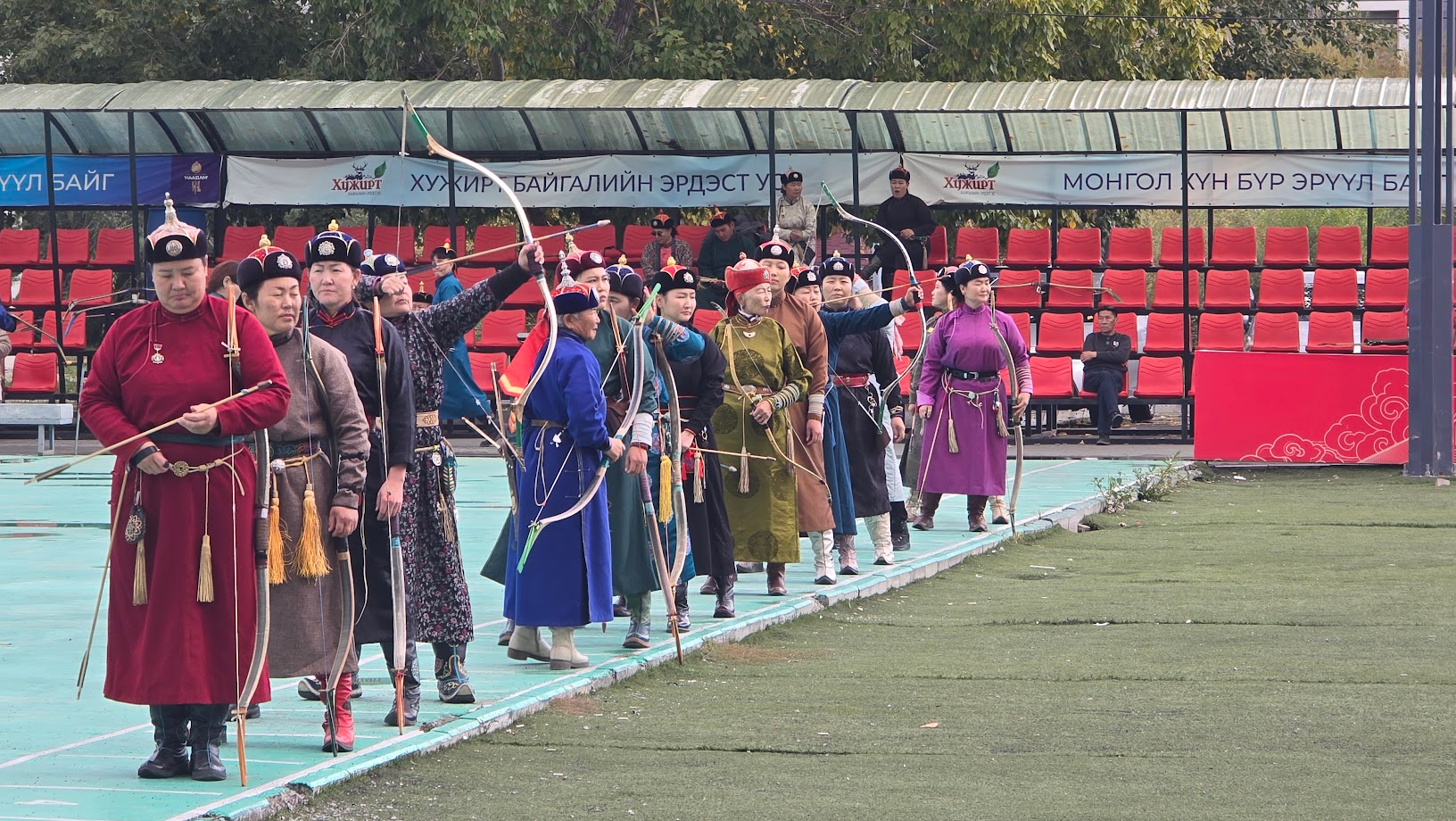
Mongolian Archery
The first surprise of the day began when we left the hotel on the way to the archery experience. Twice a year, once in June and once in September, all car traffic stops in central UB. The streets were open to pedestrians, and the people of UB were out in force, enjoying a beautiful, crisp fall morning.


So we had to (or rather, got to) walk about 20 minutes along with the UB locals until we got to the edge of the car-free area, where our van was waiting to take us to the archery stadium.
Yes, there is a stadium dedicated to archery.
In fact, there are three “manly sports” of Mongolia: archery, wrestling, and horse racing. These were the games Genghis Khan emphasized as training for the nomadic life, and they have been a centerpiece of Mongolian culture ever since. Every year in July, Mongolians celebrate the major festival of Naadam, celebrating freedom and independence. Naadam actually means “games,” and these three manly games are the focus of the festival.
The rules
Mongolian archery is a different thing from Olympic-style archery, shooting at a circular target, aiming for a bull’s-eye. The target in Mongolian archery is a low wall of leather cylinders called surs.
Men shoot from 75 meters away, women from 60 meters, and children from 40 meters. (By comparison, in the Olympics both men and women stand 70 meters from the target.) They score a point if they knock a sur out of the row.
Archers must use a traditional bow made from laminated birch, mountain goat or water buffalo horn, animal sinew, and fish glue. They completely lack modern sights, arrow rests, or stabilizers. And the archers utilize the famous “Mongolian draw.” The string is hooked using a leather or bone thumb ring rather than index fingers.


Market
Adjacent to the archery stadium is the wrestling stadium. Eric wanted to show it to us, and it turned into another surprise, because there was a big market going on both outside and inside the stadium. Since this is harvest season, there was a lot of fresh produce, and we sampled some familiar and not-so-familiar items.

Highlights: the sweetest, juiciest canteloupe I’ve ever tasted, and many varieties of wild berries.

Not a highlight: shimiin arkhi (horse-milk vodka).

There was also lots of clothing, leather goods, and crafts.

Shamanism
Later in the afternoon we went for another walk to meet a female shaman. Actually, we met two, but the second one didn’t speak at all. The one who did speak told us a lot and answered our questions, but to be honest, I didn’t really learn a great deal about what Mongolian shamanism is all about. I got that it is tied to a belief that all nature has some kind of spirit or soul, whether it’s a tree or a rock or the sky. And the shamans act as intermediaries between people and spirit worlds. They are also somehow connected with their ancestors. Being a shaman is a calling, not something one can choose.


Background
Because I’m me, I had to do some follow-up research. So here’s what I’ve learned.
In 2017, the Mongolian traditional practices of worshipping the sacred sites were inscribed on the UNESCO List of Intangible Cultural Heritage in Need of Urgent Safeguarding.
Mongolian shamanism includes religious beliefs and practises of shamans who enter trances to communicate with deities and spiritual beings who then possess the shaman’s body. Shamans wear costumes and masks and employ ritual artefacts specific for treatments or healing. Music, dance, chanting and sometimes animal sacrifices are part of these rituals. Shamans are believed to be divinely appointed at birth, showing prescribed signs as they age. Each disciple has a teacher but ancestral spirits are mainly responsible for transmitting the knowledge and skills.
UNESCO
The rest of this comes from Google Gemini.
Core beliefs and cosmology
Shamanism is a very ancient animistic practice centering on the worship of the eternal blue sky, Tenger (Heaven), and the earth spirit, Etugen (Mother Earth). The universe is mapped into tiers, featuring 99 tengri (sky spirits)—55 benevolent white spirits in the West and 44 fierce black spirits in the East—along with earth-mothers and ancestral protectors. Mountains, rivers, and the household fire are treated as living entities possessing sacred owners or protectors. Everyday acts, like tossing a spoonful of milk into the air or passing clockwise around an ovoo (stone cairn), honor these unseen forces. A böö (male shaman) or udgan (female shaman) acts as an intermediary between the human and spirit worlds. Through rhythmic drumming, chanting, and trance states, they invite spirits into their bodies to offer guidance, healing, and community reconciliation.
History
When Tibetan Buddhism became the dominant religion in Mongolia in the 16th century, Buddhist authorities banned shamanic rituals, confiscated shamanic ritual tools (like drums and costumes), and forced conversions. However, rather than physically executing shamans, the Buddhist strategy relied on cultural assimilation. They incorporated local shamanic deities, nature spirits, and rituals (such as the ovoo cairn blessings) directly into Mongolian Buddhist practice to phase out traditional shamanism peacefully.
During the Communist era, especially during the Great Repression of 1937–1939, the state targeted all religious figures under aggressive state atheism. While the institutionalized Buddhist clergy suffered the highest casualties, shamans were hunted with equal violence. They branded shamans as “feudalist exploiters” and backward reactionaries. A vast number of shamans were shot, thrown into mass graves, or sent to Soviet labor camps, forcing the surviving practitioners to hide their abilities completely underground for over 50 years.
Revival
Since the democratic transition of 1990, Mongolian shamanism has experienced a profound public and private revival as a pillar of cultural identity. Today many Mongolian Buddhists simultaneously believe in and practice shamanism. Many locals view Buddhism and shamanism as serving different purposes. A family might go to a Buddhist monastery (hiid) for philosophical guidance, astrology, funeral rites, or long-term karmic blessings, but visit a shaman (böö or udgan) to fix immediate, earthly problems like a sudden illness, financial bad luck, or to appease angry ancestral spirits.
Dinner
Also because I’m me, I love trying new foods. Dinner at Asiana last night was a good opportunity to sample lots of interesting dishes. Eric ordered about ten different dishes for us to share. And all of it it was far more delicious than horse-milk vodka.
I can’t identify all of it, but here are some photos:


For dessert, Larry bought a canteloupe from the market at the wrestling stadium, and the restaurant cut it up for us. We devoured all of it!
I’ve added from photos from yesterday to my album. Feel free to check it out for a few more images from the day.
This morning we have a few more UB activities before flying to the Gobi Desert. Stay tuned for more stories!